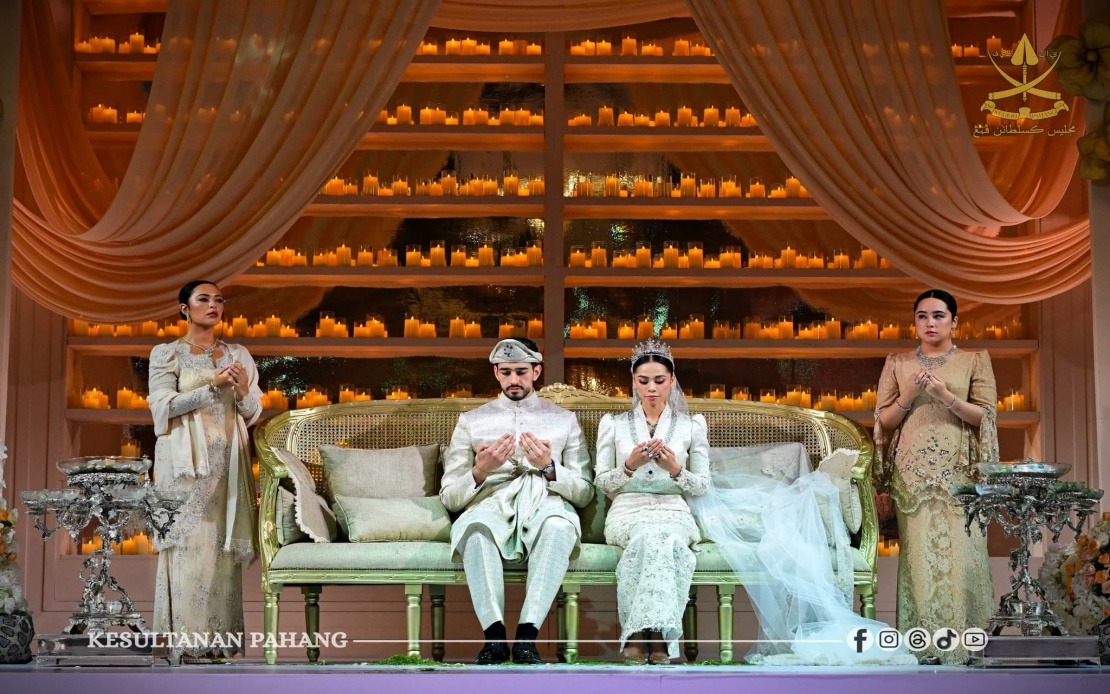
The wedding celebration of Tengku Puteri Raja Tengku Puteri Ilyana Alia, daughter of Pahang Sultan Al-Sultan Abdullah Ri'ayatuddin Al-Mustafa Billah Shah, took place at a hotel in Kuala Lumpur, marking a significant occasion in the royal calendar of the East Coast state. The Sultan's presence at the reception underscored the prominence of the union between his daughter and her husband, Christopher Lionel Froggatt, as the event drew dignitaries and members of the extended royal family to celebrate the newlyweds.
The royal entourage accompanying the Sultan reflected the formal nature of the occasion, with the Regent of Pahang Tengku Hassanal Ibrahim Alam Shah in attendance alongside other senior members of the Pahang royal household. The inclusion of both elder and younger siblings of the Sultan demonstrated the family's unified celebration of the wedding, a tradition that underscores the bonds within Malaysia's royal institutions. The gathering also welcomed representatives from international circles, emphasizing the cross-cultural dimensions of the marriage.
Among the distinguished guests was Pahang Menteri Besar Datuk Seri Wan Rosdy Wan Ismail, whose attendance highlighted the significance of the royal wedding within the state's political and social hierarchy. The presence of Shaikh Mohammed Hamad Tahnoon Al Nahyan, representing the President of the United Arab Emirates, brought international diplomatic representation to the proceedings. This international dimension reflects the growing interconnectedness of Southeast Asian royal families with Gulf state leadership and demonstrates the broader networks through which Malaysian royalty engages globally.
The reception featured a series of carefully orchestrated traditional Malay royal ceremonies that preserved cultural heritage while celebrating the union. The focal point of these rituals was the formal seating of the royal couple on an elevated dais, establishing them as the ceremonial centre of the celebration. The positioning reflected established protocols governing royal weddings in Malaysia, where the dais serves as both a physical and symbolic space distinguishing the newlyweds during formal proceedings.
The Istiadat Menyuap Nasi Semangat ceremony, conducted by Tengku Puteri Seri Lela Wangsa Tengku Tan Sri Meriam Sultan Ahmad Shah, represented a foundational ritual in Malay-Muslim wedding traditions. This ceremonial feeding of blessed rice, known as nasi semangat, carries deep cultural significance as a gesture meant to unite the couple spiritually and ensure their prosperity. The involvement of a senior female member of the royal family in conducting this rite highlighted the crucial role women play in maintaining and transmitting royal ceremonial practices within the Pahang sultanate.
Following this initial ceremony, the Istiadat Bersanding dan Merenjis unfolded as the Sultan took his place alongside the newlyweds on the dais. This ritual, performed by Al-Sultan Abdullah himself, involved the sprinkling of blessed water or oils—the merenjis—a practice designed to confer blessings and protection upon the couple as they entered married life. The Sultan's personal participation in this rite underscored his role not merely as an observer but as an active spiritual and ceremonial authority within the state's royal framework, a function integral to the institution of constitutional monarchy in Malaysia.
The ceremonial sequence continued with the Istiadat Meletakkan Panca Bicara, a blessing ritual performed by the Sultan that invoked the five pillars or principles of good fortune and harmony. This gesture, performed explicitly to honour and bless the newlyweds, demonstrated the Sultan's ceremonial function as a source of benediction within Pahang society. For Malaysian readers familiar with royal protocol, such rituals reinforce the quasi-spiritual dimensions of royal authority that extend beyond purely administrative or constitutional functions, reflecting the historical continuities embedded within the Southeast Asian concept of divine kingship.
The conclusion of the formal ceremonies involved a prayer recited by Pahang Mufti Datuk Dr Asmadi Mohamed Naim, integrating Islamic religious authority into the broader framework of royal celebration. This invocation of the state's chief religious officer alongside the Sultan's ceremonial leadership demonstrated the harmonious integration of secular and religious authority within Malaysia's hybrid governance model, where royal institutions and Islamic institutions operate in complementary fashion.
The wedding reception exemplifies how contemporary Malaysian royal families balance modern expectations with deep-rooted cultural and religious traditions. The choice to conduct multiple traditional ceremonies, despite the international and cross-cultural dimensions of the marriage, reflects a commitment to preserving Malay-Muslim ceremonial practices as core elements of royal identity. For Malaysians observing royal occasions, such events serve as living demonstrations of cultural continuity, illustrating how the monarchy functions as guardian of traditional practices even as the nation modernizes.
The presence of the UAE representative adds another layer of significance to the occasion, reflecting Malaysia's growing engagement with Gulf state monarchies and the broader Muslim world. Such diplomatic attendance at royal family occasions strengthens bilateral relationships and signals recognition of Malaysia's position within networks of Islamic state leadership. For Southeast Asian regional observers, the wedding reception illustrates how royal marriages increasingly serve diplomatic functions, facilitating connections between different regions and governance systems.
The detailed documentation of the ceremony through official channels, including the Kesultanan Pahang's social media platforms, reflects contemporary royal communication practices in Malaysia. By sharing details of the wedding proceedings publicly, the state's royal institution demonstrates accessibility and transparency while maintaining ceremonial dignity—a balance increasingly important in an era of digital communication and public engagement.
For Pahang specifically, the prominent celebration of the Sultan's daughter's wedding reinforces the continuity and stability of the state's royal institution. Such public demonstrations of royal family unity and adherence to traditional practices contribute to the broader legitimacy and acceptance of constitutional monarchy in Malaysia, a system that depends partly on the public perception of royal families as custodians of national and state identity.

