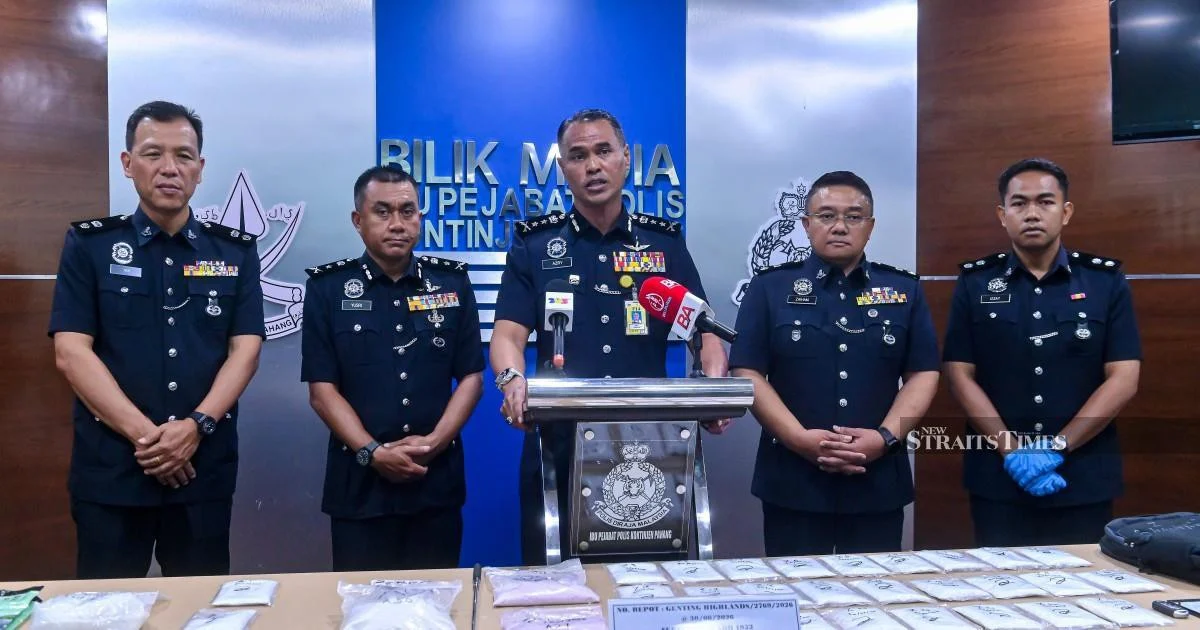
A comprehensive three-day anti-narcotics crackdown conducted across Pahang has delivered significant results, with law enforcement authorities apprehending 333 individuals and confiscating contraband valued in excess of RM500,000. Operation Hawk, as the initiative was designated, focused enforcement efforts on known drug trafficking and consumption hotspots spanning all 11 districts within Malaysia's largest peninsular state, reflecting a coordinated strategy to disrupt the supply and distribution chains feeding drug demand in the region.
The scope of the operation underscores the continuing challenge posed by illicit narcotics across Pahang's diverse geography, from urban centres like Kuantan and Kota Bharu to smaller towns and rural areas where drug activity has traditionally thrived. By casting the enforcement net across such a wide territorial mandate, authorities demonstrated their intent to prevent traffickers from simply relocating operations to less-policed jurisdictions within the state. The deliberate targeting of multiple districts simultaneously represents a tactical shift away from piecemeal enforcement, instead seeking to create sustained pressure across the entire supply ecosystem.
Beyond the headline arrests, the confiscation of drugs alongside substantial quantities of cash and motor vehicles reveals the depth of commercial drug operations operating within Pahang. The seizure of vehicles is particularly telling, as these assets often serve critical logistical functions in distribution networks, enabling dealers to transport product across district boundaries and evade mobile checkpoints. Similarly, the capture of cash suggests authorities disrupted financial flows at various points along the criminal supply chain, potentially hampering the ability of trafficking organisations to reinvest proceeds into fresh inventory and operational expenses.
The three-day intensity of the operation reflects an administrative approach increasingly common in Malaysian law enforcement, concentrating resources during discrete periods to achieve maximum impact before criminal elements can adapt their tactics. This strategy recognises that sustained, predictable enforcement patterns become easier for sophisticated trafficking networks to circumvent, whereas concentrated sweeps create temporary but acute operational disruption. The temporal compression also allows authorities to maintain operational secrecy, reducing the advance warning that informants or network intelligence might otherwise provide to targeted individuals.
From a broader Southeast Asian perspective, Pahang's drug problem cannot be isolated from regional dynamics. The state's geography, positioned along crucial trafficking corridors connecting Thailand and other upstream producers to Malaysian urban markets and beyond, has rendered it a transit zone as much as a consumption centre. International and transnational syndicates exploit Pahang's port facilities, overland borders, and internal transport networks to move contraband destined for high-value markets in Singapore, Australia, and beyond. Any serious enforcement effort in the state necessarily engages with these transnational dimensions, even if individual operations like Op Hawk focus on domestic consumption and street-level distribution.
The distribution of arrests across all 11 districts—including Kuantan, Pekan, Temerloh, Raub, Lipis, Jerantut, Kuala Terengganu, and others—demonstrates that drug-related criminal activity has become geographically diffuse rather than concentrated in a few problem areas. This diffusion complicates enforcement strategy, as it requires sustained presence across a large terrain rather than allowing authorities to concentrate limited resources in designated hotspots. It also suggests that demand for illicit narcotics has become embedded across Pahang's socioeconomic landscape, spanning urban professional classes, working populations, and marginalized groups alike.
The value of seized assets, while numerically significant, merits contextualisation within the broader economy of drug trafficking. A single major distribution organisation might move several million ringgit in product monthly, meaning that even substantial single-operation seizures represent only a fractional disruption to overall supply flows. However, the psychological and operational impact of such sweeps can exceed their material effect, as arrested individuals face incarceration, criminal records hamper future economic participation, and the loss of vehicles and cash creates immediate operational friction for trafficking networks attempting to maintain continuity.
For ordinary Pahang residents, particularly parents and community leaders concerned about drug prevalence among younger cohorts, Operation Hawk's results offer temporary reassurance of state commitment to enforcement. Yet the recurrent need for such operations, year after year, indicates that enforcement alone has proved insufficient to reverse drug trends. The absence of detailed information regarding treatment facilities offered to arrested users, diversion programmes, or rehabilitation capacity suggests that the operation emphasised punishment and disruption over addressing underlying addiction and social drivers.
Moving forward, the sustainability of drug enforcement gains in Pahang depends on whether authorities can translate one-off operations into sustained presence, and whether complementary public health, education, and economic initiatives can address the conditions that perpetuate drug demand. The scale of Op Hawk indicates recognition of the seriousness of the problem; translating that recognition into lasting change requires integration across multiple governmental and community sectors working in concert toward the shared objective of reducing drug-related harm throughout the state.

