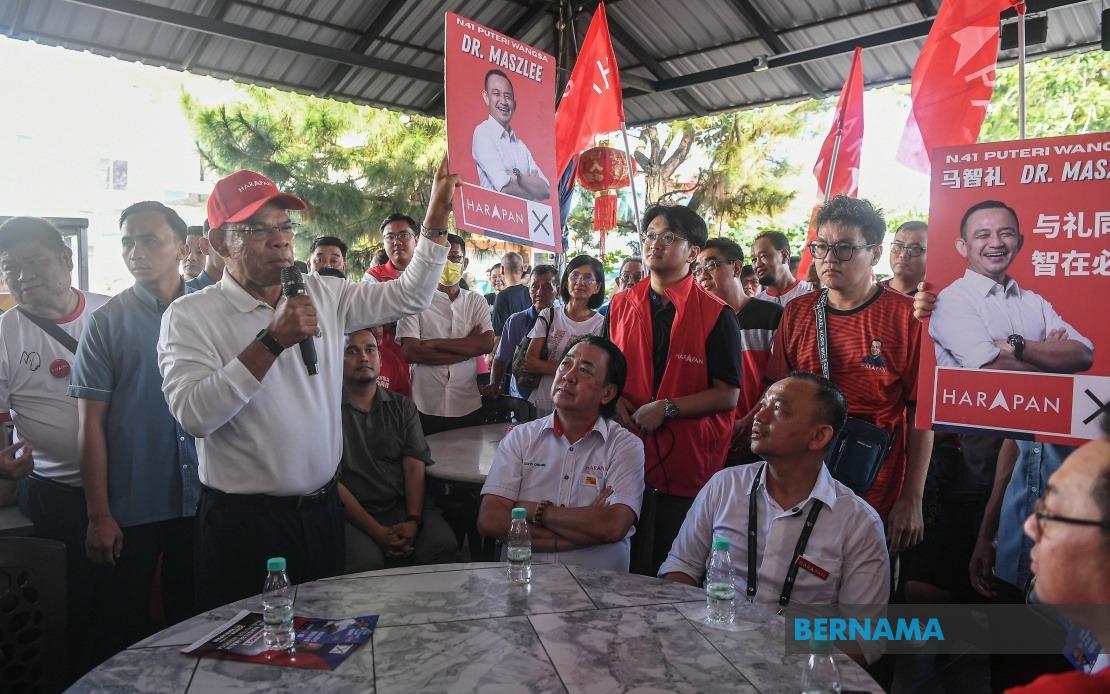
Pakatan Harapan is reporting a marked uptick in public backing as the Johor state election campaign enters its final phase, with party officials crediting their success to a methodical approach that treats the contest's 56 seats as distinct battlegrounds requiring tailored tactics. The coalition's campaign architecture reflects a deeper understanding of voter sentiment across the state's diverse constituencies, moving beyond the broad-brush approach typical of earlier electoral cycles in the region. This strategic recalibration suggests the coalition has absorbed lessons from previous campaigns whilst adapting to the particular political landscape of Malaysia's southern industrial heartland.
Datak Seri Saifuddin Nasution Ismail, serving as both Pakatan Harapan secretary-general and PKR's joint election director, outlined the coalition's methodology during remarks made after meeting with the Chinese business community in Johor Bahru. The party has implemented what officials term a grading system, clustering constituencies into priority tiers based on real-time intelligence about voter inclinations and the specific demographic and socioeconomic characteristics of each seat. Rather than allocating campaign resources evenly, the coalition concentrates its heaviest efforts on constituencies where the political terrain is most favourable or where tactical gains promise the greatest electoral impact. Saifuddin Nasution illustrated the approach by contrasting two constituencies—Puteri Wangsa and Johor Lama—to demonstrate that each battleground presents distinct challenges and opportunities that demand individualised campaign messaging and ground-level mobilisation.
The partition of constituencies into priority clusters represents a departure from conventional election strategy and signals a maturing political machinery within Pakatan Harapan. Rather than assuming uniform campaign effectiveness across all seats, the coalition recognises that voters in wealthy suburban constituencies such as Puteri Wangsa harbour different concerns than those in working-class urban divisions like Larkin or rural areas like Endau. This segmentation allows the coalition to deploy its most charismatic campaigners, senior party figures, and media resources to constituencies where the returns on such investment are likely to be greatest. Simultaneously, ground operatives in secondary-priority seats can focus on voter registration, logistics, and constituency organisation rather than requiring constant attention from central party leadership.
A secondary factor bolstering Pakatan Harapan's electoral prospects, according to Saifuddin Nasution, stems from the political positioning adopted by competitors. The Pan-Malaysian Islamic Party has limited itself to contesting just 11 of the 56 seats and has explicitly urged its supporters to back Barisan Nasional candidates in constituencies where PAS is not standing. This tactical arrangement, ostensibly designed to prevent vote-splitting between Islamist and establishment-right parties, has inadvertently created openings for Pakatan Harapan in seats where it might have struggled against a more unified opposition front. The coalition has capitalised on this fragmentation by presenting itself as the only force capable of offering a comprehensive and internally coherent electoral platform across the entirety of Johor.
By contrast, Pakatan Harapan has adopted what party officials characterise as a transparent stance regarding seat allocation and policy commitments. The coalition has publicly announced its distribution of candidacies—PKR fielding 20 candidates, Amanah 19, and DAP 17 across all 56 state seats—and has publicised a manifesto it claims is both comprehensive and realistic regarding implementation timelines. This openness stands as a deliberate counterpoint to what Saifuddin Nasution describes as opaque political manoeuvring by rival camps. For voters concerned about factional squabbling or last-minute surprises following polling day, the coalition's relative clarity regarding internal coalition mechanics offers reassurance about governance stability should Pakatan Harapan secure a state-level mandate.
The presence of Datuk Dr Mohd Puad Zarkashi, a former UMNO Supreme Council member, at a recent forum featuring Prime Minister Datuk Seri Anwar Ibrahim at Felda Ulu Tiram has further reinforced Pakatan Harapan's narrative of widening political support. Zarkashi's participation symbolises the coalition's ability to attract figures from the establishment right, suggesting internal fractures within the UMNO-led establishment that could benefit opposition candidates. For traditional Barisan Nasional voters considering a change, the visible participation of respected establishment figures in Pakatan Harapan events reduces the psychological barrier to voting outside conventional patterns. Such endorsements carry particular weight in rural constituencies and amongst older voters accustomed to voting for parties of government.
The coalition has similarly highlighted the credentials of individual candidates as part of its broader appeal strategy. Pakatan Harapan's nominee for Puteri Wangsa, Dr Maszlee Malik, has been presented as a qualified and accomplished figure whose elevation to state legislative office would represent a significant asset to coalition governance. By emphasising the calibre of individual candidates rather than focusing exclusively on party machinery or national-level messaging, Pakatan Harapan is attempting to shift voter attention to local representation quality and the prospect of competent constituency-level advocacy. This personalisation of the campaign acknowledges that Malaysian voters frequently cast ballots based on perceptions of local representatives' effectiveness and trustworthiness rather than exclusively on party affiliation.
The Johor contest, scheduled for July 11, represents a significant test for Pakatan Harapan's strategic approach across the region. With 172 candidates competing in total and early voting commencing on July 7, the election offers an opportunity to gauge whether the coalition's refined campaign methodology translates into legislative seats. A strong Johor performance would validate the coalition's approach to constituency segmentation and targeted resource allocation, potentially encouraging adoption of similar strategies in future elections across other states. Conversely, underperformance would suggest the need for further refinement of campaign mechanics or reconsideration of alliance arrangements within Pakatan Harapan itself.
For Malaysian political observers and regional analysts, the Johor election carries broader significance regarding the evolution of opposition political capacity and infrastructure. Southeast Asian democracies increasingly feature opposition coalitions attempting to compete with entrenched ruling establishments, and the techniques Pakatan Harapan employs in Johor may offer lessons applicable to Thailand, Indonesia, and other polities where multi-party coalitions challenge hegemonic parties. The sophistication of the coalition's constituency-level strategy suggests that opposition politics in Malaysia is moving beyond reactive posturing toward proactive electoral engineering. Should Pakatan Harapan succeed in translating its reported growing support into legislative gains, the election will confirm that well-organised opposition coalitions can overcome structural advantages enjoyed by parties long accustomed to managing state apparatus and resources.

