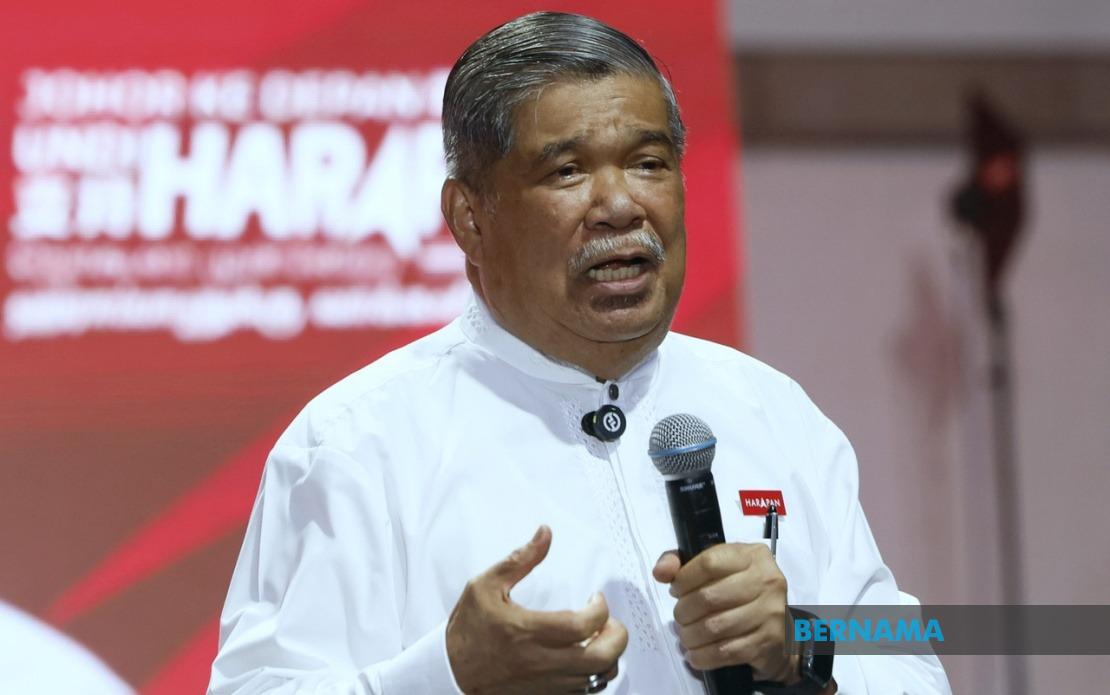
Pakatan Harapan's campaign machinery will not be derailed by PAS's latest strategic move in the Johor state election, according to Amanah president Datuk Seri Mohamad Sabu, who dismissed the directive as an ineffective distraction from PH's core message. Speaking after a ceramah in Permas Jaya, the Agriculture and Food Security Minister indicated that the opposition coalition views such manoeuvres as routine political theatre that would not influence the trajectory of its voter engagement efforts.
The PAS instruction, which asks its supporters to lend their votes to Barisan Nasional candidates in constituencies where PAS is not standing, represents a tactical consolidation between the two blocs ahead of the July 11 polling day. However, Mohamad Sabu emphasised that Pakatan Harapan would maintain its established campaign schedule without allowing external pressures to dictate its approach or messaging strategy.
At the heart of PH's counter-narrative lies an argument centred on institutional stability and cooperative governance. Mohamad Sabu articulated the coalition's belief that its greatest asset is the framework of multiracial and multi-religious partnership that underpins its political platform. This cooperation, he contended, creates the conditions necessary for sustained political confidence and establishes the groundwork upon which long-term economic progress can be constructed. The framing represents an implicit critique of alternative political arrangements that might prioritise narrow communal interests over inclusive institutional design.
In direct terms, the Amanah leader urged Johor voters to move beyond appeals grounded in racial or religious categorisation when making their electoral choices. Instead, he advocated for a merit-based evaluation of candidates, calling on constituents to assess individuals based on their demonstrated administrative competence, the quality of their prior service record, and their dedication to upholding equitable governance principles. This positioning attempts to reframe the election away from identity-based politics toward a more performance-oriented discourse.
From a state-level governance perspective, Mohamad Sabu highlighted the strategic advantages that would flow from administrative synchronisation between Kuala Lumpur and the Johor state government. Such alignment, he suggested, would streamline implementation of significant infrastructure and development initiatives that span both jurisdictions. He specifically identified public transport modernisation, enhancements to facilities at international border crossings, and the acceleration of investment-attraction activities as priority areas where federal-state coordination would prove essential.
DAP strategic director Liew Chin Tong, doubling as Deputy Finance Minister, introduced a demographic variable into the equation by identifying youth voter participation as the pivotal factor that could reshape the election outcome. Drawing on recent electoral history, Liew pointed to the 2022 Johor state election as instructive, noting that lower overall voter turnout had disproportionately benefited Barisan Nasional. He attributed part of that historical advantage to practical barriers that prevented Johor residents employed in Singapore from returning to vote, a constraint that was particularly acute during COVID-19 travel restrictions.
Liew made a case for redirecting the second phase of the campaign toward substantive policy discussion rather than allowing it to devolve into a purely adversarial political exchange. He identified employment creation as a leading concern, arguing that Johor's continued reliance on neighbouring Singapore as an employment destination for young professionals reflected a policy shortfall that the state government must address. Quality job opportunities with genuine earning potential, he suggested, would reduce outmigration and retain skilled workers within the state economy.
The DAP official expanded the scope of policy priorities beyond employment to encompass urban infrastructure and social welfare considerations. Public transport infrastructure, flood management, the maintenance of drainage and river systems, preparation for population ageing, and childcare provision emerged in his remarks as components of a comprehensive developmental agenda. These issues, he implied, should form the substantive basis of electoral competition and post-election governance priorities.
According to Liew, the Johor-Singapore Special Economic Zone represents a concrete opportunity to generate employment growth through federal-state collaborative effort. The mechanism for achieving this outcome, he argued, requires seamless operational cooperation between Putrajaya and the state administration. By implication, a PH state government aligned with the federal coalition would prove more effective at capturing the developmental potential embedded in such cross-border economic arrangements than a state administration at odds with the centre.
The electoral context frames these statements within a high-stakes competition where all 56 state assembly seats are being contested. The polling will occur on July 11, with early voting taking place on July 7, creating a compressed campaign period that intensifies competition for persuadable voters. The involvement of both major blocs in every constituency signals a comprehensive struggle for control rather than a negotiated division of political space, making every district a genuine battleground.
From a broader Southeast Asian perspective, the Malaysian electoral competition illustrates the tension between identity-based political mobilisation and performance-oriented governance narratives. Pakatan Harapan's emphasis on multiracial cooperation and administrative effectiveness represents one model of political organisation, whilst the PAS-Barisan Nasional coordination suggests an alternative configuration based on communal coalition-building. The outcome in Johor will provide important signals regarding voter preferences across these competing frameworks during an economically challenging period.

