Pakatan Harapan will unveil its manifesto for the Johor state election in the days immediately following the nomination deadline this Saturday, according to PKR vice president Datuk Seri Amirudin Shari. The coalition is finalising preparations for the document, which carries the thematic banner 'Johor Ke Depan' and aims to present voters with a detailed blueprint for economic and social progress should the opposition capture control of the state administration.
The manifesto framework draws substantially from the operational accomplishments and governance models that Pakatan Harapan has implemented across three existing state administrations. Selangor, Penang, and Negeri Sembilan will serve as the substantive foundation for policy proposals in Johor, with the coalition positioning itself as an alliance with demonstrated competence in executing development initiatives at the state level. This approach represents a deliberate strategy to move beyond theoretical promises, instead anchoring the campaign platform in documented administrative experience that voters in those jurisdictions can evaluate firsthand.
Amirudin emphasised during remarks at the PH candidate announcement ceremony in Tangkak that the manifesto represents not aspirational ideals but rather policies the coalition has already proven it can deliver. The distinction carries particular weight in Malaysian electoral discourse, where voters increasingly scrutinise campaign promises against tangible outcomes. By framing the manifesto as an extension of existing performance rather than untested proposals, Pakatan Harapan seeks to differentiate itself from opposition presentations that may lack comparable implementation track records.
The timing of the manifesto release reflects standard campaign choreography within Malaysian electoral cycles. The Election Commission has structured the Johor contest with the nomination day set for June 27, early voting scheduled for July 7, and the main polling day fixed for July 11. Unveiling the manifesto after nominations allow the coalition time to crystallise its messaging around officially endorsed candidates while maintaining momentum during the critical mid-campaign period when voter attention intensifies.
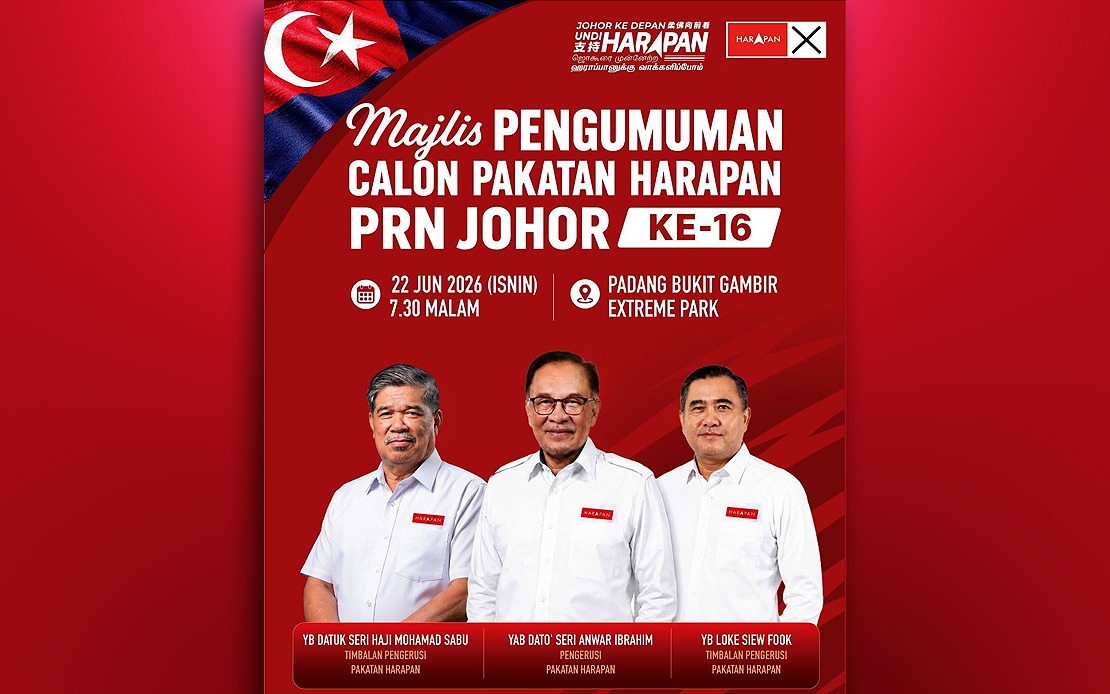
Senior coalition leadership aligned behind the announcement, with PH chairman Datuk Seri Anwar Ibrahim, DAP secretary-general Anthony Loke, and Amanah president Datuk Seri Mohamad Sabu all present at the Padang Bukit Gambir event. This display of unified party hierarchy underscores the importance Pakatan Harapan attaches to the Johor contest, a state historically dominated by the ruling coalition but increasingly competitive in recent electoral cycles. The personal attendance of multiple party presidents and senior figures signals that the campaign merits concentrated effort from the coalition's top echelon.
Johor represents strategically significant terrain in Malaysian politics. As a geographically large state with substantial population and economic output, controlling its assembly would expand Pakatan Harapan's footprint significantly and potentially create momentum for future federal contest developments. The state's proximity to Singapore and its role as an industrial and port hub make governance there consequential for broader regional economic dynamics that interest investors and businesses across Southeast Asia.
The 'Johor Ke Depan' branding reflects conscious messaging about forward momentum and future-oriented governance, deliberately contrasting with any implication of administrative stagnation or backward-looking policy frameworks. This rhetorical positioning has become standard for opposition campaigns seeking to position themselves as agents of change and modernisation against incumbent administrations.
For Malaysian voters evaluating opposition credentials, the Johor election provides a test case of Pakatan Harapan's ability to deliver policy consistency and effectiveness across diverse state contexts. Selangor's urban-industrial character, Penang's geographic and demographic distinctiveness, and Negeri Sembilan's smaller profile each present different governance challenges. Demonstrating that successful policies translate across these varied settings strengthens claims to competence at the state level and creates psychological scaffolding for future arguments about federal governance capacity.
The manifesto's emphasis on comprehensive development planning suggests the coalition intends to address infrastructure, economic opportunity, social services, and administrative efficiency as interconnected domains rather than isolated policy silos. This holistic approach aligns with contemporary governance discourse emphasising integrated development frameworks that coordinate across traditional sectoral boundaries.
Pakatan Harapan's decision to ground its manifesto in demonstrable achievements rather than rhetorical flourish reflects lessons from previous electoral cycles where gap between campaign promises and implementation capacity damaged credibility. By anchoring proposals in existing accomplishments, the coalition attempts to construct a narrative of reliability and delivery capability that resonates particularly with voters fatigued by unfulfilled political commitments.
The Johor election campaign unfolds against a backdrop of Malaysia's evolving political landscape, where state-level contests increasingly influence national trajectories and voters scrutinise opposition parties' capacity to govern effectively. This manifesto announcement marks the commencement of substantive policy debate in the campaign proper, moving beyond candidate selection toward substantive proposals that should occupy the electoral discourse through polling day on July 11.