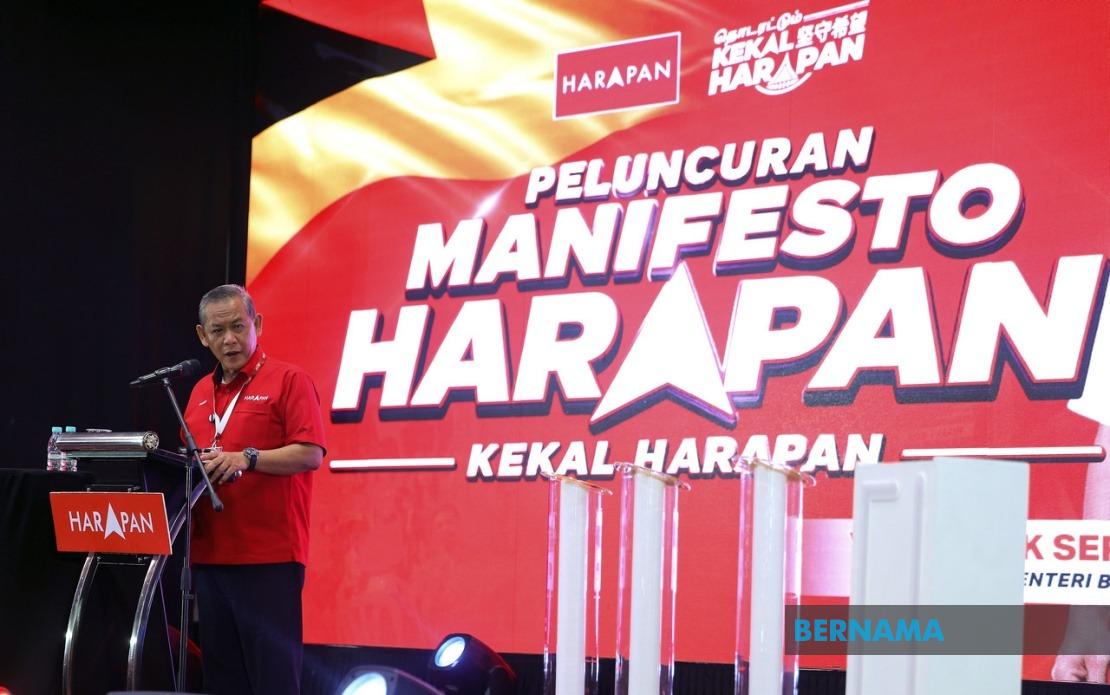
Pakatan Harapan has set out its vision for Negeri Sembilan's future through a comprehensive election manifesto unveiled in Seremban, positioning itself as the force that will keep the state on a trajectory of progress and stability. Launched by Negeri Sembilan PH chairman and Menteri Besar Datuk Seri Aminuddin Harun, the manifesto carries the rallying theme 'Negeri Sembilan Kekal Harapan'—a declaration that the state will remain anchored to the ruling coalition's stewardship as the 16th state election approaches.
At the core of the platform lies a commitment to governance that centres on stability, transparency and citizen interests. This represents a direct appeal to voters seeking reassurance in an era of shifting political dynamics across Malaysia, where state-level performances increasingly influence national sentiment. The emphasis on clean administration and people-focused policy reverberates with growing public demand for accountability and visible delivery of government services, concerns that have animated electoral contests throughout the region.
The manifesto prioritises economic opportunity through a specific target of creating 30,000 high-income jobs—a figure that speaks directly to youth aspirations and middle-class consolidation in Negeri Sembilan. Coupled with plans to build a more competitive economy, this pledge attempts to address anxieties about employment quality and wage stagnation that continue to preoccupy Malaysian workers across sectors. For a state seeking to diversify beyond traditional sectors, the commitment signals intention to modernise the employment landscape.
Housing affordability emerges as another centrepiece, with the coalition pledging to construct 20,000 homes priced within reach of ordinary Negeri Sembilan residents. This commitment reflects acute awareness of property market pressures affecting the state's urban and semi-urban areas, where housing costs have risen substantially over recent years. Simultaneously, the manifesto promises to resolve longstanding land disputes—a chronic issue that has generated friction between communities and state authorities and remains a persistent source of voter discontent.
Educational access and quality feature prominently in the platform, with the coalition undertaking to ensure all children receive competitive schooling regardless of background or geography. This resonates particularly with rural constituencies and lower-income households where educational opportunity remains unevenly distributed. In a state where economic transformation depends increasingly on human capital, this pledge reflects a strategic understanding that sustainable development cannot occur without investment in skills and knowledge.
Social welfare improvements centre on expansion of the 'Skim Sejahtera Rakyat' or People's Wellbeing Scheme, which already provides targeted assistance to vulnerable populations. Strengthening this apparatus indicates the coalition's recognition that economic growth must be coupled with safety nets protecting those unable to participate fully in market opportunities. Beyond conventional welfare, the manifesto commits to empowering youths, women and families through unspecified mechanisms—areas where Negeri Sembilan, like most Malaysian states, faces persistent structural inequalities.
Infrastructure and healthcare modernisation represent significant pledges that acknowledge both immediate service deficits and medium-term development requirements. Strategic transport connections, utilities and communications networks form the backbone enabling a competitive economy, whilst accessible, quality healthcare determines population health outcomes and productivity. These commitments suggest the coalition recognises that Negeri Sembilan's competitiveness depends on providing public goods matching or exceeding those available in neighbouring Selangor.
Tourism and cultural heritage development features as a growth lever, reflecting Negeri Sembilan's rich historical legacy and untapped potential in experiential tourism markets. In Southeast Asia's increasingly competitive tourism landscape, states must actively position themselves through cultural branding and infrastructure investment. This pledge signals ambitions to capture visitor spending and create associated employment beyond traditional sectors.
The manifesto addresses agricultural modernisation and food security through explicit commitment to sector transformation. For a state where substantial populations retain agricultural livelihoods or connections to farming, technology adoption and productivity improvements offer pathways to income enhancement. Regional food security concerns, amplified by climate variability and supply chain disruptions, elevate the relevance of this commitment beyond Negeri Sembilan's borders.
Implementation of the Federal Land Development Authority (Felda) Development Plan reflects coordination between state and federal authorities in advancing schemes benefiting rural communities, particularly those from lower income backgrounds participating in agricultural schemes. This signals political continuity and cooperation between Negeri Sembilan's state administration and the Putrajaya government.
Promoting interfaith unity in the manifesto's final commitment acknowledges Malaysia's plural society and contemporary tensions around religious identity and coexistence. For Negeri Sembilan, where multiple religious communities coexist, this pledge addresses grassroots anxieties about social cohesion and state leadership in maintaining harmony.
Collectively, the ten-point manifesto attempts comprehensive coverage spanning economic, social, and governance domains. Its effectiveness will ultimately depend on implementation capacity and resource availability. For Malaysian voters evaluating coalition performance, the specific pathways to achieving these targets—including timelines, funding mechanisms and accountability measures—will prove as consequential as the pledges themselves.

