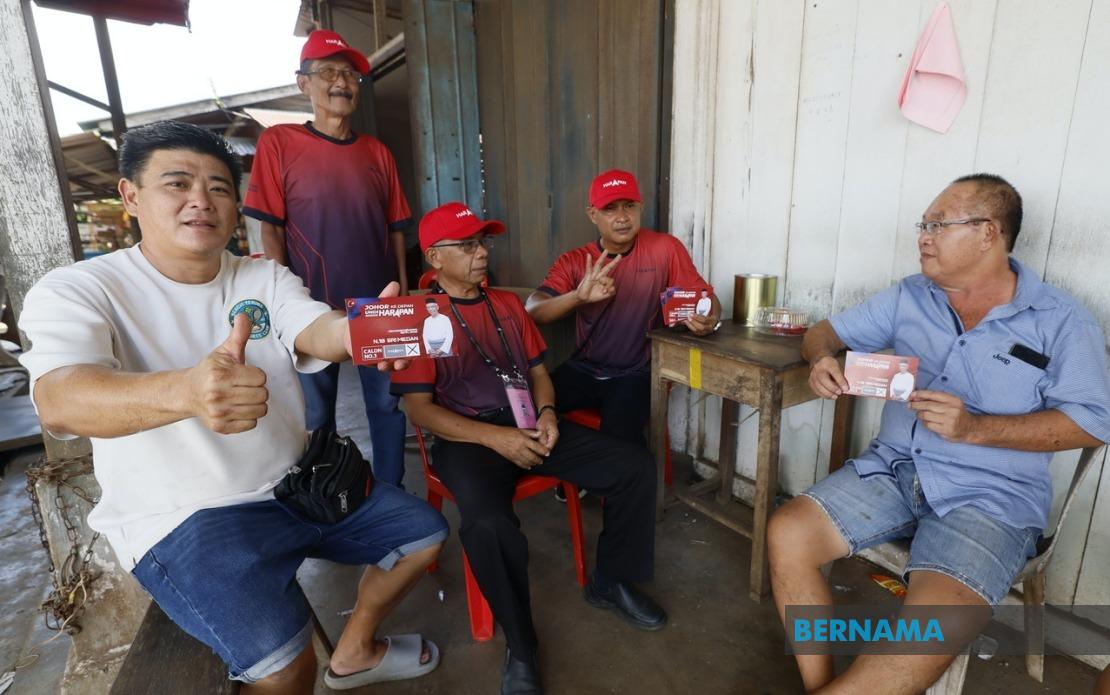
Hishamudin @ Misrin Ishak, the Pakatan Harapan candidate contesting the Sri Medan seat in Johor's upcoming state election, is pursuing a distinctly people-centred campaign strategy that emphasises direct engagement with residents and pragmatic problem-solving over grand political rhetoric. Known locally as "Cikgu Misrin" for his background as a mathematics educator, the candidate has adopted a methodical approach to his campaign walkabouts, carefully listening to constituent grievances and committing to address them within his practical capacity as a representative.
Among the most pressing concerns he has identified is the chronic flooding that continues to plague the Sri Medan area. Rather than offering vague assurances, Hishamudin has made flood mitigation a cornerstone of his platform, recognising that infrastructure failures directly undermine residents' quality of life and economic productivity. This issue resonates particularly in Johor, where seasonal flooding has repeatedly devastated communities and tested state government response capacity. His willingness to prioritise an unglamorous but essential issue signals a shift away from the kind of politics that often chases headline-grabbing announcements in favour of sustained, unglamorous service delivery.
The candidate's stated philosophy of "work first, talk later" stands in marked contrast to the promotional intensity typical of state election campaigns. This framing positions him as action-oriented and results-focused, a potentially valuable positioning in constituencies where voters have grown weary of unfulfilled promises. By committing to serve all constituents irrespective of their political affiliation, Hishamudin also attempts to transcend the tribal polarisation that has increasingly fractured Malaysian politics, though such claims require substantiation through consistent behaviour once elected.
Infrastructure equity emerges as another thematic strand in his campaign. Hishamudin advocates for balanced development spanning urban, semi-rural and rural zones within Sri Medan, acknowledging that resource concentration in developed areas often leaves peripheral communities underserved. This perspective reflects awareness that Malaysia's rapid urbanisation has created sharp developmental disparities, and that state legislators bear responsibility for ensuring that infrastructure investment—roads, water systems, electricity, telecommunications—reaches all population zones proportionally.
Youth employment and skills development occupy significant space in his campaign messaging. Hishamudin proposes expanding access to Technical and Vocational Education and Training programmes, recognising that Malaysia's economic transition requires a workforce skilled in trades and technical disciplines that secondary education often neglects. Digital literacy and exposure represent parallel initiatives designed to ensure young people in Sri Medan gain capabilities necessary for contemporary employment markets. These pledges address a genuine gap in Malaysian educational provision, where TVET pathways historically lacked prestige compared to academic tracks, leaving some youth inadequately prepared for available opportunities.
Small and medium enterprise development forms the third pillar of his economic platform. Hishamudin specifically identifies market access limitations as a constraint on SME growth, proposing initiatives to help local entrepreneurs reach customers beyond immediate geographic areas. This diagnosis reflects understanding that many Malaysian SMEs, particularly in smaller towns like those within Sri Medan constituency, struggle with distribution challenges and lack resources for marketing and supply chain development. By framing government's role as market facilitator rather than merely financial provider, he suggests a more sophisticated approach to entrepreneurial support.
The candidate's background as a village head lends credibility to his community service claims, though it also signals that he operates within existing administrative structures rather than offering transformational change. His experience managing local governance matters—welfare administration, development approvals, public complaints—equips him with practical knowledge of how state-level policies filter down to grassroots implementation. However, constituents evaluating his potential might reasonably question whether village-level administration adequately prepares candidates for state assembly complexities involving budget allocation, legislation, and constituency representation across urban-rural divides.
Sri Medan's political history complicates Hishamudin's challenge considerably. The seat has long been regarded as a Barisan Nasional stronghold, indicating entrenched incumbent advantage and voters accustomed to supporting the ruling coalition. Challenging such strongholds requires not merely competent local campaigning but also broader regional momentum that Pakatan Harapan must generate across Johor. His status as a "fresh face" potentially provides an advantage in contests where incumbent fatigue influences voting, yet it simultaneously disadvantages him in competition against established politicians with developed administrative networks and proven track records.
The candidate faces dual-front opposition in three-cornered contests against Barisan Nasional incumbent Datuk Zulkurnain Kamisan and Perikatan Nasional candidate Ahmad Rosdi Bahari. This three-way split creates unpredictable electoral dynamics, where vote distribution among opposition and establishment candidates becomes crucial. Johor's political terrain has shifted considerably in recent years, with Perikatan Nasional establishing itself as a meaningful contender, complicating the binary contests that historically characterised Malaysian state elections. Hishamudin's ability to carve differentiated positioning from PN's candidate will substantially influence his prospects.
Hishamudin's campaign approach through late June revealed encouraging voter response, according to his own assessment, suggesting that his grassroots engagement strategy resonated with at least some residents during initial campaign phases. However, the perception of BN dominance in Sri Medan creates psychological headwinds that positive local reception alone cannot overcome. State-level electoral momentum, national political events, and larger demographic shifts in Johor will ultimately matter more than individual candidate quality or constituent satisfaction in many cases.
The July 11 polling date provides just over two weeks for Hishamudin to consolidate initial campaign gains and drive voter conversion. Early voting on July 7 may provide tactical advantages for mobilising organised supporters, though the relatively short campaign window constrains his capacity to reach undecided voters through multiple contact points. His continuation of direct, door-to-door engagement represents an intensive approach appropriate for smaller constituencies, yet resource constraints compared to BN's established machinery may limit coverage breadth.
Ultimately, Hishamudin's campaign exemplifies an increasingly common opposition strategy in Malaysian politics: emphasising local competence, constituency service quality, and practical problem-solving rather than grand ideological narratives. Whether voters in Sri Medan prioritise these attributes over political affiliation and incumbent advantage will determine not only his electoral outcome but also signal broader voter preferences regarding campaign styles and political messaging in contemporary Malaysia.

