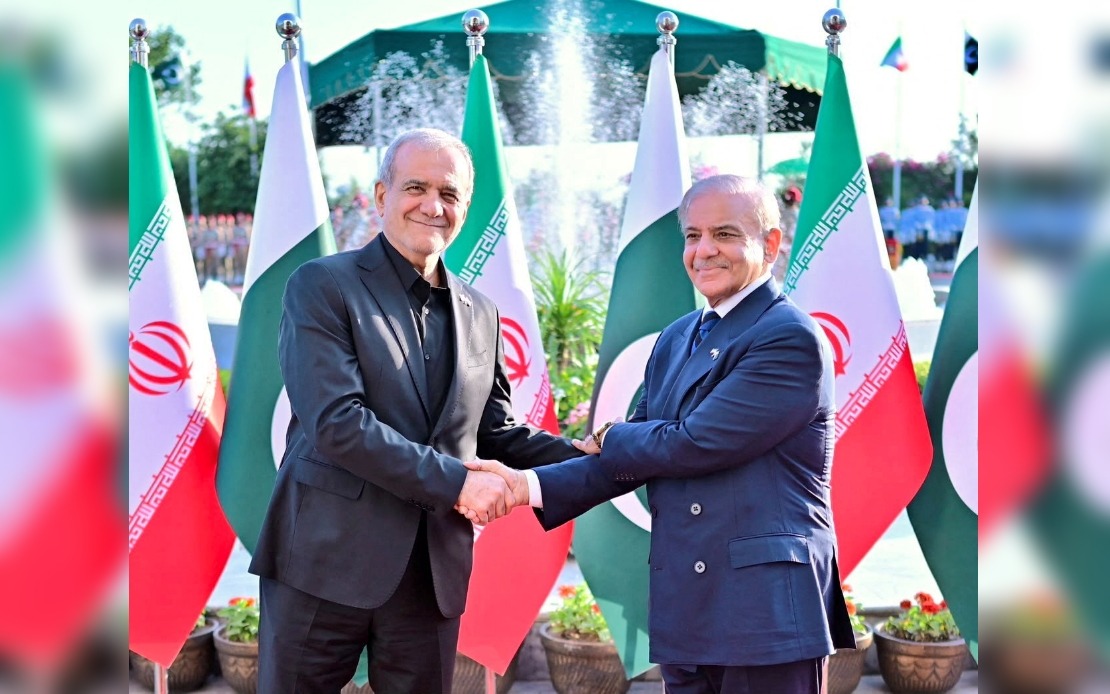
Pakistan's Prime Minister Shehbaz Sharif has thrown his country's diplomatic weight behind Iran's ballistic missile programme, insisting that Tehran should not face restrictions on weapons systems that other nations are permitted to develop. Speaking during high-level talks with Iranian President Masoud Pezeshkian in Islamabad, Sharif articulated a principled stance against what he characterised as selective enforcement of international weapons standards.
The Pakistan premier made clear that Iran's missile capabilities never featured in discussions leading up to the memorandum of understanding signed between Washington and Tehran on June 17. According to Sharif, the Iranian delegation itself declined to raise the missile issue during negotiations, a point he emphasised repeatedly to underscore that the exclusion was deliberate rather than accidental. This framing is significant because it shields Iran from criticism that it surrendered anything of strategic importance in the agreement, while simultaneously rebutting suggestions that the peace understanding should somehow constrain Tehran's defence posture.
Sharif's assertion that "some countries can have ballistic missiles and Iran should not have" them introduces a fundamental equity argument into the regional security conversation. This rhetoric resonates across much of the developing world, where perceptions of unfair treatment by powerful nations run deep. For Malaysia and other Southeast Asian nations navigating the complexities of great-power competition, Sharif's language exemplifies how smaller states attempt to champion principles of fairness in international relations, even when doing so carries diplomatic costs.
Iran's military establishment views ballistic missiles as central to its survival strategy, particularly following the February 28 attacks jointly attributed to Israel and the United States. From Tehran's perspective, these weapons serve as a credible deterrent against a technologically superior adversary, making them non-negotiable elements of national security doctrine. President Pezeshkian reinforced this stance at the joint news conference, declaring that without defensive missile capabilities, Israel and the United States would have treated Iran with the same devastating disregard shown toward Gaza's civilian population.
Pakistan's mediatory role in securing both the April ceasefire and June agreement underscores Islamabad's rising importance as a diplomatic intermediary in Middle Eastern affairs. Deputy Prime Minister and Foreign Minister Ishaq Dar, alongside Chief of Army Staff Field Marshal Syed Asim Munir, played instrumental roles in shuttling between the conflicting parties. Sharif's public endorsement of Iran's missile rights represents more than rhetorical support; it signals Pakistan's strategic alignment with Tehran despite concurrent tensions with Western powers, a delicate balancing act that reflects Islamabad's geographical and geopolitical realities.
The Pakistan premier acknowledged that powerful interests oppose the emerging rapprochement between Washington and Tehran, characterising these opponents as "spoilers" determined to sabotage peace initiatives. This language points toward Israel and its regional allies, though Sharif refrained from naming specific countries in his formal remarks. Israel has indeed positioned itself as fundamentally opposed to any agreement that leaves Iran's military capabilities intact, viewing the Islamic Republic's weapons programmes as existential threats to Israeli security.
US President Donald Trump's recent concession that Iran should be permitted ballistic missiles if other nations possess them provides unexpected diplomatic cover for Pakistan's position. Trump's June 17 statement to reporters in Paris essentially validated the equity argument that Sharif has now amplified on the international stage. When the American president acknowledges the unfairness of denying one nation weapons others possess, it complicates efforts by Washington's regional partners to maintain pressure against Iranian rearmament.
The ceremonial dimensions of Pezeshkian's Islamabad visit underscored the importance both nations attach to their relationship. Six Pakistani Air Force fighter jets escorted the Iranian president's aircraft, while President Asif Ali Zardari and Prime Minister Sharif received him with a 21-gun salute, honours typically reserved for the highest-ranking state visitors. Such pageantry serves diplomatic purposes beyond hospitality, signalling to international observers and neighbouring states the depth of Pakistan-Iran coordination at this pivotal moment in Middle Eastern affairs.
For Malaysian policymakers and security analysts, Pakistan's explicit support for Iran's missile programme offers instructive lessons about how middle-power nations navigate regional rivalries and great-power interests. Southeast Asia's own experience with arms control and non-proliferation issues, coupled with its increasing involvement in Indo-Pacific security debates, makes understanding Pakistan's strategic calculus directly relevant. When Sharif insists that weapons programmes should not be selectively restricted based on political preference rather than technical capability, he articulates a concern that resonates across the developing world's security establishments.
The broader implications of this diplomatic episode extend beyond bilateral Pakistan-Iran relations. The emergence of any geopolitical consensus around Iran's right to possess ballistic missiles, however qualified or contested, could reshape calculations across the Middle East and influence how regional powers perceive their own defence requirements. Malaysia's own commitment to the Non-Proliferation Treaty and international non-proliferation frameworks means carefully monitoring how powerful nations like Pakistan frame and justify exceptions to established weapons control norms.
Shahif's gratitude toward Iran for trusting Pakistan's mediation, combined with his assurance that Pakistan would never betray Iranian interests as "brothers," employs language that emphasises religious and civilisational solidarity. This rhetorical choice reflects how Islamic identity remains a powerful framework through which Pakistan constructs its regional diplomacy, even as it maintains formal relationships with Western powers. The commitment to never "let down" Iran, if taken at face value, suggests Pakistan views its relationship with Tehran through a lens of long-term strategic partnership rather than transactional convenience.
Moving forward, the stability of any US-Iran understanding will depend significantly on whether key intermediaries like Pakistan can maintain their diplomatic credibility with both sides. Sharif's public backing of Iranian missile rights, while politically popular in Pakistan and across much of the Muslim world, potentially complicates his government's ability to mediate future disagreements between Washington and Tehran should ballistic weapons again become contentious. The stakes involved in Pakistan's diplomatic positioning extend well beyond South Asian regional interests into the broader architecture of global security and the evolving balance of power in the Middle East.