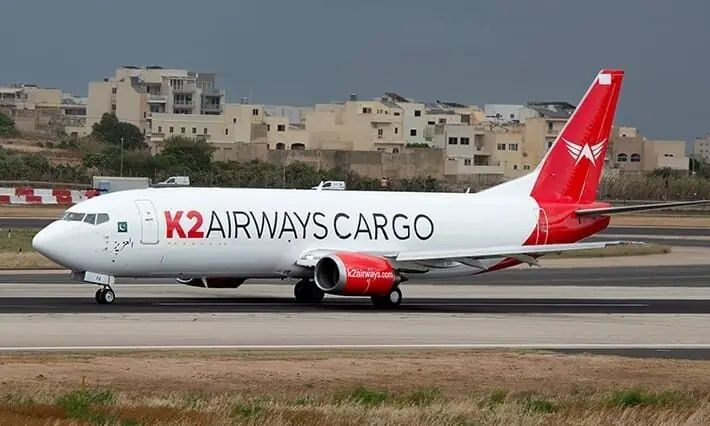
Pakistan's aviation authorities launched an intensive search operation Wednesday for a K2 Airways Boeing 737-400 freighter that vanished from radar while approaching Karachi from Sharjah, with Prime Minister Shehbaz Sharif confirming the aircraft had crashed into the Arabian Sea carrying five people. The disappearance marks a significant incident for Pakistan's civil aviation sector, which has struggled with safety concerns in recent years despite efforts to improve its regulatory framework.
Radar data from the Pakistan Airports Authority revealed that the aircraft experienced a critical malfunction during its descent into Karachi on Tuesday evening. At 21:21 pm local time, roughly 155 nautical miles west of the port city, the plane underwent a rapid descent accompanied by sudden directional changes before communication was severed entirely. Prior to losing contact, the aircraft's crew had reported a navigational system issue to air traffic control, indicating technical problems had already emerged during the approach phase.
Flight-tracking service Flightradar24 provided additional technical insight into the aircraft's final moments, releasing preliminary data showing an erratic pattern of altitude changes. The plane initially lost altitude substantially, then climbed again, before experiencing what the service described as a "sudden and dramatic" second descent. This pattern of rapid changes suggests the pilots may have attempted corrective measures before losing the ability to recover the situation, though investigators will require comprehensive flight data recorders to determine the precise sequence of events.
Responding to the crisis, Prime Minister Shehbaz Sharif issued an immediate statement expressing "deep sorrow, grief, and regret" over the tragedy and pledging the full resources of Pakistan's aviation, naval, and military establishments to locate the aircraft and its crew. He personally directed aviation authorities, the Pakistan Navy, and the Air Force to intensify search and rescue operations, demonstrating the high-level political attention the incident has attracted within government circles.
The search effort has mobilized substantial maritime and aerial assets across Pakistan's southern waters. According to sources familiar with the operation, both naval vessels and merchant ships have been deployed to comb the Arabian Sea, while military aircraft provide aerial surveillance and coordination of rescue efforts. The involvement of multiple agencies reflects the complexity of maritime search operations in the deep sea environment off Pakistan's coast, where weather conditions and limited visibility often hamper rescue attempts.
K2 Airways, the operator of the missing aircraft, is a privately-owned Pakistani cargo airline that maintains both scheduled and charter operations across domestic and international routes. The company serves the critical role of moving freight and general cargo throughout Pakistan and across regional markets, making the loss of one of its aircraft a significant operational setback for Pakistan's freight infrastructure.
The missing Boeing 737-400 itself carried considerable history before joining K2 Airways' fleet. Originally manufactured in 1999, the aircraft initially operated in passenger service for Russian carrier Aeroflot and Indonesian airline Garuda Indonesia before being reconfigured as a dedicated freighter in 2012. At the time of its disappearance, the aircraft would have been approximately 25 years old, raising questions about maintenance protocols and the condition of aging aircraft in Pakistan's cargo sector, though technical age alone does not determine safety outcomes without comprehensive inspection records.
This incident occurs within the context of Pakistan's troubled aviation safety record, which has drawn international scrutiny over the past decade. The country experienced several catastrophic crashes that claimed hundreds of lives, prompting the European Union to impose a four-year flight ban on Pakistan International Airlines, the country's national carrier, over concerns regarding safety standards and licensing compliance. Though the EU lifted this ban in 2024 following improvements to regulatory oversight and safety protocols, the incident demonstrates that challenges persist across Pakistan's broader aviation sector, including among private operators.
The disappearance of K2 Airways' aircraft raises important questions about maintenance standards, crew training, and ground support systems across Pakistan's private aviation industry. While the national carrier has undergone intensive scrutiny and reform following international sanctions, private cargo operators may operate under less rigorous oversight mechanisms, though they remain subject to Civil Aviation Authority regulations. The navigational system failure reported by the crew suggests that either equipment maintenance or crew response protocols may warrant investigation.
For Malaysia and other Southeast Asian nations, the incident serves as a reminder of the interconnected nature of regional aviation networks and the importance of maintaining robust safety standards across all operators. Malaysian airlines and cargo carriers frequently interact with Pakistani counterparts through Karachi's port facilities and regional trade routes, making the safety performance of Pakistani operators relevant to the broader regional aviation community.
The outcome of Pakistan's search and rescue operation and subsequent investigation into the technical causes of the crash will likely influence regulatory discussions both domestically and within regional aviation bodies. Indonesia, Bangladesh, and Malaysia maintain similar aging aircraft fleets in cargo service, meaning the technical and operational lessons from this incident could have practical applications across Southeast Asia's freight sector.
As search efforts continue in the Arabian Sea, the incident underscores the persistent vulnerabilities in Pakistan's aviation infrastructure despite recent regulatory improvements. The recovery of the flight data recorders will be essential for understanding the precise technical failure sequence and determining whether systemic issues require broader corrective action across Pakistan's civilian and cargo aviation sectors. Until then, authorities face an ongoing challenge to locate the wreckage and recover evidence that will inform both accident investigation and future safety improvements.

