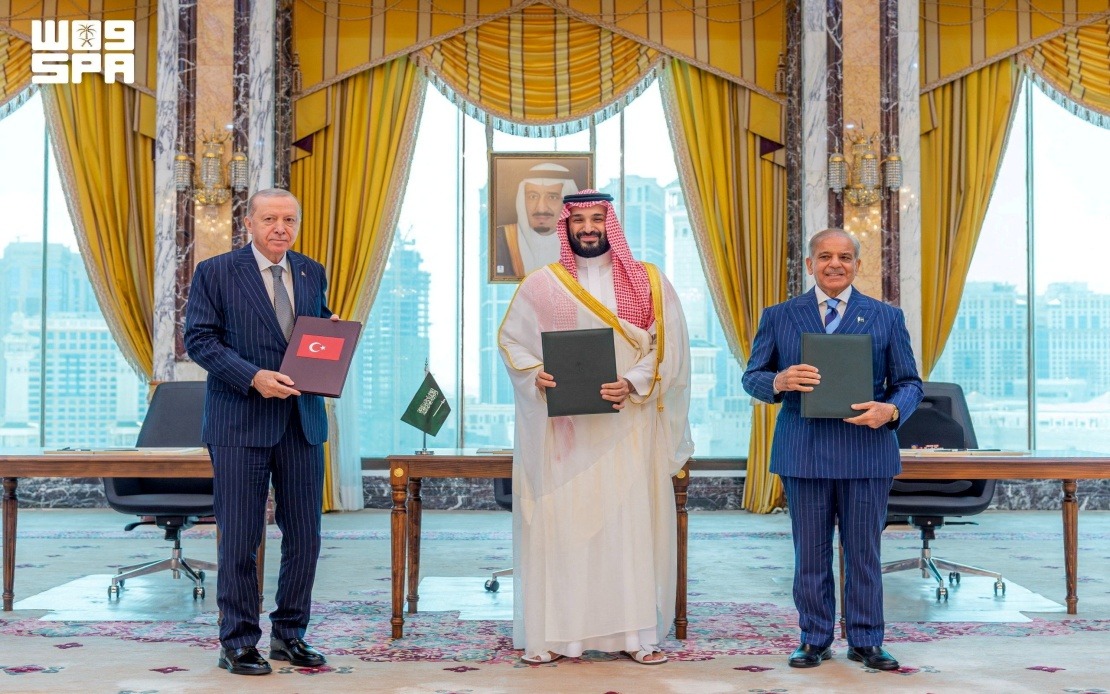
Three major Muslim-majority powers solidified their strategic partnership on Friday with the signing of a landmark collective defence pact, with leaders gathering at Al Safa Palace in Makkah to formalise their commitment to mutual security. Saudi Crown Prince Mohammed bin Salman bin Abdulaziz Al Saud, Pakistan Prime Minister Shehbaz Sharif and Turkish President Recep Tayyip Erdogan each affixed their signatures to the Joint Defence Agreement, establishing a binding framework that treats armed aggression against any signatory as an assault on the entire alliance.
The accord represents a significant deepening of bilateral relationships that have historically existed between these three nations. Pakistan has long maintained robust defence ties with both Türkiye and Saudi Arabia, though this trilateral arrangement elevates cooperation to a new institutional level. The agreement stipulates that armed attacks targeting any member state automatically trigger a collective response mechanism, fundamentally reshaping the security calculus for the three countries and their respective spheres of influence across South Asia, the Middle East and Eastern Mediterranean.
Beyond the core mutual defence commitment, the pact encompasses broad cooperation across multiple defence sectors. The signatories pledged to enhance collaboration in all dimensions of military capability, intelligence sharing and operational coordination. This architectural expansion signals an intention to move beyond traditional bilateral agreements toward integrated defence frameworks that could enable joint exercises, technology transfer, standardisation of equipment and coordinated strategic planning. For Pakistan particularly, the arrangement supplements existing bilateral accords, including a 2023 defence agreement with Saudi Arabia requiring mutual assistance in cases of external attack.
Riyadh sought to emphasise that the alliance poses no threat to regional stability. Saudi Arabia's deputy public diplomacy minister Rayed Krimly used the social media platform X to clarify that the pact aims to develop integrated defence capabilities and strengthen deterrence mechanisms without escalating tensions. His statement suggests awareness that such multilateral arrangements can trigger concerns among neighbouring countries, particularly Iran and other regional actors monitoring shifts in the strategic balance. The clarification underscores how officials are attempting to frame the agreement as a stabilising measure rather than a provocative realignment.
The timing and location of the agreement carry symbolic weight. Makkah's selection as the signing venue emphasises the Islamic dimension of the alliance, reinforcing shared religious and civilisational bonds alongside security interests. The focus on collective deterrence reflects contemporary regional security challenges, including terrorism, proxy conflicts and drone attacks that have increasingly affected all three nations. Pakistan faces persistent militant threats and cross-border terrorism; Saudi Arabia confronts Houthi attacks; and Türkiye manages security challenges across its borders and internally.
For Malaysian policymakers and analysts, this trilateral arrangement warrants close attention as it reflects broader reorganisation of geopolitical alignments. The agreement demonstrates how medium and large powers in non-Western regions are constructing alternative security architectures outside traditional Western-led frameworks. This mirrors patterns seen elsewhere, from BRICS expansion to ASEAN's hedging strategies, as nations seek greater strategic autonomy. However, unlike ASEAN's consensus-based approach, this pact involves explicit mutual defence commitments that could entangle signatories in conflicts beyond their direct interests.
Pakistan's participation is particularly noteworthy given its complex international relationships and nuclear weapons status. As one of nine nations possessing nuclear capabilities, Pakistan's security alignment carries implications extending beyond the three signatories. The country's historical oscillation between different international partners suggests this agreement provides welcome stability, though critics might question whether formal commitments could become liabilities if geopolitical circumstances shift dramatically. The defence accord simultaneously strengthens Pakistan's regional standing while potentially constraining its diplomatic flexibility.
The agreement emerges within a context of broader Middle Eastern realignment. Saudi Arabia's growing security cooperation with Pakistan reflects Riyadh's efforts to diversify strategic partnerships beyond traditional relationships. The inclusion of Türkiye completes a significant power triangle spanning South Asia, the Arabian Peninsula and the Eastern Mediterranean. These three nations collectively represent substantial military capabilities, population resources and economic influence, creating a coalition of considerable regional weight.
Southeast Asian nations should monitor whether this trilateral arrangement expands to include broader mechanisms for regional dialogue or whether it remains focused narrowly on the three signatories. The precedent could influence whether other regional groupings pursue similar formalised collective defence arrangements. Additionally, if the pact includes provisions for joint exercises or coordinated military operations, this could reshape traffic patterns for arms sales and military technology flows, potentially affecting global defence markets and regional suppliers who compete for these countries' procurement budgets.
The joint statement accompanying the agreement emphasises commitment to regional peace, security and stability while pursuing mutual prosperity. This language suggests the signatories recognise potential international sensitivities and wish to position themselves as contributors to rather than disruptors of regional order. However, the fundamental transformation remains significant: three major powers have now formally codified an obligation to treat attacks on one as attacks on all, establishing what amounts to an Asian equivalent of NATO-style collective defence commitments.
The pact's implications for international law and regional diplomacy are substantial. It establishes clear tripwires that could automatically activate mutual defence obligations, potentially limiting diplomatic options during crises. Conversely, the deterrent effect of unified defence capabilities might prevent potential aggressors from miscalculating or initiating conflicts. How these mechanisms function in practice will depend heavily on interpretation and the specific circumstances triggering their activation.

