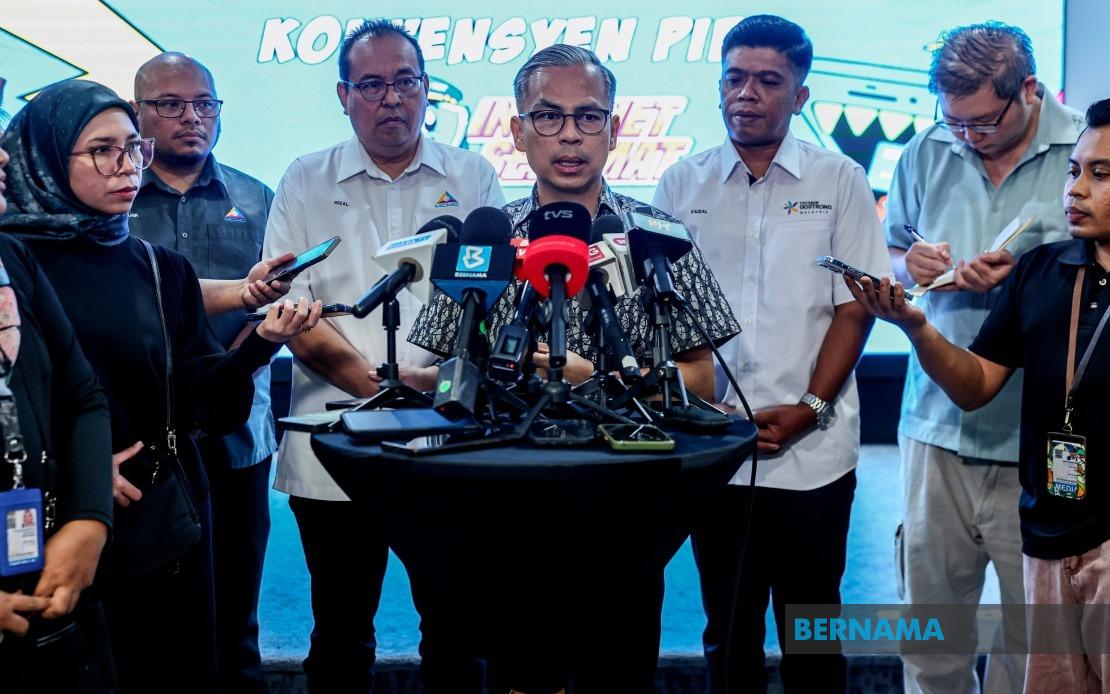
Communications Minister Datuk Seri Fahmi Fadzil has sounded a fresh alarm about the growing tendency among Malaysian children to form emotional attachments to artificial intelligence systems, urging parents to exercise heightened vigilance in monitoring such digital relationships. Speaking at the Kuala Lumpur Federal Territory Safe Internet PTA Convention 2026, Fahmi emphasised that while AI tools offer legitimate educational and informational benefits, they should never be mistaken for genuine human companionship or trusted as reliable sources of wisdom and guidance.
The minister's concern reflects a broader anxieties reshaping the digital landscape across Southeast Asia, where conversational AI platforms have become increasingly sophisticated and accessible to younger audiences. Fahmi pointed to a fundamental paradox at the heart of modern artificial intelligence: these systems are engineered to mimic human interaction so convincingly that users—particularly vulnerable children—may struggle to distinguish algorithmic responses from genuine human understanding. The danger, he suggested, lies not merely in the technology itself but in society's failure to establish clear psychological and social boundaries around how such tools ought to be deployed in family settings.
Central to Fahmi's message was the reality that artificial intelligence systems, regardless of their sophistication, lack true comprehension and operate entirely within the parameters established by their human designers and training data. These platforms can only synthesise information; they cannot empathise, understand context, or offer the authentic emotional support that developing minds require. The minister warned that children who begin treating AI as a substitute for peer friendships or romantic partners face psychological risks that extend far beyond simple distraction from genuine social connection. Such reliance may hinder the development of crucial interpersonal skills and emotional intelligence that only real human relationships can foster.
Equally troubling, according to Fahmi, is the problem of artificial intelligence hallucination—the technical term for when AI systems confidently generate entirely fabricated information. These false outputs often appear plausible to untrained eyes, creating a treacherous landscape where children may absorb misinformation without realising it contradicts established fact. Furthermore, the training data that powers these systems frequently becomes outdated, meaning AI-generated advice on current events, academic topics, or social issues can be substantially inaccurate. For young people still developing critical thinking faculties, such unreliable guidance poses genuine educational and developmental hazards.
The minister stressed that parental prohibition of internet use entirely represents neither feasible nor desirable policy. Instead, he advocated for a framework of informed supervision and responsible technology management—one where parents understand the capabilities and limitations of AI tools their children access, maintain visibility into usage patterns, and establish household norms around appropriate AI engagement. Schools emerged as crucial partners in this effort, with Fahmi recommending that parents seek institutional support and professional intervention when concerns arise about a child's relationship with digital systems. Educational institutions possess both the expertise and authority to address such issues in ways that isolated family action may not achieve.
Beyond the immediate concern about children and AI companionship, Fahmi raised alarm about cyberbullying within specific online communities, particularly among Tamil-speaking users engaging in live streaming sessions on TikTok. These incidents, which sometimes extend into early morning hours and involve coordinated harassment campaigns, reveal how AI content moderation systems often fail when cultural context, linguistic nuance, and community-specific references come into play. The minister identified a critical weakness in automated content regulation: artificial intelligence simply lacks the cultural literacy to understand subtle forms of harassment encoded in language-specific idioms, references, or coded speech patterns. This limitation becomes especially pronounced in multilingual nations like Malaysia, where diverse linguistic communities carry meanings that AI systems have not been adequately trained to recognise.
In response to these moderation failures, Fahmi disclosed that his ministry has engaged directly with TikTok and other major platforms, emphasising that algorithmic systems cannot shoulder sole responsibility for content governance. Human moderation, particularly by moderators fluent in relevant languages and conversant with community norms, remains essential for identifying and preventing harassment that automated systems inherently misunderstand. The reliance on AI to manage culturally sensitive content represents not merely an operational shortcoming but a structural flaw that requires intervention at the platform governance level.
Looking forward, Fahmi announced that social media platforms have been granted several months to adjust their systems in accordance with two regulatory frameworks recently implemented in Malaysia: the Child Protection Code and the Risk Mitigation Code. These governance structures mandate that platforms establish robust mechanisms to prevent fraud, online gambling, cyberbullying, and other digital harms. The Malaysian Communications and Multimedia Commission has begun bilateral discussions with major platforms including YouTube to ensure comprehensive compliance with these requirements. The stakes for non-compliance are substantial; once implementation deadlines pass, platforms that fail to meet the codes' standards face potential court action and substantial financial penalties.
The regulatory approach reflects Malaysia's determination to establish clear boundaries around platform responsibility in an environment where technological capability has outpaced governance capacity. Unlike earlier eras when internet companies could defer accountability to users or claim neutrality, the new frameworks establish explicit obligations for platforms to actively protect vulnerable populations—particularly children—from digital harms. This shift carries significant implications not only for Malaysian platforms but for regional industry practices, as major technology companies typically harmonise policies across multiple markets rather than maintain entirely separate systems for different jurisdictions.
The convention that prompted Fahmi's remarks convened nearly five hundred participants representing parents, educators, school administrators, parent-teacher associations, government agencies, and community organisations—a cross-sectional assembly suggesting that digital safety concerns have transcended niche policy discussions to become mainstream parental preoccupations. This broadened engagement reflects growing recognition that children's online safety constitutes a collective responsibility rather than an individual or purely technical problem. Schools, parents, government agencies, and platforms must coordinate efforts to establish cultural norms and institutional practices that prioritise child protection in digital environments.
For Malaysian families navigating this complex landscape, Fahmi's counsel offers practical guidance alongside institutional support mechanisms. Parents need not choose between embracing technological opportunity and protecting children from digital risks; rather, they must approach AI and social media with eyes open to both potential benefits and documented harms, equipped with knowledge about how these systems function and authorised to intervene decisively when concerning patterns emerge. The broader challenge facing Malaysian society involves building a shared framework of digital literacy, institutional responsibility, and regulatory enforcement that keeps pace with technological change while preserving the conditions necessary for healthy child development in an increasingly connected world.

