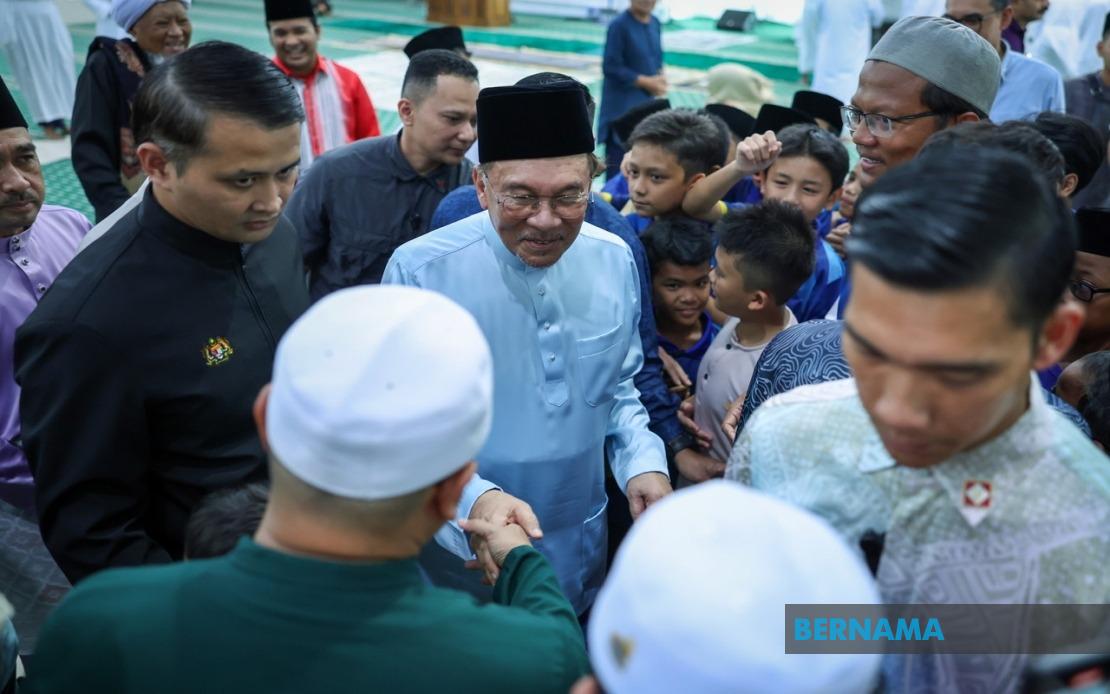
Prime Minister Datuk Seri Anwar Ibrahim has drawn a clear distinction between parliamentary constituency allocations and the personal entitlements of elected representatives, asserting that such funds exist primarily to serve the broader population rather than individual MPs. Speaking after Friday prayers at Masjid Ar-Rasyidin in Alor Gajah, Anwar stressed that government funding directed towards constituencies carries a mandate that extends far beyond the political figure who holds the seat.
The clarification comes amid mounting complaints from several MPs who have alleged that the government has reduced or suspended their constituency allocations, creating friction within the parliamentary system. Anwar's intervention appears designed to reframe the narrative around these financial arrangements, positioning them as public resources dedicated to improving the quality of life for ordinary residents rather than as discretionary benefits tied to individual legislators. This stance reflects a governance philosophy that prioritises direct service delivery to constituents over traditional patronage structures that often characterise parliamentary funding mechanisms across the region.
According to Anwar, the intended use of such allocations encompasses a wide spectrum of community priorities. The funds are earmarked for essential infrastructure improvements including educational facilities, religious institutions, drainage systems, and mosques—projects that directly enhance neighbourhood amenities and address day-to-day infrastructure gaps. When RM2 million is allocated to a constituency, for instance, the expectation is that these resources flow into tangible improvements that raise living standards across the entire community, not accumulate as discretionary spending under an MP's control. This approach suggests a deliberate effort to depoliticise the distribution of public money and anchor it instead to measurable community outcomes.
The government appears committed to ensuring that this principle operates consistently regardless of the political affiliation of the sitting MP. Anwar indicated that if an MP belongs to an opposition party, the government will nonetheless channel allocated funds directly to local communities and beneficiaries rather than route them through the opposition legislator. This mechanism effectively bypasses potential obstruction or alternative deployment of resources, though it also raises questions about checks and balances in how communities access information about available funding and submit project proposals.
Anwar noted that this allocation philosophy is not novel within Malaysia's political governance. The principle has existed for some time and should be familiar to MPs who have previously held government positions, suggesting that earlier administrations operated under similar frameworks. However, the current emphasis on this distinction appears to signal a shift in how the government intends to monitor and enforce these guidelines. Opposition MPs experiencing reduced allocations may interpret this as a consequence of the government's commitment to ensuring funds reach constituents directly, though the political implications of differential treatment based on party affiliation remain contentious.
The timing of Anwar's remarks carries additional significance given the broader political landscape in Malaysia. The statement reinforces the government's position during a period of parliamentary tension and reflects efforts to maintain public support by demonstrating that development resources are managed fairly and transparently. For Malaysian constituencies, particularly those represented by opposition MPs, understanding this policy distinction becomes crucial when assessing infrastructure development timelines and community funding prospects.
Beyond the immediate parliamentary dynamics, Anwar's comments touch on a fundamental question about democratic governance and resource allocation in Southeast Asia. The principle that government funds serve populations rather than individual politicians is theoretically sound, yet implementation often proves complex. Community participation in project selection, transparency in fund disbursement, and accountability mechanisms become essential if this model is to function as intended rather than create parallel systems of resource distribution that lack traditional parliamentary oversight.
In a separate development during the same visit, Anwar addressed personnel changes within his party hierarchy. PKR deputy president Nurul Izzah, who is also Anwar's daughter, has temporarily stepped down from her position to focus on other commitments. Anwar characterised this arrangement as a temporary measure, emphasising that Izzah remains actively involved in party activities despite her reduced formal responsibilities. The nature of these alternative commitments was not elaborated, though Anwar indicated they warrant temporary prioritisation within Izzah's schedule.
The statement regarding Izzah's status carries implications for party succession planning and the balance between family political dynasties and broader party leadership structures. Her temporary step-down, framed as voluntary and circumstantial rather than disciplinary, allows the party to maintain flexibility in leadership arrangements while preserving her position within the broader organisational framework. This approach reflects contemporary Malaysian political practices where family members of senior leaders often retain significant influence even when formal titles are temporarily relinquished.
For Malaysian voters and constituents, Anwar's clarification about parliamentary allocations represents an important statement about the government's approach to public resource management. The emphasis on direct delivery to communities rather than through individual MPs suggests a modernising impulse within the administration, though successful implementation will depend on transparent mechanisms, community awareness, and consistent application across all constituencies regardless of political colour. As Malaysia continues to evolve its democratic practices and institutional frameworks, these principles around resource allocation and public accountability will likely remain focal points in broader discussions about governance quality and equitable development across the nation.

