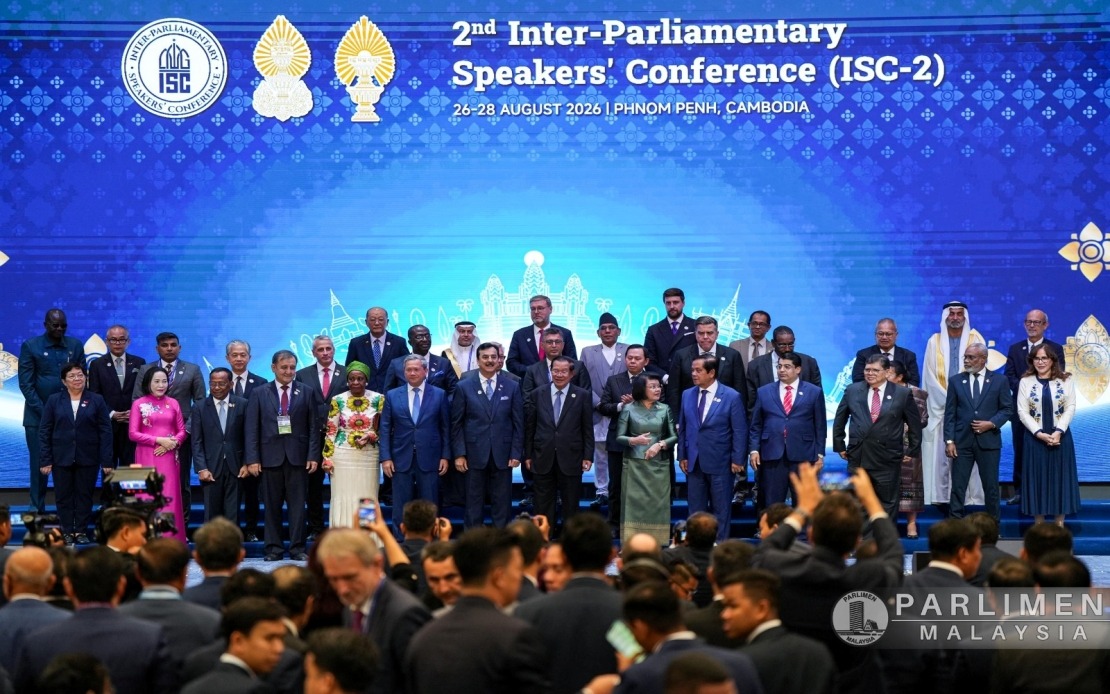
Legislatures across the world must step beyond their traditional boundaries and become active participants in resolving international disputes, geopolitical tensions and shared global challenges, according to Malaysia's Dewan Rakyat Speaker Tan Sri Dr Johari Abdul. His call came during the Second Inter-Parliamentary Speakers' Conference in Phnom Penh, jointly organised by Cambodia's National Assembly and Senate from August 26 to 28. The gathering, themed "Solidarity for Peace and Shared Prosperity: Strengthening International Law and Resolving Conflicts Peacefully," brought together legislative leaders from across the world to deliberate on the escalating complexities facing the international community.
Johari's intervention reflects a growing recognition that executive-led diplomacy, whilst essential, requires institutional counterbalance through parliamentary engagement. He articulated a nuanced argument that executive branches, by their nature, often view international relations through a political lens focused on immediate national interests, whereas legislatures possess a broader aperture for understanding the underlying concerns of ordinary citizens affected by geopolitical developments. The interplay between these two branches of government, he suggested, creates a more holistic and durable approach to peace-building. This perspective challenges the conventional hierarchical division of labour in foreign policy, where presidents and prime ministers typically dominate international negotiations whilst parliaments remain relegated to ratifying agreements or debating policies after decisions have been made.
The human dimensions of global conflicts form the crux of Johari's argument for parliamentary empowerment. Modern warfare, he noted, extends far beyond military engagements—it fractures communities, displaces families and denies children access to education. These consequences ripple through generations, creating long-term developmental deficits that international statistics often fail to capture. By involving parliaments in conflict resolution mechanisms, nations can ensure that the voices of affected populations, channelled through their elected representatives, directly inform diplomatic strategies. This democratic legitimacy becomes particularly important when populations question the rationale for military expenditures or sanctions regimes that impose economic hardship on civilians.
Parliamentary diplomacy offers unique advantages when formal government relations deteriorate. Johari emphasised that legislators can maintain dialogue channels when official state-to-state relations freeze or become hostile. This "back-channel" function allows for conversation to continue across political and national divides, creating spaces where trust can be gradually rebuilt and misunderstandings clarified without the rigid protocol constraints of executive-level diplomacy. Such informal exchanges can preserve relationships and prevent conflicts from escalating to irreversible points. For Southeast Asia, where memories of past regional tensions remain fresh and ongoing disputes persist over maritime boundaries and resource access, this parliamentary safety valve becomes strategically significant.
Malaysia's approach to international relations, as articulated by Johari, rests on foundational principles of respect for national sovereignty, territorial integrity, observance of international law and preference for peaceful dispute resolution. These principles, he argued, hold particular resonance for Southeast Asia, where the Association of Southeast Asian Nations was conceived on dialogue, consensus-seeking and continuous cultivation of regional stability. ASEAN's founding philosophy emphasises non-interference and consultation rather than coercive measures, making it a distinctive regional architecture in an increasingly fractious world. Johari's remarks underscore Malaysia's commitment to this model and signal that parliamentary institutions should reinforce rather than undermine these regional consensus-building mechanisms.
The role of parliaments in complementing ASEAN's diplomatic efforts deserves deeper examination. Regional legislators, through inter-parliamentary bodies and informal networking, can strengthen people-to-people understanding and foster civil society connections that transcend government positions. When official channels become strained—as they periodically do within ASEAN over South China Sea disputes or humanitarian concerns—parliamentary engagement can nurture the relationships necessary to prevent permanent fractures. Malaysian parliamentarians, drawing from diverse ethnic and religious backgrounds, exemplify the bridge-building potential that legislatures can offer in multicultural Southeast Asia.
The Inter-Parliamentary Speakers' Conference itself represents an institutional innovation in global governance. By creating dedicated forums where legislative leaders from different nations convene to address transnational challenges, the conference acknowledges that traditional state-centric diplomacy increasingly struggles with problems requiring coordinated responses across borders. Climate change, migration, pandemics and terrorism all demand legislative engagement because their domestic impacts ultimately require parliamentary approval for resource allocation and policy implementation. The conference, having begun in Pakistan in 2025, is now rotating through major economies—this year in Cambodia, next year in Indonesia—indicating the commitment of Asia-Pacific nations to formalise parliamentary diplomacy as a structural component of international relations.
Indonesia's forthcoming hosting of the third conference elevates the role of Southeast Asian parliaments in global discourse. The region's demographic weight, economic significance and geopolitical importance position its legislatures as influential voices in shaping international norms around conflict resolution and institutional reform. Indonesian parliamentary leadership, leveraging its position as chair of ASEAN and the world's third-most populous democracy, can amplify the message that legislatures must become indispensable partners in global peace-building efforts.
Critically, Johari's advocacy suggests that parliamentary engagement in international affairs need not dilute executive authority but rather strengthen legitimate decision-making. When citizens see their representatives actively participating in peace processes and international law development, public support for difficult policy choices increases. Conversely, when legislatures are marginalised from these processes, democratic deficits widen and populations may perceive foreign policy as distant and unresponsive to their concerns. For Malaysia, whose foreign policy must navigate complex relationships with major powers whilst maintaining regional solidarity, enhanced parliamentary involvement offers an avenue to deepen democratic participation in international affairs.
The conference's emphasis on international law and peaceful conflict resolution carries particular importance for Southeast Asia. The region confronts multiple potential flashpoints—disputed maritime zones, resource competition and great power rivalry—where clear adherence to international legal frameworks becomes essential for preventing miscalculation. Parliamentary bodies, by developing expertise in international law and building legislator-to-legislator networks grounded in legal principles rather than pure realpolitik, can help entrench norms that favour negotiation over confrontation. Johari's articulation of this vision positions Malaysian parliament as a serious contributor to regional stability architecture beyond traditional government diplomacy.

