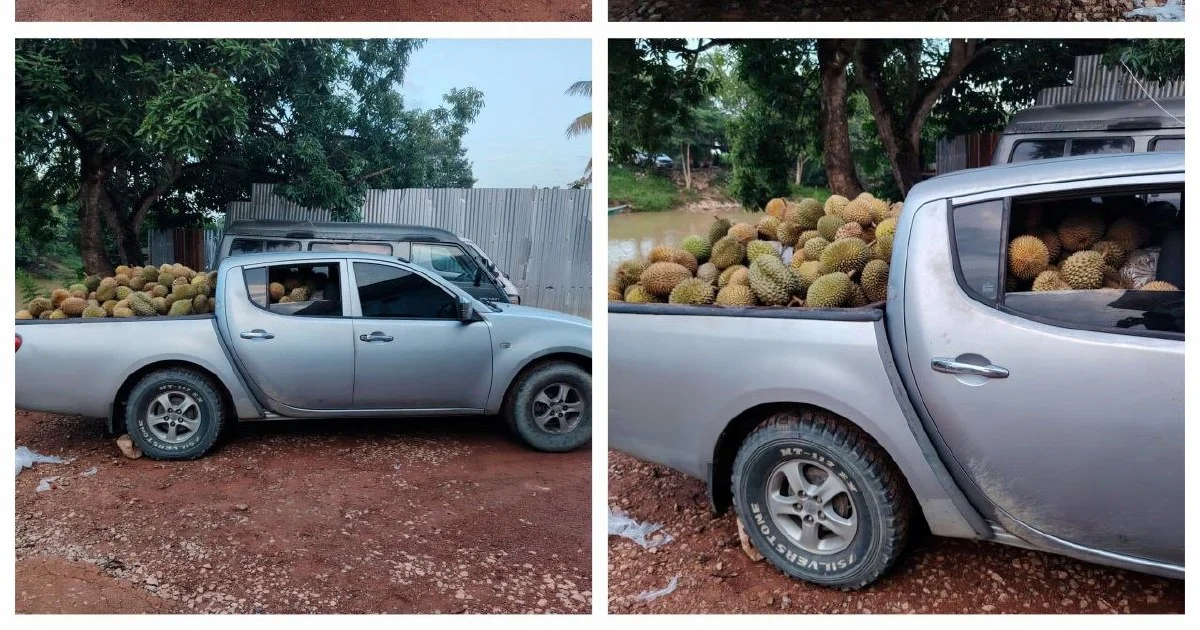
A young part-time driver's pursuit of modest daily earnings has ended in arrest following the seizure of 700kg of suspected smuggled durians at Rantau Panjang in Kelantan last night. The 22-year-old man, lured by the promise of RM60 to RM70 per day, became ensnared in what enforcement authorities are investigating as part of a larger cross-border smuggling network. The incident underscores how fruit smuggling syndicates deliberately target economically vulnerable workers, offering barely subsistence wages to execute high-risk transportation operations.
Rantau Panjang, situated near the Malaysia-Thailand border, has long been a critical interception point for customs and excise authorities combating illicit trade. The strategic location makes it an obvious chokepoint for smugglers attempting to move contraband goods between the two countries. Durians represent a particularly valuable commodity in this underground economy, commanding premium prices in markets across Malaysia and Singapore, where legitimate supplies are often constrained by seasonal availability and strict import regulations. The sheer volume seized—700kg—indicates this was not a casual, one-off transaction but rather a coordinated shipment of the type typically associated with organized smuggling rings.
What makes this case instructive is the exploitation mechanism at work. Smuggling syndicates deliberately structure their operations to insulate themselves from direct exposure, employing disposable couriers who bear the legal and personal risk disproportionate to their compensation. A daily rate of RM60 to RM70 translates to roughly RM1,800 to RM2,100 monthly, positioning such work as genuinely attractive to economically struggling youth lacking conventional employment alternatives. By design, these workers know little about the ultimate destination or broader network, serving merely as the visible link in a chain that extends upward to better-protected organizers and financiers.
The arrest reflects intensified enforcement activity along Kelantan's borders, where authorities have increased surveillance and checkpoint operations to combat rising smuggling volumes. Cross-border fruit smuggling has evolved into a sophisticated criminal enterprise, with networks deploying multiple vehicles, encrypted communications, and varied routes to circumvent detection. Durians, despite their distinctive odour that one might assume would aid detection, have become increasingly difficult to identify through routine inspections, particularly when packaging deliberately obscures origin markers. The sheer scale of this single seizure suggests that enforcement is merely scratching the surface of a much larger problem.
The economic incentives driving this trade extend beyond the wages paid to individual couriers. Thai durians, particularly the premium varietals produced in southern Thailand, command significantly higher prices when diverted into Malaysian markets than through official channels. Import tariffs, quotas, and licensing requirements designed to protect local producers create artificial scarcity that smugglers exploit ruthlessly. The profit margins generated by moving 700kg of durians illegally across the border dwarf the pittance paid to this young driver, enriching syndicates while transferring all criminal liability to expendable foot soldiers.
For Malaysian consumers, such smuggling operations present hidden risks often overlooked in discussions of the underground fruit trade. Smuggled produce lacks traceability and typically bypasses phytosanitary inspections meant to ensure food safety standards. Additionally, these goods enter the food supply chain through unregulated channels, potentially feeding into wet markets, hawker stalls, and restaurant networks without proper documentation or quality assurance protocols. The arrest of this driver thus represents not merely a customs violation but a vulnerability in Malaysia's broader food security and consumer protection framework.
The case also illustrates why enforcement approaches focusing purely on street-level couriers yield limited long-term impact. Arresting individual drivers deters no one when financial desperation remains endemic and replacement couriers are readily available. Addressing the structural conditions that fuel this trade requires multi-pronged strategies: strengthening border control infrastructure, enhancing inter-agency coordination between Malaysian and Thai authorities, implementing targeted economic development in border communities, and disrupting supply chain networks upstream by targeting the organisers and financiers rather than mere operatives.
Kelantan's position as a major transit point for contraband has positioned it as a focus of national enforcement priorities. The Royal Malaysian Customs Department and other agencies have intensified operations across northern border zones, yet the persistence of large seizures indicates that detection capacity remains inadequate relative to smuggling volume. Intelligence-driven enforcement—identifying patterns in timing, routes, and vehicle types—offers greater promise than reactive checkpoint operations, though building such capabilities requires sustained investment and inter-agency cooperation that remains inconsistent.
This arrest serves as a stark reminder that economic desperation and organised criminal enterprise intersect in ways that ensnare vulnerable individuals. While authorities must pursue enforcement vigorously, policymakers should simultaneously consider whether current border management strategies and import regulations inadvertently create conditions that incentivise smuggling by restricting supply and inflating black-market prices. The 22-year-old driver now faces serious legal consequences for relatively minimal gain, a cautionary tale likely to be lost on the next economically desperate young person approached by smuggling recruiters along Malaysia's permeable borders.

