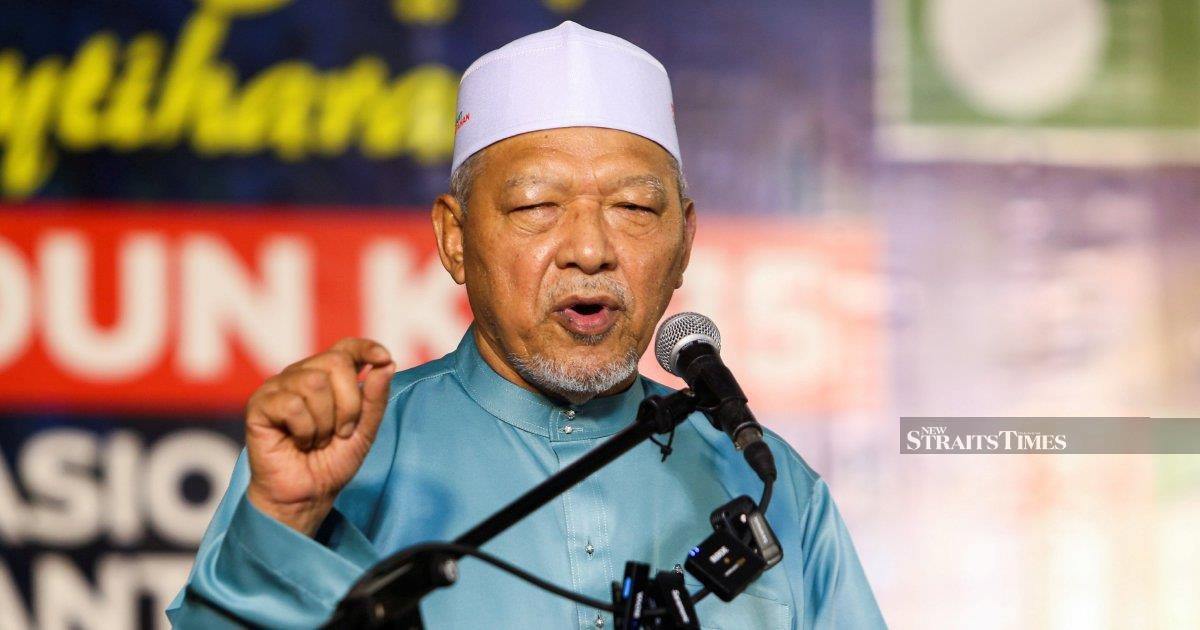
The Islamic party has taken a significant step toward consolidating its relationship with the coalition by endorsing a cooperative understanding with Barisan Nasional ahead of forthcoming state-level contests. At a gathering in Tumpat, PAS president Tan Sri Abdul Hadi Awang publicly confirmed that his party had agreed to coordinate its electoral strategy with BN in contests scheduled for Johor and Negri Sembilan, alongside making preparations for the subsequent Melaka election. The move represents a deepening of ties between two political entities whose relationship has undergone substantial evolution over recent years, signalling a shift in how Malaysian political alliances are being reconfigured.
Hadi's endorsement of these arrangements came on the heels of evaluating what he characterized as a "dangerous" political development facing the nation. Although the precise nature of this threat remained unelaborated in his public remarks, the assessment appears to have weighed heavily in the party leadership's decision-making process. The framing of this rationale underscores how Malaysian political calculations are often driven not merely by incremental advantage-seeking but by broader perceptions of systemic risk. For PAS, a party that has historically maintained ideological distance from BN's secular-oriented governance philosophy, such pragmatic cooperation signals that electoral mathematics and existential political concerns can override doctrinal considerations.
The Johor election assumes particular importance within this context, given the state's size, economic significance, and role as a barometer for national political sentiment. Johor has historically served as a stronghold for BN, though recent electoral cycles have demonstrated that no territorial advantage remains permanently secured in Malaysian politics. By aligning with the coalition in this crucial state, PAS appears to be placing a strategic bet that joint competition will prove more effective than fragmented candidacies. Negri Sembilan, meanwhile, presents a different political landscape where PAS cooperation with BN could reshape the existing balance of power between competing coalitions that have contested for influence over the state's legislative assembly.
The agreement regarding Melaka elections extends the partnership framework into a territory where timing and momentum will prove decisive. The scheduling of multiple state elections in rapid succession creates opportunities for either coalition to generate sustained electoral momentum or face cascading reversals. PAS's commitment to coordinate with BN across these three separate electoral contests suggests confidence that the partnership structure can deliver tangible benefits across diverse political environments, rather than functioning as a temporary arrangement confined to a single election cycle.
From a structural perspective, this pact reflects the broader realignment occurring within Malaysian politics following the 2022 general election. The landscape has become increasingly multipolar, with PKR, PAS, BN, and other coalitions jockeying for position in ways that defy simple ideological categorization. PAS's decision to work alongside BN challenges the notion that Malaysian political competition follows fixed, predictable patterns. The party has demonstrated willingness to operate tactically rather than being bound by historical affiliations or doctrinal purity, a pragmatism that extends its appeal to constituencies focused primarily on effective governance rather than abstract political philosophy.
Hadi's framing of a looming "dangerous" threat warrants scrutiny from observers attempting to understand PAS's strategic calculus. Whether this refers to opposition coalition strength, concerns about secular governance, internal party vulnerabilities, or a combination of factors remains open to interpretation. What seems clear, however, is that PAS leadership has determined that standalone competition carries greater risks than coordinated action with an established coalition. This calculation suggests confidence among party strategists that association with BN—despite its mixed electoral record in recent years—remains preferable to alternative arrangements.
The implications for Malaysian voters are substantial. Electoral pacts and pre-election understandings fundamentally alter the competitive dynamics that citizens encounter in polling booths. When parties agree beforehand to coordinate candidacies or campaign efforts, the theoretical universe of choices available to voters narrows, though it may simultaneously provide clearer alternatives in terms of contrasting governance visions. The PAS-BN arrangement means that in these three electoral contests, voters will encounter fewer multi-cornered fights and more head-to-head competitions between defined blocs.
For Southeast Asian observers monitoring Malaysian political development, the PAS-BN pact demonstrates how regional democracies navigate complex coalition politics. Unlike systems with rigid two-party structures, Malaysian politics requires continuous negotiation among multiple actors with overlapping but distinct constituencies and objectives. The fluidity demonstrated by PAS's strategic repositioning illustrates both the flexibility and potential fragility of these arrangements. Partnerships formed around shared concerns about specific threats may prove durable or ephemeral depending on how actual electoral outcomes unfold and whether the perceived threats materialize with anticipated severity.
The broader significance of Hadi's endorsement extends beyond the mechanics of candidate placement or campaign coordination. It signals to voters, party members, and other political actors that PAS has assessed the current political environment and determined that its interests align more closely with BN than with available alternatives. Whether this calculation proves strategically sound will become evident as the state elections unfold and voters register their preferences. The results will likely influence whether similar arrangements extend into subsequent electoral cycles or whether circumstances prompt another repositioning of these fluid political alignments.

