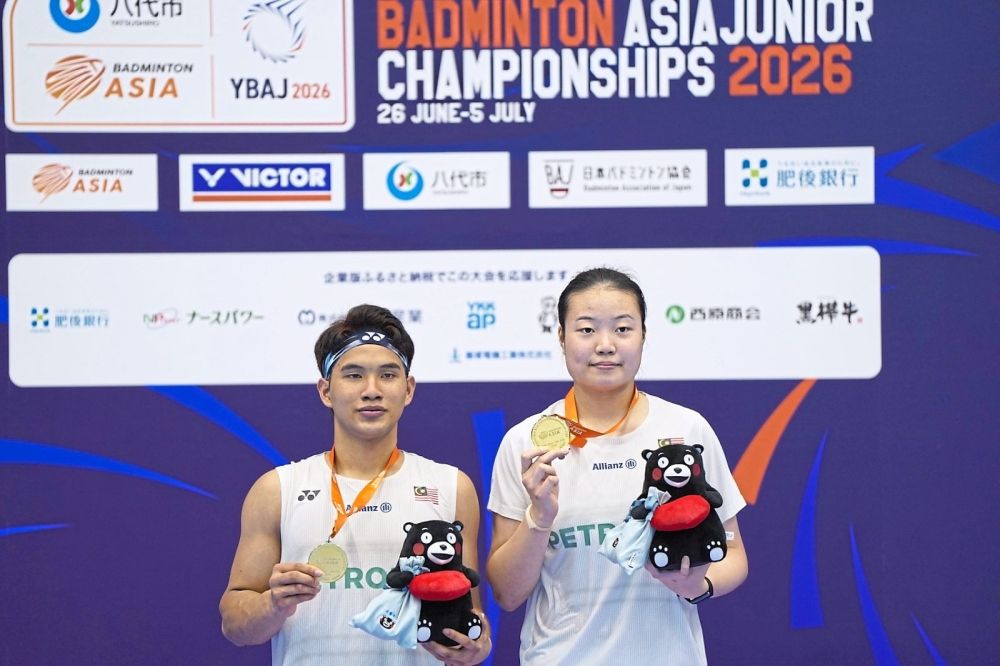
Ahmad Redzuan Zulwaqqarizal and Low Zi Yu have delivered a breakthrough triumph for Malaysian badminton by clinching the mixed doubles gold at the Asian Junior Championships in Yatsushiro, Japan. The victory represents a watershed moment for the country, ending an extended wait that stretches back nearly two decades to 2007, when Tan Wee Kiong and Woon Khe Wei last captured the title in Kuala Lumpur. The 21-15, 22-20 triumph over China's Zheng Weigang and Li Menghan, accomplished in 43 minutes of intense competition, signals renewed promise in a category where Malaysian excellence has become increasingly elusive at the junior level.
The path to victory proved far more arduous than the final scoreline might suggest, particularly during a second game that saw the Malaysian duo pushed to the brink of defeat. Trailing with just two points separating them from the championship, Redzuan and Zi Yu demonstrated the composure and mental fortitude required to overcome their rivals' spirited comeback attempt. The Chinese pairing refused to surrender gracefully, clawing back from a position of weakness to force the match into a decisive third game. Yet the Malaysians held firm when it mattered most, executing with precision during the crucial closing exchanges to secure their historic win.
Low Zi Yu, reflecting on the demanding contest, attributed their success to a combination of tactical discipline and psychological resilience that ultimately outweighed their opponents' physical prowess. According to the 15-year-old shuttler, the Malaysian pair possessed a sharper mental edge at critical junctures, particularly when both teams were locked at 20-20 in the second game. Beyond technical execution, Zi Yu highlighted an often-underestimated element of team success: the intangible boost provided by their supporting cast. Despite their own defeats in earlier rounds, Malaysian teammates continuing to cheer from the sidelines created an atmosphere of collective purpose that fortified the finalists' determination. This sense of unity and mutual support appears to have proven decisive in an otherwise closely contested affair.
For Ahmad Redzuan, the championship represents far more than a single trophy. The Terengganu-born shuttler endured three consecutive campaigns of acute disappointment at the Asian Junior Championships before breaking through. He first appeared in 2023 at the Yogyakarta edition, competing in both boys' doubles and mixed doubles, but neither event yielded encouraging results. The following year brought him back to Yogyakarta, where he again encountered early exits. Last year, at the Surakarta championship, history appeared to repeat itself with another premature departure. The cumulative weight of these setbacks could have discouraged a younger player, yet Redzuan persisted, eventually capitalizing on renewed training regimens and competitive experience to deliver when the stakes reached their highest. His measured post-victory statement reflected both satisfaction with technical execution and awareness that this accomplishment represents merely a milestone, not a ceiling, in his ongoing development as a competitor.
Redzuan's remarks about executing trained patterns and preparing for the next competitive level underscore a maturing attitude prevalent among Malaysia's emerging badminton talent. Rather than basking solely in the accomplishment, he acknowledged the necessity of continued refinement and progression toward senior-level competition. This perspective mirrors approaches adopted by successful sports systems that view junior championships as developmental platforms rather than final destinations. For Malaysian badminton, the significance lies partly in the victory itself and partly in the message it conveys about sustainable pathway construction for young athletes navigating from junior to professional circuits.
Low Zi Yu contributed additional silverware to Malaysia's medal haul through her girls' doubles partnership with Genevie Lim, claiming bronze after their semi-final loss to Japan's second-seeded Aoi Banno and Yuzu Ueno. The teenage Kuala Lumpur player demonstrated admirable competitive capacity by simultaneously contesting both mixed and girls' doubles events without apparent fatigue or performance degradation. When asked about the demands of juggling two categories, Zi Yu revealed the competitive advantage conferred by selecting reliable partners capable of independent court management. By trusting Lim and Redzuan to execute their responsibilities without constant guidance, Zi Yu freed her own focus to concentrate on personal tactical positioning and shot execution. Her tactical maturity—recognizing when to offer encouragement and when to prioritize individual performance—suggests capacities for leadership and self-awareness unusual in athletes of her age cohort.
The broader Asian Junior Championships results painted a picture of regional badminton supremacy concentrated primarily among Chinese and Japanese programs. Hong Tianyue of China prevailed in men's singles, overcoming Indonesia's Fardhan Joe 21-18, 21-19 in a competitive final. Taiwan's table tennis-inspired badminton tradition reasserted itself in men's doubles, where Huang Tzu-yuan and Lin Sheng-ming dispatched their domestic rivals Chen Ping-hsuan and Lee Wei-ting 21-10, 21-13 in a display of comfortable superiority. The women's singles category remained within Chinese control courtesy of Yin Yiqing's victory over compatriot Zhang Yixin 21-17, 21-15. Japan solidified its doubles pedigree by claiming both remaining gold medals: Aoi Banno and Yuzu Ueno captured women's doubles through a thrilling 21-13, 9-21, 23-21 victory against domestic rivals Ria Haga and Rio Yamakita.
Malaysia's solitary gold medal at the championships reflects both the intensity of competition at Asia's junior level and the specific strengths of the nation's mixed doubles programming. While individual medalists from other nations and categories demonstrated exceptional abilities, Redzuan and Zi Yu's triumph suggests that targeted investment and focused partnership development in mixed doubles continues yielding returns for the Malaysian Badminton Association. The absence of medals in other categories, however, signals potential areas requiring attention as the national federation evaluates performance gaps against East Asian competitors.
The 19-year championship gap ending at Yatsushiro provides Malaysian badminton stakeholders with renewed optimism, particularly regarding junior development trajectories. Since Tan Wee Kiong and Woon Khe Wei's 2007 victory, the mixed doubles category has become increasingly competitive, with Chinese and Japanese partnerships establishing consistent dominance across junior and senior levels. Redzuan and Zi Yu's breakthrough demonstrated that Malaysian pairings can still compete effectively against the region's elite, provided sufficient preparation quality, mental conditioning, and psychological composure converge. The challenge now extends beyond singular tournament victories toward sustaining pipeline consistency, ensuring that junior champions successfully transition into productive senior careers that maintain Malaysia's badminton relevance internationally.

