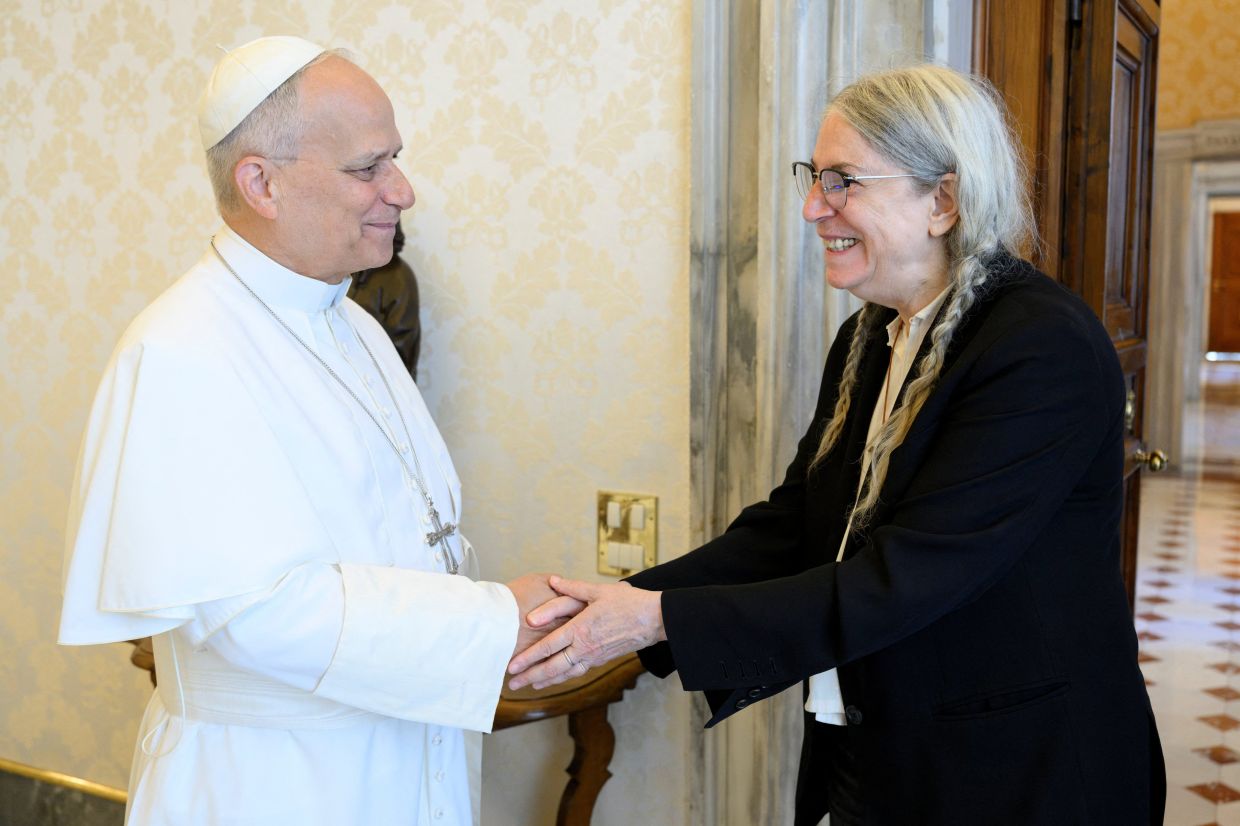
American rock icon Patti Smith found herself momentarily speechless during a private audience with Pope Leo XIV at the Apostolic Palace on Friday, a sign of the profound respect the musician holds for the pontiff. The encounter, which lasted approximately 40 minutes according to those present, represented far more than a ceremonial papal greeting—it embodied a genuine meeting of minds between two figures shaped by their shared Chicago heritage and their commitment to artistic expression as a vehicle for spiritual and humanitarian values.
Smith, dressed in her characteristic style complete with a crucifix necklace and her signature braided hair, has cultivated an increasingly prominent position within Vatican cultural circles over recent years. This visibility stems largely from her friendship with Rev Antonio Spadaro, the undersecretary of the Vatican's culture ministry, who arranged and attended Friday's audience. The relationship reflects how the Vatican has broadened its engagement with cultural figures beyond the boundaries of formal Catholicism, recognizing in artists like Smith kindred spirits committed to exploring the deeper dimensions of human experience.
Though Smith has consistently identified herself as someone outside the Catholic faith tradition, she has spoken eloquently about her profound attraction to recent papal leadership and its philosophical orientation. In particular, she has expressed deep admiration for the late Pope Francis, whose tenure she characterized as embodying a "gentle, open, and steadfast sense of humanity." This theological openness on Smith's part—her ability to find spiritual resonance with papal teaching without formal religious adherence—mirrors a broader contemporary phenomenon of secular and non-religious individuals finding moral and spiritual inspiration in the Catholic Church's evolving social and cultural messaging.
Smith's connection to the Vatican deepened through her participation in significant cultural moments. In May of this year, she performed during the official inauguration of the Holy See's pavilion at the Venice Biennale, one of the world's most prestigious contemporary art exhibitions. The timing of this appearance on May 8 held particular significance, as it coincided with the anniversary of Pope Leo XIV's election, suggesting careful coordination between Smith and Vatican officials to align her artistic contributions with important institutional moments.
The musician's relationship with papal leadership took on new dimensions following the death of Pope Francis on April 21, 2025. Smith responded to his passing not through conventional statements but through poetry, which serves as her primary vehicle for processing profound emotion. She shared verses on social media that compared the late pontiff to a dandelion—"humble yet strong"—and lamented that "nature and poetry and the suffering shall miss their champion." This characterization revealed Smith's understanding of Francis's papacy as fundamentally concerned with the voiceless, the marginalized, and those suffering at the peripheries of society.
Smith's previous encounters with Pope Francis had already established the depth of their connection. She first met Francis in 2013, early in his pontificate, and returned to perform for him the following year in 2014. These earlier interactions laid the groundwork for her continued engagement with the Vatican under Leo XIV's leadership, suggesting a continuity of vision and values between the two pontiffs that Smith evidently recognizes and respects.
According to Spadaro's account of Friday's audience, the encounter transcended the formal protocols typically associated with papal meetings. Rather than the usual ceremonial exchange, Spadaro described the meeting as "a conversation between two people discovering they were old friends, sharing memories woven from words and music, dreams, visions, and hopes—both from yesterday and for today." This characterization underscores how the Vatican under Leo XIV appears committed to fostering genuine intellectual and spiritual exchange with cultural figures, moving beyond symbolic gestures toward substantive dialogue.
The Pope's familiarity with Smith's musical catalogue became evident during their conversation. When Smith referenced one of her compositions, Leo XIV responded with evident knowledge and appreciation, affirming that the work "was marvelous." This exchange demonstrated that the Vatican's engagement with contemporary culture involves more than ceremonial recognition—it reflects actual familiarity with and appreciation for artistic contributions that explore spiritual and existential themes.
For Malaysian and Southeast Asian observers, Smith's Vatican presence carries particular relevance as it exemplifies how religious institutions globally are adapting to contemporary pluralism. In diverse, multicultural societies like Malaysia, where multiple faith traditions coexist and citizens navigate complex religious identities, the Vatican's openness to meaningful engagement with non-Catholic artists and thinkers offers a model of interfaith and cross-cultural dialogue. Smith's case demonstrates how spiritual and artistic values can create common ground across religious boundaries, a principle increasingly important in our interconnected region.
The Vatican's continued cultivation of relationships with cultural figures reflects a broader institutional strategy under Leo XIV to position the Catholic Church as a guardian not merely of doctrinal tradition but of humanistic values expressed through art, music, and literature. Smith's repeated appearances at Vatican events and private audiences signal the Church's recognition that contemporary influence flows through cultural channels as much as through institutional or political ones.
Interestingly, Pope Leo XIV's week of high-profile cultural engagement did not end with Smith's visit. Just days earlier, on July 29, the pontiff attended a concert honoring his papacy performed by celebrated Italian tenor Andrea Bocelli, further underlining his commitment to fostering connections between the Church and the world's artistic community. These orchestrated moments of cultural communion suggest a deliberate papal strategy to communicate that the Catholic Church remains a vital force in contemporary global culture, capable of inspiring and being inspired by the world's greatest creative minds.
Smith's continued gravitational pull toward the Vatican, despite her stated distance from Catholic doctrine, speaks to something deeper: the enduring human hunger for institutional spaces that grapple seriously with questions of meaning, suffering, justice, and transcendence. In an era of fragmenting communities and declining institutional trust, the Vatican's success in attracting figures like Smith suggests that authenticity, moral consistency, and genuine engagement with artistic and intellectual traditions remain powerful draws, even across theological divides.

