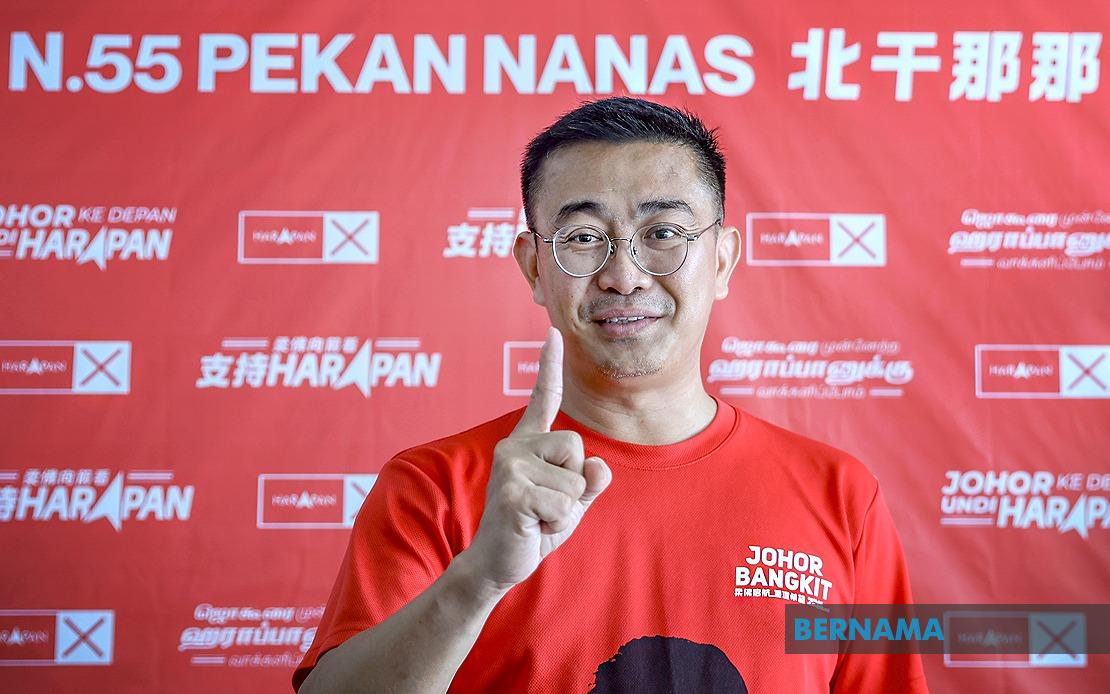
Yeo Tung Siong, the Pakatan Harapan candidate contesting the Pekan Nanas state constituency in the latest Johor election, is banking substantially on his nine-year tenure as the seat's representative to convince voters to return him to office. The former assemblyman and experienced educator believes his previous service provides the foundation for a political comeback, particularly after devoting considerable effort to door-to-door campaigning and community engagement throughout the nomination period.
During his two consecutive terms representing Pekan Nanas between 2013 and 2022, Yeo established a reputation for accessibility and responsiveness to constituent concerns. Rather than operating from behind formal barriers, he actively positioned himself as an approachable representative willing to address grievances directly. This philosophy appears to have translated into his current campaign strategy, which emphasises personal contact and visible presence within the constituency across diverse venues and community settings.
Yeo has claimed remarkable penetration in his canvassing efforts, reporting that approximately 60 per cent of eligible voters have encountered him through various campaign mechanisms. His engagement encompasses traditional neighbourhood walks, organised community discussions, smaller group meetings within residential areas, visits to household units, and appearances at informal commercial spaces where residents congregate. The candidate reports receiving uniformly positive feedback from these interactions, suggesting that his message of proven service experience is resonating with voters evaluating their electoral choices.
The approach reflects a deliberate strategy to differentiate himself through demonstrated accomplishment rather than rhetoric alone. Yeo explicitly frames his candidacy around tangible achievements, pointing to specific infrastructure improvements executed during his previous tenure. A substantial government allocation of RM500,000 was secured for river management works along the Pulai River, addressing a chronic flooding vulnerability that had afflicted the constituency for many years. Additionally, he collaborated with private sector partners to implement drainage infrastructure improvements around Kampung Melayu Raya, demonstrating the capacity to leverage both government resources and business partnerships toward constituent benefit.
The constituency faces persistent challenges that continue to preoccupy residents and feature prominently in electoral discourse. Traffic congestion and limited employment opportunities emerge as the principal concerns articulated repeatedly during Yeo's campaign interactions. These issues carry particular significance in Pekan Nanas given the area's proximity to major urban centres and the aspirations of working-age residents seeking stable livelihoods and economic advancement. Addressing these interconnected challenges requires sustained effort and strategic thinking that extends beyond rhetorical commitments.
Should voters grant Yeo the mandate he seeks, he has outlined concrete development priorities intended to ameliorate transportation challenges. Two specific road projects feature prominently in his platform: a shortcut route linking Ulu Pulai to Pekan Nanas and an alternative thoroughfare connecting Pulai to the Sri Bunian junction. These complementary infrastructure initiatives, if realised, would substantially compress travel times between Pontian and Johor Bahru, generating efficiency gains for commuters and potentially stimulating economic activity through improved connectivity to adjacent urban markets. The strategic focus on transportation reflects sophisticated understanding of the constituency's geographical positioning and the economic constraints imposed by inadequate road networks.
Regarding employment generation, Yeo proposes revitalising a career fair programme that he previously organised during his earlier tenure as assemblyman. The initiative involved partnership with substantial regional employers to present job opportunities to local residents. Reconstituting this mechanism would directly address the recurring complaint about constrained livelihood prospects while fostering productive engagement between workers and major enterprises operating in the Pekan Nanas area. The proposal demonstrates how previous experience can be adapted to continuing constituent needs rather than reimagined from scratch.
Yeo has also committed to ensuring that vulnerable populations receive appropriate assistance through established governmental welfare machinery. The Social Welfare Department, the Social Security Organisation, and other specialised institutions possess mandates and resources to support those requiring intervention. The candidate's intention to facilitate more effective utilisation of these formal mechanisms suggests recognition that grassroots political activity must complement and activate professional social service infrastructure rather than attempting to substitute for it.
The Pekan Nanas constituency presents a direct two-candidate contest between Yeo representing the opposition coalition and Tan Eng Meng from Barisan Nasional, the incumbent seeking to retain the seat. This straightforward matchup reflects broader political dynamics within Johor, where the coalition system and geographic distribution of support produce distinct competitive configurations across different constituencies. The binary choice facing voters provides clear alternatives with markedly different track records and political alignments.
For Malaysian political observers, the Pekan Nanas contest exemplifies how candidates leverage previous service records, particularly when continuity has been interrupted and electoral opportunity permits attempted reinstatement. Yeo's campaign fundamentally rests on demonstrating that prior accomplishments and constituent relationships accumulated over nine years have sufficient salience to overcome the disadvantage of having been absent from office for the intervening period. His emphasis on measurable achievements and systematic voter engagement suggests a strategy calibrated toward constituencies where performance-based evaluation might outweigh other electoral considerations. The outcome in Pekan Nanas will provide insight into whether Malaysian voters in this particular seat value experienced governance and documented results over alternative appeal mechanisms.

