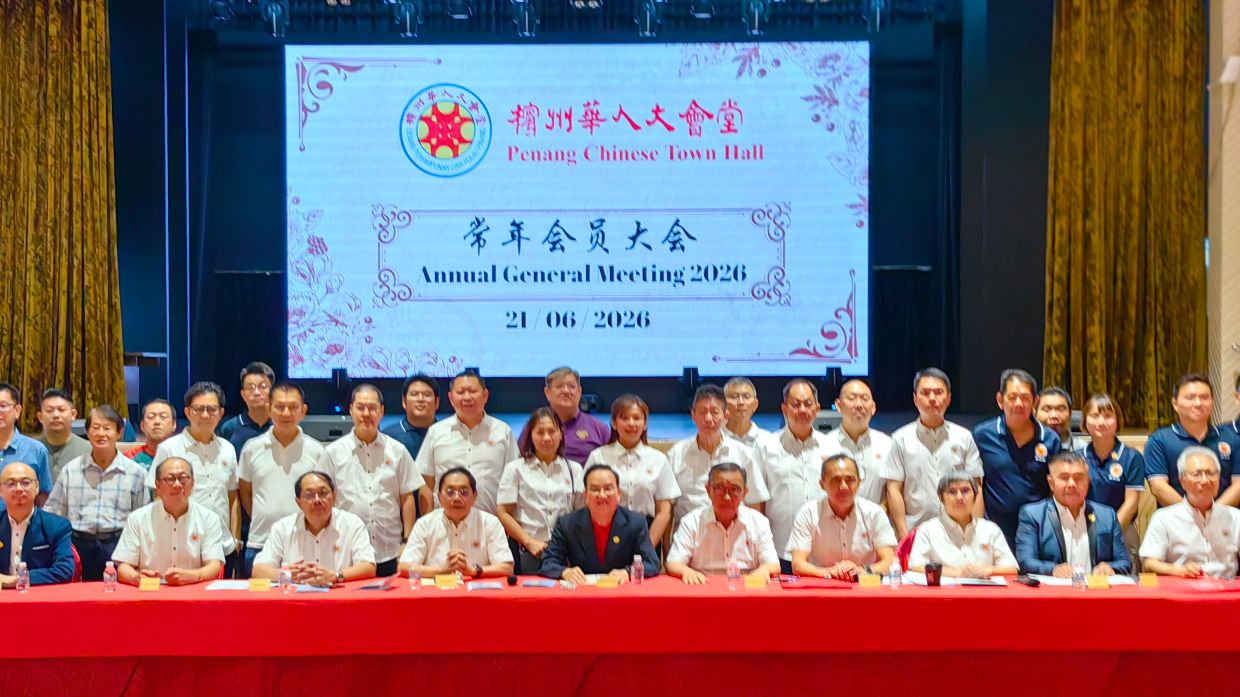
Penang Chinese Town Hall has closed its financial year with healthy fundamentals, declaring total income of RM12.61mil against spending of RM12.55mil for the twelve months ending December 31, 2025. The organisation's bottom line reflected careful stewardship, leaving a surplus of RM59,191 that demonstrates stable operations despite the challenging economic environment facing cultural and community institutions across Malaysia.
The revenue composition reveals heavy reliance on philanthropic support, with donations representing RM11.24mil of the intake—nearly 89 percent of total income. Secondary revenue streams proved more modest in scale: rental and maintenance charges yielded RM439,671 while auditorium bookings brought in RM361,245, underscoring the venue's importance as a community gathering space. Anniversary-related receipts contributed a further RM222,498. This diversified but donation-dependent funding structure is typical of longstanding cultural organisations in Malaysia, where community backing remains essential to operational sustainability.
Expenditure patterns closely tracked revenue sources, with charitable contributions consuming the lion's share of resources. PCTH distributed RM11.12mil in donations during 2025, representing approximately 88.6 percent of total spending. This figure actually declined from RM12.35mil in the previous year, suggesting either more targeted donation practices or reduced funding requests from beneficiary organisations. Operating costs edged upward, with salaries and allowances increasing to RM502,625 from RM452,761 in 2024—a rise reflecting inflationary pressures on human resources across the non-profit sector.
At its annual general meeting held on June 21 with some 200 members present, PCTH chairman Tan Sri Prof Tan Khoon Hai struck a civic note beyond the traditional annual report presentation. He encouraged Malaysians to exercise their electoral responsibilities thoughtfully, particularly given upcoming state elections in Johor and Negeri Sembilan scheduled for 2025. His remarks reflected growing emphasis among community leaders on voter engagement and informed democratic participation, themes that resonate across Southeast Asia as the region navigates political cycles and institutional development.
Tan Sri Prof Tan framed elections as moments of profound national consequence rather than local administrative exercises, urging voters to evaluate parties' track records and policy proposals with analytical rigour. He identified three qualities essential to candidates seeking electoral support: demonstrated commitment to social cohesion, capacity to stimulate economic expansion, and dedication to preserving social order. These themes align with broader governance concerns animating policy discussions in Malaysia, where post-pandemic recovery depends on political stability and investor confidence.
The Penang institution simultaneously showcased tangible renewal through the upgraded Ping Zhang Hall, which has undergone comprehensive renovation and modernisation. The enhanced venue now features improved spatial configuration, refined comfort standards, and contemporary audio-visual infrastructure including professional sound, lighting and LED systems. Leadership positioned the renovated facility as versatile event infrastructure suitable for corporate functions, association gatherings, commemorative celebrations, philanthropic occasions and miscellaneous assemblies—essentially repositioning PCTH as competitive infrastructure provider within Penang's event management ecosystem.
Beyond heritage preservation and community service, PCTH is positioning itself at the intersection of regional technological advancement. The organisation will co-organise the 2026 China-Asean Artificial Intelligence Cooperation Forum in Penang during November, alongside partner organisations from China and Southeast Asian countries. This initiative marks strategic repositioning, leveraging Penang's established reputation as a technology manufacturing centre—colloquially termed the Silicon Valley of the East—and the state's foundational strengths in electrical and electronics production.
Penang's manufacturing credentials are well-established within global supply chains, but the AI cooperation initiative signals ambitions to move beyond component production toward technological leadership and intellectual contribution. The planned forum will convene research specialists, corporate executives and sector practitioners from across the region to examine emerging AI applications, commercial deployment scenarios and mechanisms for cross-border technological collaboration. Such platforms typically generate valuable networking connections, knowledge transfer and investment interest from regional technology funds seeking expansion opportunities.
Tan Sri Prof Tan characterised the forum as offering a prestigious venue for technological dialogue and regional partnership building, explicitly inviting PCTH members possessing relevant technical expertise to engage with the initiative. His framing suggests recognition that Penang's future competitiveness depends on deeper integration into regional innovation networks rather than continued focus solely on manufacturing. For Malaysia more broadly, the initiative reflects how established community institutions are adapting to support national positioning within emerging technology sectors—a strategic imperative as Southeast Asian economies seek competitive advantages in artificial intelligence development and deployment.
The modest annual surplus, venue modernisation and regional technology initiative together illustrate institutional evolution at work. PCTH is managing traditional community responsibilities while simultaneously positioning Penang for expanded roles in regional technology cooperation. This dual orientation reflects how cultural and business organisations across Southeast Asia are responding to changing economic circumstances and technological disruption by diversifying activities and seeking platforms for expanded influence beyond their immediate constituencies.
%22%2F%3E%3C%2Fpattern%3E%3C%2Fdefs%3E%3Crect%20width%3D%22100%25%22%20height%3D%22100%25%22%20fill%3D%22url(%23ph3ryapg)%22%2F%3E%3Crect%20width%3D%22100%25%22%20height%3D%22100%25%22%20fill%3D%22url(%23ph3ryapp)%22%2F%3E%3Ctext%20x%3D%2250%25%22%20y%3D%2250%25%22%20text-anchor%3D%22middle%22%20dominant-baseline%3D%22central%22%20fill%3D%22rgba(255%2C255%2C255%2C0.95)%22%20font-family%3D%22Georgia%2C%20'Times%20New%20Roman'%2C%20serif%22%20font-weight%3D%22700%22%20font-size%3D%22272%22%20letter-spacing%3D%22-0.02em%22%3EFahmi%3C%2Ftext%3E%3C%2Fsvg%3E)
%22%2F%3E%3C%2Fpattern%3E%3C%2Fdefs%3E%3Crect%20width%3D%22100%25%22%20height%3D%22100%25%22%20fill%3D%22url(%23ph46dodg)%22%2F%3E%3Crect%20width%3D%22100%25%22%20height%3D%22100%25%22%20fill%3D%22url(%23ph46dodp)%22%2F%3E%3Ctext%20x%3D%2250%25%22%20y%3D%2250%25%22%20text-anchor%3D%22middle%22%20dominant-baseline%3D%22central%22%20fill%3D%22rgba(255%2C255%2C255%2C0.95)%22%20font-family%3D%22Georgia%2C%20'Times%20New%20Roman'%2C%20serif%22%20font-weight%3D%22700%22%20font-size%3D%22320%22%20letter-spacing%3D%22-0.02em%22%3E70%3C%2Ftext%3E%3C%2Fsvg%3E)