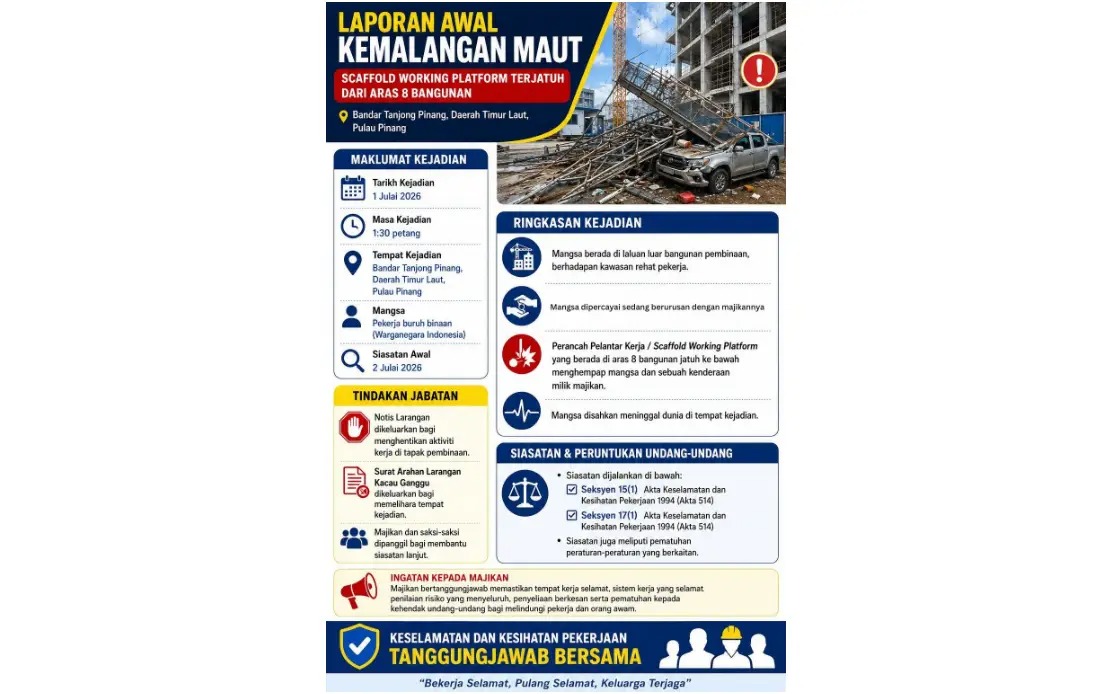
The Department of Occupational Safety and Health (DOSH) in Penang has taken swift enforcement action by issuing a prohibition notice to suspend all work activities at a construction site in Bandar Tanjong Pinang following a tragic workplace fatality that occurred on July 1. The fatal incident, which claimed the life of an Indonesian construction worker, has triggered a comprehensive investigation into whether safety protocols were properly observed and whether responsible parties complied with the relevant occupational safety legislation.
According to preliminary accounts of the accident, the worker was positioned on an external walkway at a lower level of the building, outside the designated workers' rest area, when he was struck by a scaffolding working platform that detached from the eighth floor and fell. The falling structure not only killed the worker but also damaged a vehicle belonging to his employer. The timing of the incident at 1.30 pm places it during the afternoon work period when construction sites typically maintain full operational activity, potentially increasing the number of workers in the vicinity.
The regulatory response from Penang DOSH reflects the severity with which Malaysian authorities are treating workplace safety violations. Beyond the immediate work stoppage order, officials have also implemented a non-disturbance order to preserve the accident scene in its original condition. This measure is critical for forensic analysis and reconstruction of the events leading up to the collapse, allowing investigators to gather physical evidence before the site is altered or cleaned up by contractors. Such preservation efforts often reveal crucial details about whether safety barriers were in place, whether warning signs were posted, and whether maintenance records indicated any prior issues with the scaffolding system.
Investigations are currently examining whether employers and contractors fulfilled their legal obligations under the Occupational Safety and Health Act 1994 (Act 514), specifically focusing on compliance with Sections 15(1) and 17(1). These sections typically mandate that employers must ensure, so far as reasonably practicable, the safety of workers and others affected by their operations. The investigation process involves interviewing employers, witnesses, and other personnel who were present at or near the site during the incident. Regulatory authorities are also likely examining maintenance records, equipment certifications, training documentation, and the chain of responsibility among the main contractor and any subcontractors involved in the project.
The fatal accident in Bandar Tanjong Pinang underscores persistent challenges within Malaysia's construction industry, where workplace incidents involving migrant workers remain a significant concern. Indonesian nationals comprise a substantial portion of the construction labour force in Malaysia, and this incident raises questions about whether language barriers, unfamiliarity with local safety standards, or inadequate supervision may have contributed to the tragedy. The positioning of the worker on an external walkway rather than within a properly cordoned work area suggests potential gaps in site management and hazard communication.
Penang DOSH has made clear that enforcement action will be pursued if investigations reveal violations of occupational safety provisions. This warning carries weight, as Malaysian regulators can impose substantial fines on companies and individuals found culpable in fatal workplace accidents. In previous high-profile cases, courts have issued penalties exceeding one million ringgit, alongside criminal liability for company directors and safety officers who fail in their duty of care. The prospect of enforcement action creates incentives for all stakeholders—developers, contractors, and subcontractors—to review their safety management systems and ensure compliance across their operations.
The incident also prompts reflection on the adequacy of current scaffolding safety standards in Malaysia. Temporary working platforms and scaffolding systems are among the most commonly cited sources of workplace fatalities in the construction sector across Southeast Asia. Proper design, installation, inspection, and maintenance of scaffolding require expertise and adherence to engineering specifications, yet cost pressures and tight project timelines sometimes lead contractors to compromise on safety measures. The question of whether the Bandar Tanjong Pinang scaffolding system was designed and installed in accordance with relevant standards, whether it had undergone periodic inspection, and whether any defects had been identified and remedied will likely form core elements of the investigation.
For Malaysian construction companies and developers, this incident serves as a stark reminder of both the human cost of safety lapses and the legal and financial consequences of workplace accidents. The construction industry remains one of Malaysia's economic drivers, employing hundreds of thousands of workers directly and indirectly, yet fatality rates continue to exceed international benchmarks. Industry associations and regulatory bodies have repeatedly called for stronger safety culture, better training, and more rigorous enforcement, but progress requires commitment from all parties involved in project delivery.
The stop-work order issued by Penang DOSH will remain in effect until investigations conclude and any violations have been addressed. Depending on the findings, the site operator may be required to implement corrective actions, resubmit safety plans for approval, or conduct additional worker training before resuming work. Contractors operating in Penang and throughout Malaysia should view this case as a critical juncture and an opportunity to audit their own safety practices, particularly regarding temporary working structures, worker positioning, and supervision protocols. The loss of life is irreversible, but learning from such tragedies and strengthening preventive measures can protect future workers across the region's construction sites.

