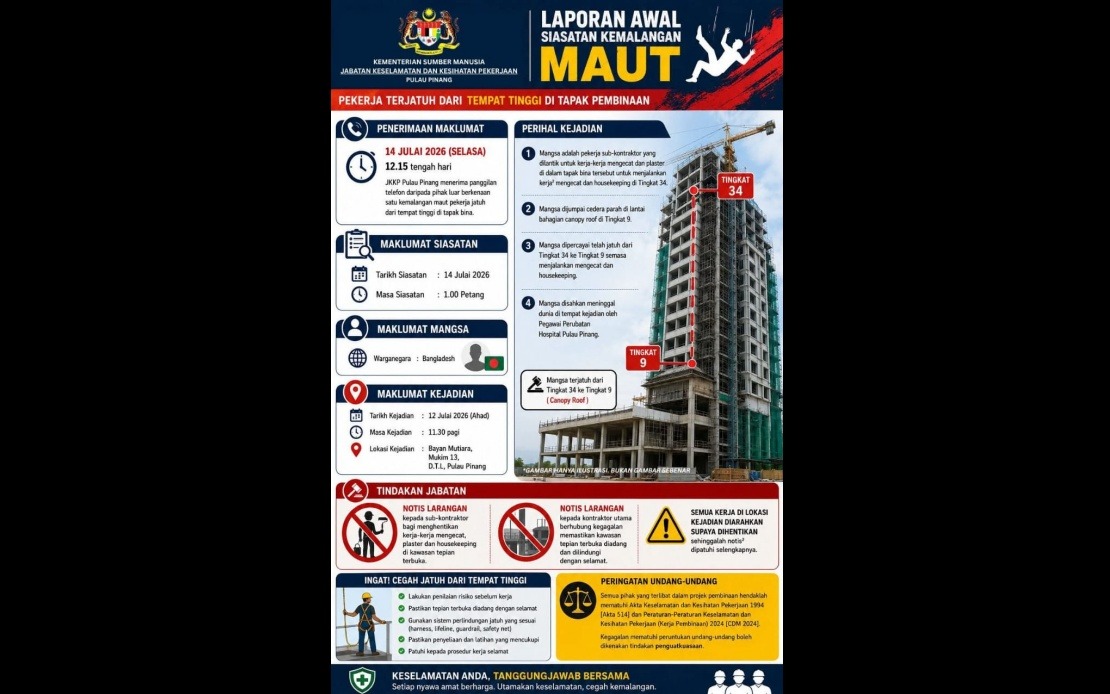
A Bangladeshi construction worker has died following a fall at a building site in Bayan Mutiara, Penang, sparking an immediate investigation by the state's Department of Occupational Safety and Health. The fatality represents the latest in a series of workplace accidents in Malaysia's construction sector, a sprawling industry that employs hundreds of thousands of migrant workers alongside local staff. Authorities confirmed the worker succumbed to injuries sustained in the incident, which has triggered a comprehensive inquiry into safety protocols at the project.
The Penang DOSH received notification of the accident on the afternoon of July 15, with investigators reaching the site within hours. Penang DOSH director Hairozie Asri disclosed that the victim had been engaged as part of a subcontracting team responsible for painting, plastering, and finishing work. According to preliminary findings, the worker was stationed on the 34th floor when the incident occurred, with his body subsequently discovered on a canopy roof structure at Level 9—a vertical distance that underscores the severity of the fall.
Medical professionals stationed at Penang Hospital attended the scene and pronounced the worker deceased. The incident has cast renewed attention on safety management systems within Malaysia's construction industry, particularly regarding the protection of migrant workers who make up an estimated 30 to 40 percent of the construction workforce. The circumstances of the fall raise questions about fall-protection measures, including harness systems, scaffolding integrity, and site-specific safety training that should be in place on high-rise projects.
In response to the fatality, regulatory authorities moved swiftly to restrict operations. The DOSH department served a prohibition notice on the subcontractor, explicitly forbidding the continuation of painting, plastering, and housekeeping activities in any open-edge or exposed areas. A separate prohibition order was issued to the main contractor overseeing the overall project. These enforcement actions represent a standard regulatory response designed to prevent further incidents while investigations proceed.
All work activities connected to the accident location have been halted entirely, with the department maintaining that resumption of operations is conditional upon full compliance with the issued prohibition notices. This measure ensures that investigators can preserve the accident scene and conduct thorough examinations without the complication of ongoing construction activity. The cessation also signals to other contractors and workers that safety compliance is non-negotiable in Malaysia's regulatory framework.
The incident highlights systemic challenges within Malaysia's construction sector regarding migrant worker safety. Many migrant workers, particularly those from South Asia, face language barriers that can impede their understanding of safety protocols and hazard communication. Additionally, economic pressures and employment precarity sometimes discourage workers from reporting unsafe conditions or refusing to work in hazardous circumstances, creating vulnerability to accidents that might otherwise be preventable.
Bayan Mutiara, located in George Town, has undergone substantial development in recent years, with multiple high-rise residential and commercial projects transforming the skyline. These construction activities have generated employment opportunities but have also exposed gaps in occupational safety management. The focus on speed and cost efficiency in the construction industry can occasionally overshadow safety considerations, particularly on subcontracted work where accountability may be diffused across multiple layers of contractors and subcontractors.
The Malaysian government has periodically intensified efforts to strengthen occupational safety standards, recognizing that workplace fatalities carry economic, social, and humanitarian costs. The government's Social Security Organization and DOSH collaborate to enforce the Occupational Safety and Health Act, with penalties ranging from fines to imprisonment for serious violations. However, enforcement remains inconsistent across sectors and states, with resource constraints affecting inspection frequency and thoroughness.
For Malaysia's substantial migrant worker population, this tragedy underscores the importance of robust pre-employment safety training, multilingual hazard communication, and genuine worker empowerment to report unsafe conditions without fear of retaliation or employment termination. Industry bodies and employers have been encouraged to adopt international best practices in fall prevention, including universal harness requirements for work at heights exceeding certain thresholds, regular safety audits, and dedicated on-site safety personnel with appropriate qualifications.
The investigation will likely examine multiple factors including whether the worker received adequate safety training, whether appropriate fall-protection equipment was available and properly maintained, and whether site supervisory staff had implemented adequate monitoring systems. Questions will also arise regarding whether the subcontractor possessed appropriate certifications and insurance coverage, and whether the main contractor had established adequate oversight mechanisms to ensure subcontractor compliance with safety requirements.
This incident serves as a reminder that Malaysia's economic growth through construction development requires parallel investment in safety culture and regulatory effectiveness. Each preventable workplace death represents not only personal tragedy for workers and their families but also a signal of systemic inadequacy that demands correction. Moving forward, stakeholders across government, industry, and labour organizations will need to collaborate in addressing the root causes that make construction one of Malaysia's most hazardous occupational sectors.

