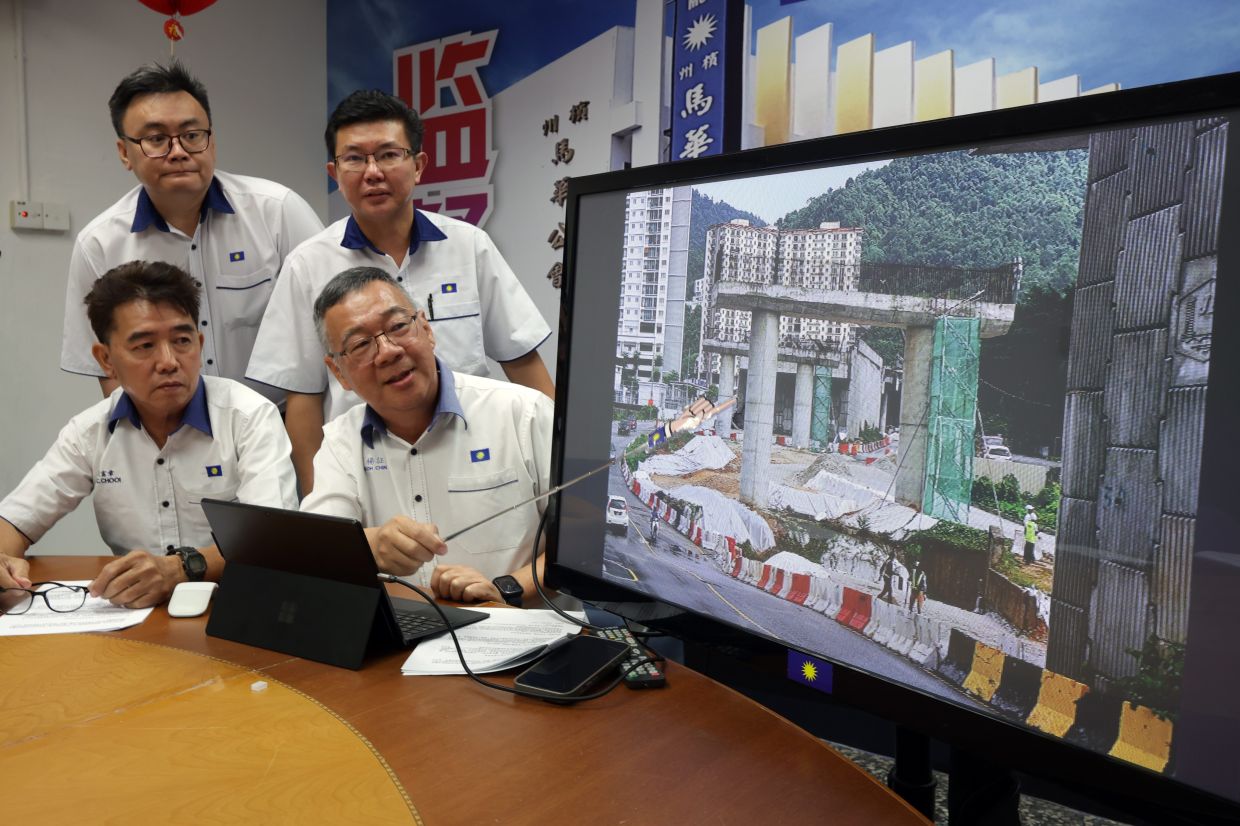
The Penang chapter of the Malaysian Chinese Association has escalated pressure on the Penang state government to account for delays and apparent discrepancies in the construction of the Air Itam-Tun Dr Lim Chong Eu Expressway bypass, transforming what began as a project management concern into a broader question of governmental accountability and public trust. Secretary Yeoh Chin Kah has issued a pointed ultimatum: the authorities must produce payment records, consultant certification documents, and project assessments within seven days, or face formal complaints to both the National Audit Department and the Malaysian Anti-Corruption Commission.
The underlying tension stems from a widening gap between official progress claims and what MCA members have observed during ground inspections. When Penang MCA representatives visited the construction site on July 1, they documented substantial incomplete work across multiple critical sections, including Valley Road, Changkat Tembaga, and Jalan Thean Teik. Their findings present a stark contrast to state government statements characterising the endeavour as entering its "final sprint"—a description that sits uneasily with photographs and reports showing skeletal bridge piers standing without deck structures, unfinished road surfaces, and numerous mechanical, electrical, and connecting road works still in preliminary stages.
Yeoh has zeroed in on what he views as a credibility problem rather than merely a scheduling setback. The jump from 80 per cent completion recorded in May to 89 per cent by December appears suspiciously rapid given the visible quantum of work remaining, raising the question of whether progress metrics accurately reflect construction reality or whether reporting standards lack rigour. This distinction matters profoundly for residents in Air Itam, Bandar Baru Air Itam, and Paya Terubong, who have waited years for relief from traffic congestion that currently burdens approximately 300,000 people in these neighbourhoods.
The 6-kilometre toll-free bypass, officially known as Package Two of the broader Penang undersea tunnel and paired roads initiative, represents a significant component of the state's long-term transport infrastructure strategy. Originally scheduled for delivery in 2024, the project has already absorbed two time extensions, with completion now targeted for April 12, 2027—three years past the initial deadline. The bypass will integrate elevated viaducts, underground tunnels, and ground-level roads to create a continuous link between Lebuhraya Thean Teik in Bandar Baru Air Itam and the Tun Dr Lim Chong Eu Expressway, fundamentally reshaping traffic patterns across the northern corridor.
In response to MCA's accusations, Paya Terubong assemblyman Wong Hon Wai offered a more optimistic assessment, asserting that construction has reached 91 per cent completion and remains aligned with the April 2027 deadline. Wong cited a June 30 meeting with the construction team and outlined upcoming milestones, including the launching of 12 bridge beams on the Gelugor side between July and August, with six additional beams scheduled for the final quarter of the year. He also confirmed that all bridge beams on the Bandar Baru Air Itam side have already been installed, signalling that the project has passed certain structural checkpoints.
However, Wong's comments inadvertently underscored why scepticism persists among critics. The assemblyman acknowledged that even upon completion of construction work, the road will not immediately open to the public. Instead, the relevant government agency must conduct a Road Safety Audit, after which the Public Works Department will determine the actual opening date based on audit findings. This sequential process introduces additional uncertainty and potential for further delays beyond the April 2027 construction deadline, a nuance that tends to escape public announcements emphasising target completion dates.
The dispute reflects broader governance questions facing Malaysian infrastructure projects, where discrepancies between reported progress and observable reality have repeatedly emerged as flashpoints for public concern. For Southeast Asian readers and regional observers, the Penang bypass controversy emblematises the challenges that democratic governments face in managing large-scale construction initiatives transparently. When official statistics diverge significantly from on-site conditions, public confidence erodes regardless of contractual technicalities or explanations from project management teams.
MCA's decision to establish a special monitoring committee indicates the party views the issue as sufficiently serious to warrant sustained oversight. The threat to escalate complaints to anti-corruption authorities also signals that party leadership suspects potential misconduct beyond mere incompetence or optimistic forecasting. Whether such concerns prove substantiated or whether they reflect political positioning ahead of local elections remains to be determined, but the ultimatum has placed the state government on notice that transparency demands can no longer be deferred.
For the residents most directly affected by this project, the extended timeline translates into continued congestion, longer commute times, and deferred economic benefits that a functioning bypass would bring. Air Itam, Bandar Baru Air Itam, and Paya Terubong have become focal points for examining how Penang—often cited as a relatively well-governed Malaysian state—manages accountability when projects slip schedules. The coming week will be revealing: if the state government produces comprehensive documentation that satisfactorily explains the completion percentages, public confidence may stabilise. If documents are withheld or explanations prove inadequate, MCA's escalation strategy will likely catalyse wider scrutiny from media, civil society groups, and potentially opposition coalitions seeking ammunition for broader governance criticism.

