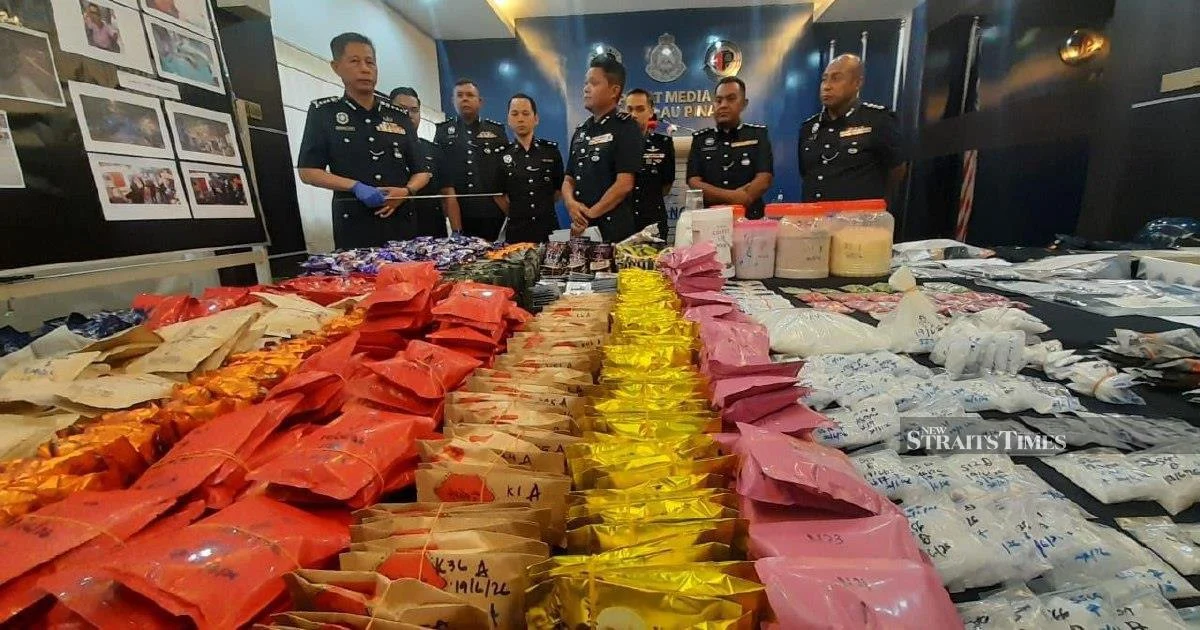
Penang police have dismantled what investigators describe as a significant drug manufacturing and trafficking operation after moving in on a residential unit in Butterworth, resulting in the arrest of a couple and the seizure of illegal substances worth RM9.7 million. The operation, which appears to have been coordinated from within a condominium complex in the industrial heartland adjacent to George Town, represents one of the larger busts the state has recorded in recent enforcement action against organised drug networks.
The investigation, which culminated in the arrests and seizures, points to an increasingly sophisticated approach among drug syndicates operating across Penang. Rather than operating from marginal locations, organised groups are now embedding themselves within residential properties in developed areas, potentially to exploit the perceived legitimacy and lower police visibility that comes with apartment-based operations. The Butterworth location, situated at the strategic intersection of Seberang Perai's industrial zones and commuter corridors, provides traffickers convenient access to distribution routes across the northern corridor while maintaining a facade of residential normalcy.
The scale of the haul—nearly RM10 million in street value—underscores the substantial profit margins driving the narcotics trade in Malaysia's northern regions. These margins remain extraordinarily attractive to criminal networks despite escalating enforcement efforts and lengthening prison sentences for trafficking convictions. The ability of syndicates to accumulate such quantities in a single location suggests either a centralised processing hub serving multiple retail dealers or a preparation point for bulk distribution to secondary markets, potentially including interstate operations.
For Malaysian law enforcement, the Penang seizure reinforces patterns observed in recent years whereby drug processing operations have migrated from traditional hotspots to residential environments. This shift complicates police work significantly, as residential compounds offer operational concealment within plain sight. Neighbours, building management, and casual observers are far less likely to report suspicious activity in apartment blocks compared to abandoned warehouses or rural manufacturing sites. The condominium setting also provides the operators with ready access to utilities, waste disposal, and the anonymity that comes with high residential turnover.
The arrest of the couple raises questions about the hierarchical structure within this particular operation. Whether the two individuals functioned as primary operators, mid-level supervisors, or specialist components in a larger supply chain will become clearer as investigations progress. Malaysian narcotics cases frequently reveal that residential operations employ this model: a core couple handles domestic manufacturing or repackaging, while external networks manage sourcing raw materials and handling retail distribution, thereby compartmentalising the criminal enterprise to limit exposure if one segment faces police action.
Penang's position as a logistics and manufacturing hub in Malaysia's northwest corridor has long made it attractive to drugs syndicates. The state's proximity to Kuala Lumpur, combined with established infrastructure and transport corridors extending into Thailand and across the Strait of Malacca, creates natural advantages for trafficking operations. Recent years have seen consistent enforcement pushes against major syndicates, yet the persistence of large operations like the one uncovered in Butterworth suggests that supply disruptions are temporary rather than structural. As long as consumer demand remains robust and profit incentives remain compelling, new networks fill the voids created by police action.
The condominium-based approach also reflects adaptation by traffickers to the reality of enhanced checkpoint enforcement on major roads. Rather than transporting bulk quantities across state boundaries through conventional border crossings, syndicates increasingly rely on decentralised processing and smaller shipments routed through less scrutinised pathways. A processing hub in a Butterworth residential unit potentially serves this function: raw materials arrive in manageable quantities, are processed or repackaged into retail units, then distributed through informal networks and courier systems that law enforcement finds inherently difficult to monitor comprehensively.
For resident communities in areas where such operations take root, the discovery raises uncomfortable questions about proximity to criminal activity. Condominiums housing hundreds or thousands of residents create operational challenges for police surveillance precisely because routine activity provides cover for illicit operations. The couple's arrest will prompt building management and authorities to consider enhanced vetting procedures, though such measures face practical limitations in an open residential market where property transactions occur through multiple channels and verification often remains cursory.
The seizure value—RM9.7 million—reflects calculations based on street-level retail pricing rather than wholesale cost, meaning the actual manufacturing and acquisition cost for the seized material was likely substantially lower, perhaps 20 to 30 percent of that figure. This pricing methodology, while standard for law enforcement reporting, can create a distorted public perception of the operation's actual profitability. Nevertheless, even at conservative wholesale valuations, the operation represented a genuinely significant commercial enterprise, suggesting either extended operation before police moved in or very rapid accumulation of inventory.
The Penang operation also highlights the challenge Malaysian authorities face in balancing prevention with enforcement. Police interdiction methods have improved considerably, yet they remain reactive by nature—responding to specific intelligence rather than preventing emergence of new syndicates. The evolution toward residential-based processing suggests that organised criminals are learning from previous operations, becoming more mobile and diffuse in their operational footprint. For policymakers, this trend points toward the necessity of more sophisticated intelligence-gathering approaches and possibly enhanced regulatory oversight of residential property management to identify suspicious patterns.
Moving forward, investigators will need to trace connections between this Butterworth operation and any broader distribution networks. The quantity seized suggests this was not simply a retail operation serving local consumers but rather a significant node in a supply chain extending potentially across the region. Intelligence derived from the couple's arrest—communications records, financial transactions, operational contacts—will likely prove as valuable as the physical seizure in disrupting the larger network these individuals were servicing.