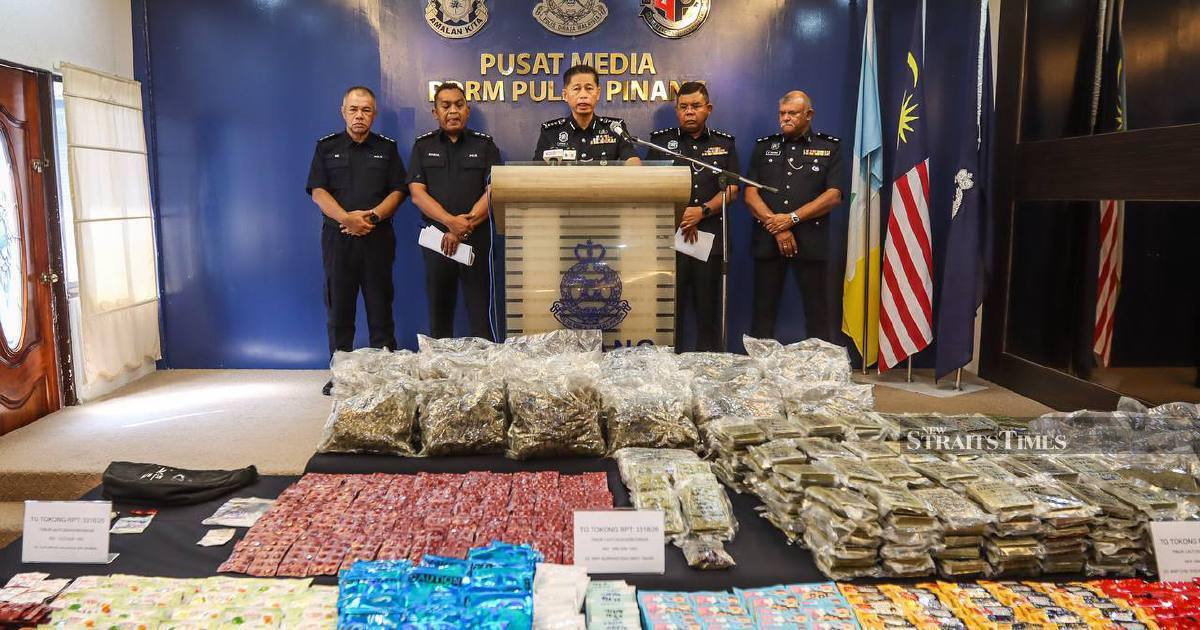
Law enforcement authorities in Penang have achieved a major breakthrough in combating illicit drug operations following coordinated raids that resulted in the collapse of three distinct trafficking networks. The successful operations culminated in the arrest of seven individuals, among them a married couple suspected of playing key roles in distribution networks across the state. The seized contraband, valued at RM3.2 million, represents a substantial haul that demonstrates both the scale of drug operations in the region and the effectiveness of sustained police investigative efforts.
The three-pronged enforcement action reflects intensified efforts by the Penang police force to address the persistent challenge of organised drug trafficking. Rather than isolated arrests of street-level operators, these raids targeted the structural components of criminal syndicates, suggesting police intelligence had identified the organisational architecture linking multiple trafficking groups. The decision to conduct simultaneous operations across different locations points to careful planning and coordination, minimising the risk that suspects could warn associates or dispose of evidence before raids commenced.
The involvement of a married couple in criminal operations underscores how family networks and intimate relationships can be weaponised within trafficking hierarchies. Such arrangements often provide operational advantages for criminal enterprises, including enhanced trust relationships that facilitate coordination, reduced scrutiny from law enforcement accustomed to monitoring individual suspects, and simplified money trails that can be disguised as household expenses. The specific roles performed by the arrested couple have not been detailed in available reports, yet their joint participation suggests they may have occupied positions of relative significance within the network structures.
For Malaysia and the region, this seizure forms part of a broader pattern of intensifying drug enforcement along established trafficking corridors. The value of the confiscated narcotics—RM3.2 million—represents material disruption to criminal cash flows and supply chains. Whether these substances originated from regional production centres in Myanmar or Thailand, or entered Malaysia through established maritime or overland routes, their interception disrupts the commercial pipelines that feed domestic addiction and sustain transnational criminal organisations.
Penang's geographic position as a major port and commercial hub renders it particularly vulnerable to drug trafficking operations. The state's connectivity to international shipping networks, its position within Southeast Asian trafficking corridors, and its established communities create conditions conducive to both large-scale importation and local retail distribution. Police operations targeting high-value syndicates therefore represent necessary interventions to prevent the state becoming a regional drug distribution centre.
The seven arrests provide potential intelligence sources for ongoing investigations. Interrogation of suspects may yield information about upstream suppliers, downstream distribution networks, money laundering mechanisms, and the financial benefits flowing to trafficking principals. Such intelligence frequently catalyses subsequent enforcement actions, suggesting these initial arrests may represent the opening phase of expanded operations targeting larger criminal networks.
From a public health perspective, the removal of RM3.2 million in narcotics from circulation prevents these substances from reaching vulnerable populations including young people and individuals in economically disadvantaged communities. The psychological and social costs of drug addiction extend far beyond individual users, affecting family structures, employment outcomes, educational attainment, and contributing to criminal behaviour. Each kilogram of drugs interdicted represents potential addiction cases prevented and social harm avoided.
The successful operations also carry implications for criminal organisations operating throughout Southeast Asia. Traffickers continuously assess risk-reward calculations; enforcement actions that increase operational costs through personnel loss, asset seizure, and increased police attention gradually render trafficking less economically attractive relative to other criminal enterprises. Sustained pressure on distribution networks, even if not eliminating trafficking entirely, can displace operations geographically or force criminal entrepreneurs into higher-risk operating patterns that eventually lead to their apprehension.
Government authorities have signalled continued commitment to disrupting drug trafficking through such enforcement actions. The coordination required to execute three simultaneous raids successfully demonstrates institutional capacity that should provide some assurance to Malaysian residents concerned about drug-related crime and its associated social consequences. However, the sheer volume of drugs continuously flowing through regional trafficking networks means that even substantial seizures represent only a portion of total contraband in circulation.
Looking ahead, the intelligence derived from the arrested suspects may reveal connections to broader trafficking organisations operating across state and national boundaries. Such discoveries could prompt cross-border coordination with law enforcement agencies in neighbouring jurisdictions, reflecting the transnational nature of modern drug trafficking. The syndicates dismantled in Penang likely represent nodes within larger networks that extend throughout Malaysia and into other Southeast Asian countries.
These operations underscore the ongoing challenge facing Malaysian authorities in combating one of the region's most significant organised crime problems. While enforcement actions generate positive headlines and demonstrate police capabilities, trafficking organisations continue adapting their methods and routes in response to enforcement pressure. Long-term solutions require sustained investment in interdiction, intelligence gathering, community education, and drug treatment and rehabilitation programmes designed to reduce demand among vulnerable populations.

