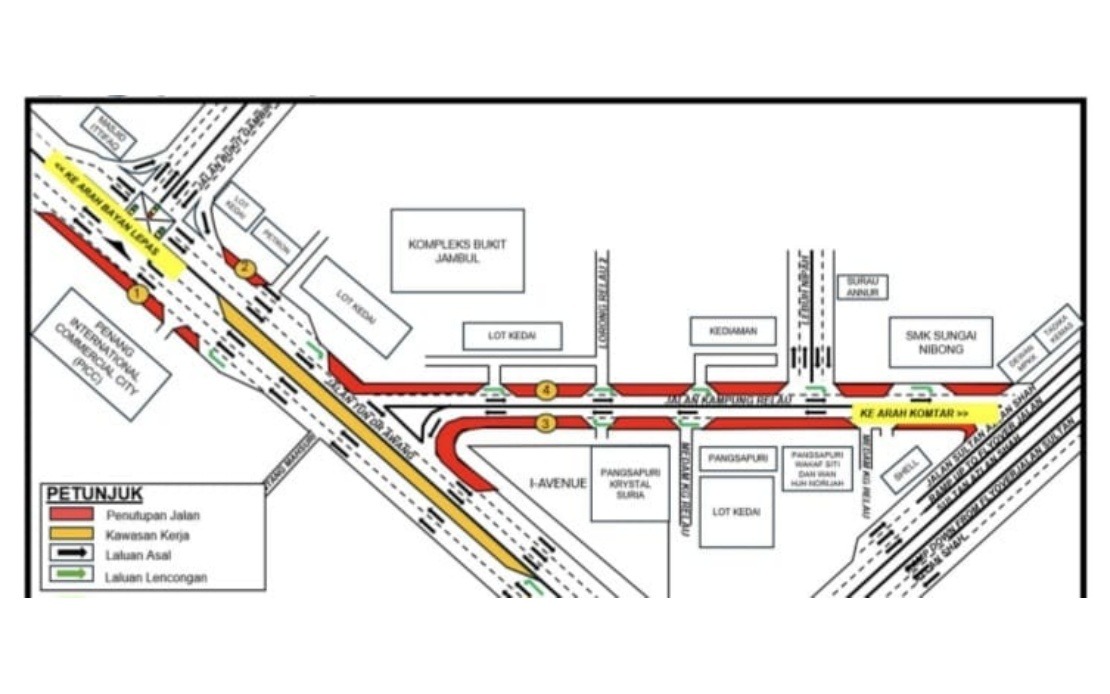
Penang residents and commuters face significant traffic disruptions beginning Friday as Malaysia Rapid Transit Corporation Sdn Bhd (MRT Corp) implements a three-month programme of partial lane closures along two key arterial routes in George Town. The Mutiara Line Light Rail Transit Project's infrastructure works will restrict traffic flow on Jalan Kampung Relau and Jalan Tun Dr Awang for 75 consecutive days, requiring motorists to navigate reduced capacity during peak hours and adjust their daily travel patterns accordingly.
The disruptions will operate on a restricted schedule, with lane closures in effect only between 8 am and 4 pm daily, allowing some relief during early morning and evening peak periods. This phased approach continues through October 15, suggesting that the project management team has considered the impact on the business and residential communities that depend on these corridors for daily operations. The timing decision reflects an attempt to balance infrastructure development needs with economic activity in the George Town area, though morning and evening commuter traffic will still experience congestion during the restricted hours.
Three specific sections of roadway will be affected, each representing a critical chokepoint in the existing network. The leftmost lane fronting the Penang International Commercial City (PICC) heading towards Bayan Lepas addresses traffic serving the commercial precinct and light industrial areas in the southern approaches to George Town. Simultaneously, the leftmost lane in front of the Petron Bukit Jambul petrol station on the route towards Komtar will be restricted, affecting commuters and commercial vehicles accessing the central business district. The third restriction spans from the Jalan Tun Dr Awang entry slip road through to Jalan Kampung Relau and past SMK Sungai Nibong, again directed towards Komtar, creating a compound effect that forces traffic to compress into fewer available lanes.
MRT Corp emphasises that all other lanes will remain operational, theoretically maintaining traffic flow albeit at reduced speeds and with increased congestion during the closure windows. This reassurance, while technically accurate, understates the practical impact on a road network already operating near capacity during business hours. The concentration of restrictions during daytime hours means that businesses along these corridors, delivery services, and public transportation will face heightened challenges in meeting schedules and managing operational costs through inefficient routing.
The underlying purpose of these closures—drainage improvements and road widening works—forms part of the broader Mutiara Line LRT Project, a major public transportation infrastructure initiative designed to enhance connectivity across the Klang Valley region and eventually extend into Penang. These foundational works are essential prerequisites for the rail line's construction, addressing existing drainage deficiencies that would otherwise compromise the integrity of the permanent infrastructure. The CMC1 Package, under which these works fall, represents an important early phase that must be completed before main construction activities can commence.
For the greater Penang economy and the broader Malaysian transportation ecosystem, the Mutiara Line represents a significant investment in reducing vehicle dependency and improving public transport networks. However, the temporary disruptions create a tension between short-term inconvenience and long-term benefit. Small businesses operating in the affected areas, logistics companies with fixed delivery schedules, and daily commuters will absorb costs through additional fuel consumption, extended travel times, and operational inefficiencies during the implementation period.
MRT Corp has implemented standard traffic management protocols, deploying directional signage to guide motorists through the affected zones. The corporation operates a dedicated customer service line at 1-800-88-6782 and maintains an email contact point at [email protected] for public enquiries and complaints. These communication channels acknowledge that disruptions of this magnitude inevitably generate public concern and require transparent, responsive engagement with affected stakeholders.
The geographic scope of these works reflects Penang's role as a major commercial and industrial hub within the northern corridor, where road networks built decades ago now struggle to accommodate current traffic volumes. The concentration of restrictions around routes serving Komtar and the southern business precincts indicates that the project designers have prioritised maintaining some flow capacity on the most critical connections, though this leaves other routes to absorb the displaced traffic.
Motor clubs and transport associations have traditionally advocated for nighttime closures to minimise daytime disruption, yet the decision to restrict works to business hours may reflect practical constraints in lighting, safety protocols, and labour availability. The choice also allows supervisory and technical staff to work under full daylight conditions, potentially reducing errors and safety incidents during critical infrastructure work.
Penang's rapid urbanisation and the persistence of congestion on existing routes underscore why projects like the Mutiara Line are essential for the state's continued economic viability. The temporary inconvenience of 75 days represents a relatively modest price for infrastructure that will serve commuters for decades. Nevertheless, the immediate impact on local businesses and commuters demands that MRT Corp maintain transparent communication, address concerns promptly, and ensure that traffic management measures minimise unnecessary delays. As work progresses, the corporation's responsiveness to public feedback will influence public perception of the broader Mutiara Line project and regional support for future transit infrastructure initiatives.

