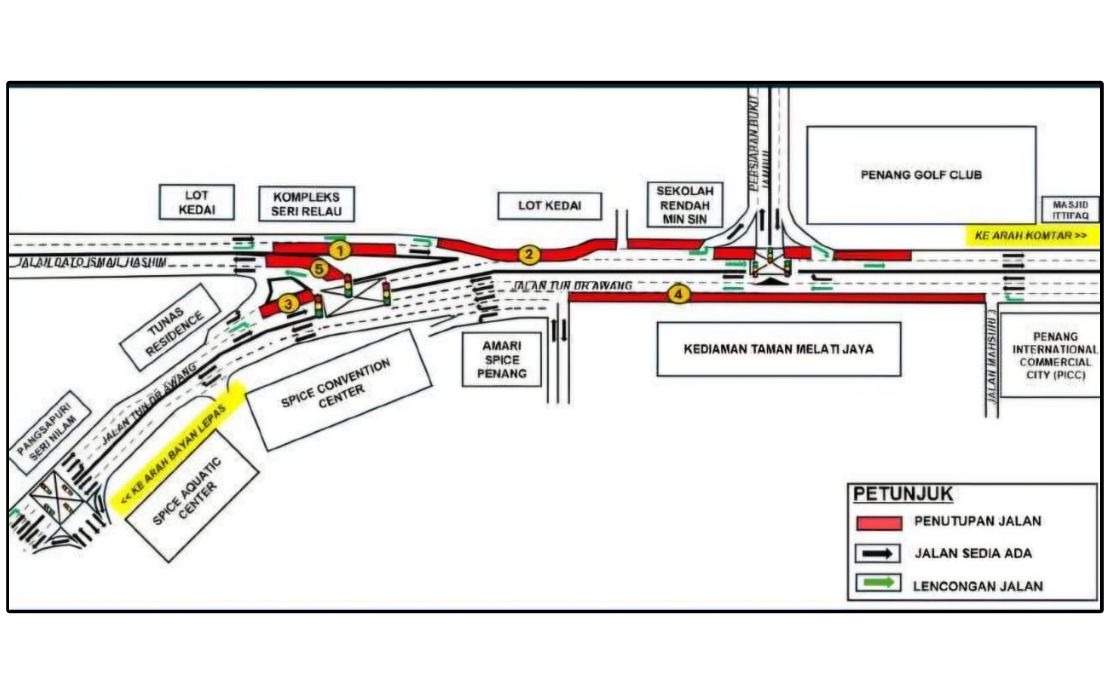
The Mutiara Line Light Rail Transit project in Penang is entering an intensive preliminary construction phase that will reshape traffic patterns in central George Town for the next ten weeks. Beginning August 20 and continuing through October 31, Malaysia Rapid Transit Corporation Sdn Bhd (MRT Corp) will enforce periodic partial lane closures across two major thoroughfares—Jalan Tun Dr Awang and Jalan Dato Ismail Hashim—in the vicinity of the Sri Relau Complex and Penang Golf Club. This 72-day window represents a critical juncture in the development of what is intended to become a major transportation artery for the Penang metropolitan area, though it comes with significant implications for daily commuters and businesses along the corridor.
The scope of the construction activity encompasses drainage system preparation and road widening initiatives classified under Package CMC1 of the broader Mutiara Line development. Rather than implementing complete road closures that would paralyse traffic flow, MRT Corp has designed a staggered closure strategy that will operate during standard business hours from 8:30 am to 4:30 pm each day. This timing acknowledges the reality that George Town remains an active commercial and administrative hub, with morning rush-hour traffic preceding the work window and evening congestion following the afternoon completion. The decision to maintain at least partial lane availability throughout the work period reflects an attempt to balance project acceleration with community tolerance for disruption.
The affected lanes form a complex patchwork reflecting the specific engineering requirements of the underground infrastructure development. On Jalan Dato Ismail Hashim, the right lane immediately in front of the Sri Relau Complex heading toward Komtar will be unavailable, while simultaneously the left lane beginning from commercial properties near SJK (C) Min Sin and extending to the Penang Golf Club entrance will also be closed. Additionally, at the traffic light intersection where Jalan Dato Ismail Hashim meets Jalan Tun Dr Awang, the leftmost lane in the Komtar direction will be sealed off. Jalan Tun Dr Awang near the Taman Melati Jaya residential neighbourhood heading toward Bayan Lepas will experience closure of its leftmost lane. Collectively, these restrictions mean that drivers cannot proceed on their preferred routes and will require flexibility in their journey planning.
For Malaysian and Southeast Asian readers, the Mutiara Line represents part of a broader strategic vision to develop Penang's rapid transit infrastructure, comparable to expansions underway in Kuala Lumpur, Selangor, and other major metropolitan regions. The project connects to national economic development strategies emphasizing reduced congestion and improved regional competitiveness. The current construction phase represents movement from planning into physical reality, meaning the temporary traffic disruptions visitors and residents will experience are the tangible cost of realising longer-term transportation improvements. Understanding this context helps stakeholders appreciate why the inconvenience of the next two months serves a purpose extending beyond immediate local concerns.
MRT Corp has implemented standard traffic management protocols to mitigate accident risks and maintain awareness of ongoing construction. Signboards positioned throughout the affected corridors will provide directional guidance, whilst traffic cones will demarcate lane boundaries and restricted zones. Human flagmen stationed at critical junctions and transition points will actively manage traffic flow during peak periods and respond to incidents in real time. These layered safety measures acknowledge that partial lane closures create complex driving conditions where motorist error becomes more likely and accident severity potentially greater due to compressed traffic volumes.
Motor vehicle operators transiting the George Town area should anticipate extended journey times and prepare alternative routes in advance. The approximately eleven-week closure period coincides with the transition from monsoon season toward year-end festivities and commercial activity intensification. Businesses relying on customer vehicle access or goods delivery along these corridors should consider operational adjustments, including modified delivery scheduling, adjusted staffing to accommodate traffic delays, and potentially enhanced online or alternative distribution channels. The cumulative economic impact across numerous small and medium enterprises, whilst difficult to quantify precisely, will likely be material enough to warrant contingency planning.
The closure represents Package CMC1 specifically, suggesting that the Mutiara Line project encompasses multiple construction packages that will likely require additional road access restrictions in subsequent phases. Residents and business operators should view August-October 2024 as the initial manifestation of construction-related disruption rather than an isolated event. Future announcements regarding subsequent packages may involve different corridors, timing, and intensity levels. Long-term planning by affected parties should incorporate realistic expectations about transportation challenges persisting intermittently throughout the broader project timeline.
MRT Corp has established dedicated communication channels for public inquiries and concerns regarding the construction impacts. The MRT Careline at 1-800-88-6782 provides voice-based contact, whilst the email address [email protected] offers an alternative channel for detailed concerns or suggestions. These mechanisms exist to document public feedback and allow MRT Corp to identify unanticipated problems requiring operational adjustments. Effective utilisation of these channels by affected stakeholders can contribute to adaptive management during the closure period, potentially enabling modifications if implementation reveals unforeseen difficulties.
The Mutiara Line project itself carries significance for Penang's positioning within Malaysia's urban development hierarchy. As the nation's second-largest metropolitan region, Penang has historically maintained public transportation infrastructure lagging behind Klang Valley standards. The Mutiara Line, complementing the existing George Town-Bayan Lepas RapidPenang bus service, represents technological and capacity advancement intended to attract both residents and employers seeking modern, efficient metropolitan characteristics. The preliminary works now commencing represent the physical manifestation of strategic commitment to this transformation, even as the immediate consequences involve familiar inconveniences that test public patience.
Drivers navigating the affected corridors should allow additional travel time margins, remain attentive to flagmen and signage instructions, and maintain heightened defensive driving awareness. The compressed lanes and modified traffic patterns will create stress points where driver attention lapses become safety hazards. Pedestrians and cyclists should similarly exercise caution, as construction zones typically see reduced sightlines and increased heavy vehicle movements. Collectively, these adjustments represent the behavioural adaptations necessary when urban infrastructure transitions from maintenance mode into active development, a reality increasingly familiar to residents of Malaysia's rapidly modernising metropolitan centres.

