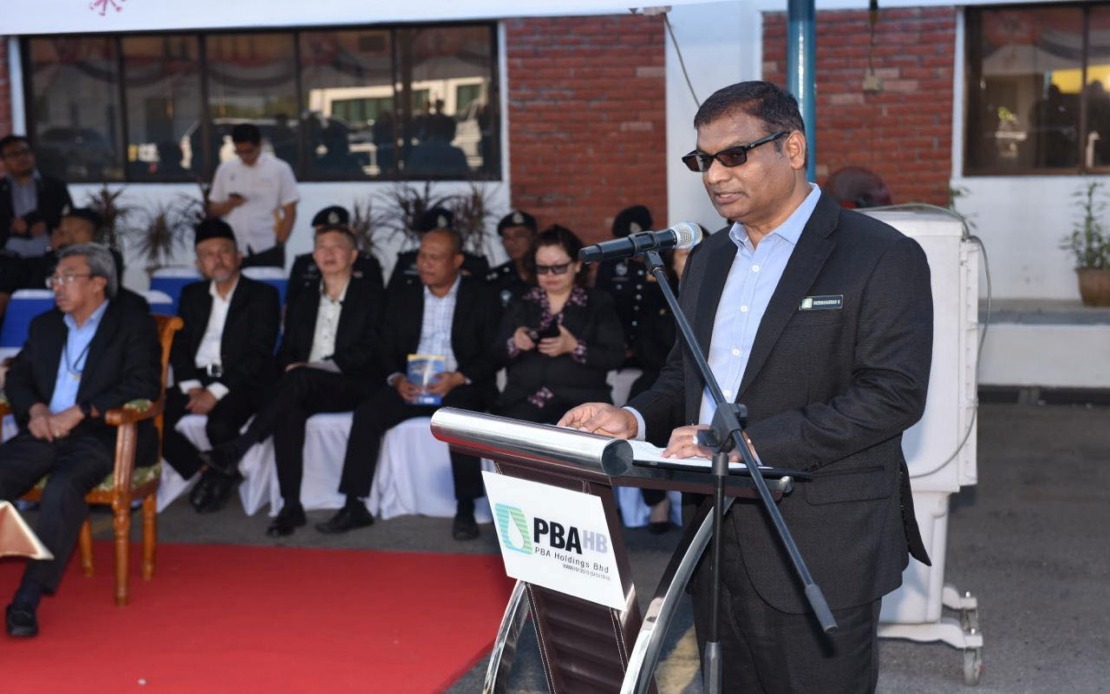
Penang Water Supply Corporation (PBAPP) is advancing its water infrastructure strategy with plans to commission a new 80 million litres-per-day (MLD) treatment plant in Seberang Perai Selatan (SPS) by 2027, marking a significant investment in the state's water security. The facility, structured under a Build-Operate-Transfer (BOT) arrangement, will draw raw water supplies from Sungai Kerian and represent a critical response to mounting pressures on the district's water resources. According to PBAPP chief executive officer Datuk K. Pathmanathan, the project addresses immediate supply challenges driven by accelerating population growth and intensive industrial expansion across the southern region.
The new plant functions as part of a staged, multi-year expansion programme designed to systematically enhance water availability in SPS through the 2030s. Following the 2027 commissioning, a larger 114 MLD facility at Sungai Kerian is scheduled to begin operations by 2030 under the Water Contingency Plan 2030, further reinforcing supply resilience in the district. Beyond these initiatives, the Perak-Penang Water Project represents the most ambitious undertaking, with expectations for delivery of between 300 and 500 MLD of treated water from Perak to SPS commencing in 2031, simultaneously benefiting neighbouring Seberang Perai Tengah (SPT). This layered approach reflects a recognition that single-phase solutions cannot adequately accommodate the scale of projected demand growth.
SPS already demonstrates the urgency underlying these infrastructure plans. Current consumption stands at an average of 116.8 MLD across 87,611 registered water users, representing approximately 13.5 per cent of Penang's total water demand. However, this baseline masks the transformative development occurring across the district. The RM2.2 billion Batu Kawan Industrial Park 3 (BKIP3) alone, spanning roughly 165 hectares, is projected to generate approximately 220 MLD of water demand by the 2030s—nearly double the district's existing consumption. Such industrial complexes fundamentally alter the character of water demand, introducing large-volume, continuous requirements that differ substantially from residential usage patterns.
Beyond BKIP3, additional projects amplify pressure on SPS water resources. The SkyWorld Cassia development and a planned semiconductor manufacturing facility operated by Siliconware Precision are expected to significantly elevate water consumption within the same timeframe. These ventures reflect Penang's competitive positioning in high-value manufacturing and real estate sectors, drawing investment precisely because of the state's economic ecosystem and infrastructure. Water availability thus becomes a competitive asset—regions unable to guarantee adequate supply risk losing such developments to rival jurisdictions across Southeast Asia. The convergence of residential, commercial, and industrial demand growth creates a compounding challenge that cannot be addressed through demand management alone.
PBAAPP's interim response demonstrates pragmatism in bridging the gap between current shortages and long-term solutions. A compact water treatment facility commissioned in March 2024, constructed at a cost of RM8.1 million, currently produces up to 6.4 MLD of treated water from Sungai Kerian, serving approximately 4,000 consumers as a temporary measure. This smaller installation exemplifies the corporation's strategy of layering capacity additions rather than attempting single megaproject solutions. Temporary facilities provide breathing room during the extended development timelines required for larger installations, allowing distribution networks to expand and industrial projects to proceed without facing water rationing constraints that could deter investment.
The governance framework surrounding these developments reflects Chief Minister Chow Kon Yeow's emphasis on aligning water supply expansion with broader socio-economic objectives. PBAPP's positioning of these projects as essential infrastructure supporting Penang's development agenda underscores a policy perspective that treats water availability as inseparable from economic growth and competitiveness. This approach acknowledges that water shortages impose direct costs on industrial productivity, property values, and investor confidence. The explicit commitment to ensuring development is not constrained by water limitations represents a deliberate policy choice to prioritise infrastructure investment alongside economic diversification.
From a regional perspective, Penang's water infrastructure trajectory carries implications for broader Southeast Asian patterns. As manufacturing capabilities increasingly concentrate in specific clusters—semiconductor production in Penang and Malaysia more broadly, automotive manufacturing elsewhere—water-intensive industries compete for locations with guaranteed supply. The Perak-Penang Water Project, drawing supplies from neighbouring Perak, illustrates how water security requires inter-state cooperation and coordination. Such arrangements test federal-state relations and raise questions about equitable allocation of shared water resources. Penang's approach of securing supplies through contractual arrangements with other states offers a model, though one that may face resistance as water scarcity intensifies across Malaysia.
The technological and financial dimensions of these projects merit attention. BOT structures shift capital and operational risk from government to private operators, enabling larger-scale development without immediate budget constraints. However, such arrangements typically transfer costs to consumers through higher tariffs over contract periods. PBAPP's implementation of treatment facilities using Sungai Kerian as source reflects confidence in that river basin's sustainable yield, despite broader concerns about water quality and availability across Malaysia's rivers. Climate variability and rainfall pattern changes introduce uncertainty into long-term supply projections, potentially requiring adaptive management approaches beyond currently announced plans.
The timeline compression embedded in these announcements—three major facilities coming online between 2027 and 2031—reflects both optimism about implementation capacity and urgency regarding supply deficits. Executing such projects requires sustained funding, technical expertise, and administrative coordination across multiple agencies and private partners. Delays in any component cascade through the system, potentially creating supply constraints during critical development periods. The existing compact facility's success provides some confidence that PBAPP can deliver on such commitments, though scaling from a 6.4 MLD temporary installation to an 80 MLD permanent plant represents a substantial leap in complexity and financing.
For Malaysian stakeholders, these developments illuminate the deepening interconnection between water security and economic prosperity. Penang's experience demonstrates that competitive positioning for high-value manufacturing increasingly depends on unglamorous infrastructure—water treatment plants, distribution networks, quality assurance systems. Businesses making long-term investment decisions regarding production locations scrutinise water availability with the same rigour applied to electricity supplies or port facilities. As other Malaysian regions pursue industrial diversification and economic upgrading, similar infrastructure expansions will become necessary prerequisites rather than optional enhancements. The question facing state governments across Malaysia is whether institutional and financial capacity exists to match infrastructure investment to economic ambitions.

