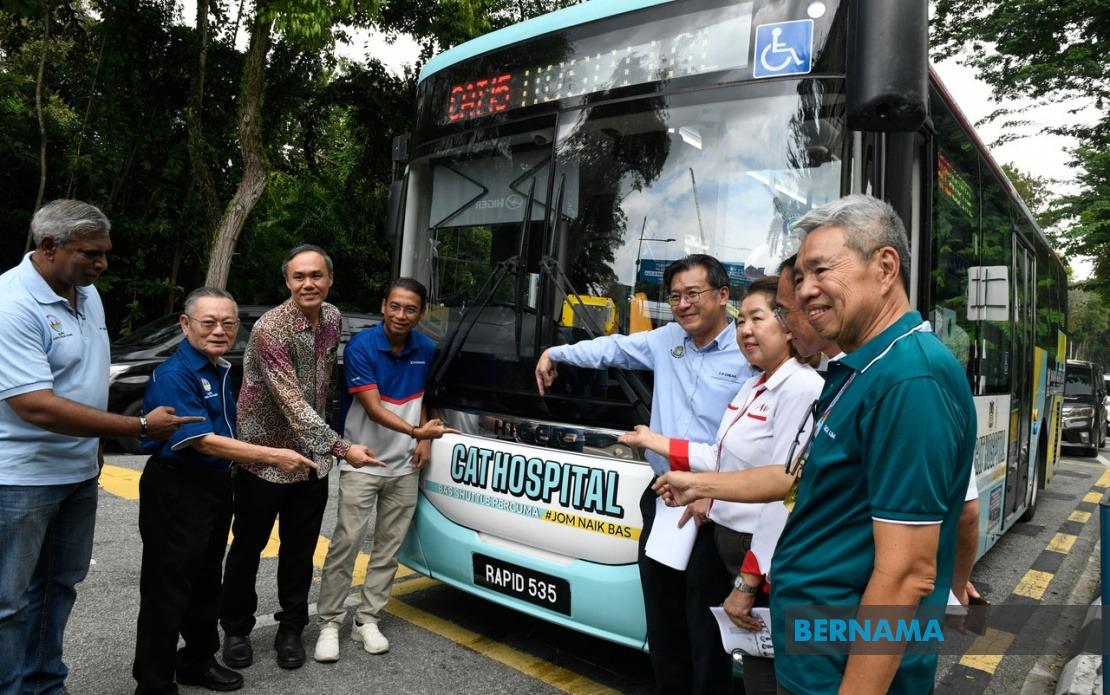
Penang's urban transport landscape is undergoing a significant shift as the Penang Island City Council (MBPP) commits RM900,000 annually to operate a free Central Area Transit (CAT) shuttle bus service. The initiative connects Komtar, the state's administrative heart, with Penang Hospital and three private healthcare institutions alongside multiple health facilities clustered in the city centre, reflecting a growing recognition that accessible public transport to medical facilities serves a crucial public health function.
The service represents a deliberate policy choice to reshape how residents and patients access healthcare. Rather than relying exclusively on private vehicles, the MBPP engineering leadership has positioned the shuttle as essential infrastructure supporting both Penang Hospital's recent expansion and the broader congestion challenges plaguing the city's core. Engineering Director Cheah Chin Kooi emphasised that reducing car dependency around these facilities addresses twin concerns: the severe parking scarcity that has frustrated patients and visitors, and the traffic gridlock that characterises the area during peak hours.
Operational performance metrics suggest the initiative is gaining acceptance among its target demographic. Since commencing operations on January 1, the service has witnessed passenger numbers nearly double, climbing from approximately 300 daily riders to around 600 currently. This trajectory, though measured over several months, indicates growing awareness and shifting transport behaviour among Penang residents accustomed to private vehicle use. The eight-kilometre route relies on three Rapid Penang buses maintaining service from 6 am to 8 pm, completing 36 trips at 20-minute intervals, a frequency that balances operational costs against service accessibility.
The conceptualisation of this service emerged from institutional analysis rather than ad-hoc planning. Following Penang Hospital's expansion project, the MBPP commissioned a detailed survey that quantified the mismatch between facility capacity and existing transport infrastructure. The resulting service was specifically engineered to serve vulnerable populations—patients facing health challenges, elderly individuals with mobility constraints, and family caregivers managing complex logistics around hospital visits. By eliminating the RM1 to RM3 fare that typically discourages casual or frequent users, the initiative removes financial barriers that can deter lower-income patients from accessing timely care.
Complementary infrastructure improvements underscore the MBPP's comprehensive approach. Penang Hospital has upgraded pedestrian walkways along Jalan Residensi, while ongoing works target the main entrance on Jalan Utama to create seamless connections between the bus service and hospital access points. These enhancements transform the shuttle from an isolated service into an integrated transport-health ecosystem, recognising that the final hundred metres of a patient's journey matter as much as convenient arrival.
The policy alignment across institutions reflects institutional maturity. The presence of Rapid Bus Sdn Bhd's Northern Region leadership, Penang Hospital's director, and the Penang Women's Development Corporation at the service inspection signals coordinated governance. Unlike fragmented approaches where transport and healthcare operate independently, this model embeds public health considerations into urban mobility planning—a principle increasingly relevant across Southeast Asia as cities grapple with ageing populations and rising healthcare demand.
For Malaysian observers, the Penang initiative illuminates how regional governments can address cost-of-living pressures through targeted subsidies. Rather than universal free transport—financially unsustainable for most councils—the MBPP focused investment on high-need routes serving essential services. This precision targeting maximises social benefit relative to expenditure, a fiscal discipline increasingly important as municipal budgets face competing demands.
The service also demonstrates how public transport can serve as economic stimulus without appearing as such. By facilitating easier hospital access, the shuttle indirectly supports the healthcare sector's operational efficiency and reduces congestion that degrades commercial activity in the city centre. Hotels, restaurants, and retail establishments benefit from improved traffic flow, while visitors accompanying patients have clearer navigation options.
The current ridership trajectory raises questions about scalability. If the 600 daily passengers continues climbing, the MBPP may need to recalibrate its bus allocation or frequency, potentially increasing the RM900,000 allocation. Conversely, the service provides a testbed for understanding how subsidised public transport affects behaviour change in tropical urban environments where private vehicles traditionally dominate.
For other Malaysian municipalities watching Penang's experiment, the model offers a replicable framework. Cities like Kuala Lumpur, Johor Bahru, and Kota Kinabalu face similar hospital access challenges, yet comparable services remain limited. The RM900,000 investment, while substantial, represents modest cost relative to the economic losses from congestion and healthcare delivery inefficiencies. State governments could explore comparable initiatives, particularly linking major private hospitals—often located in congested areas—to transport hubs.
The service ultimately reflects evolving expectations about government's role in healthcare access. Beyond clinical facilities themselves, enabling patients to reach medical care affordably and conveniently constitutes a legitimate public health function. As Malaysia ages and healthcare costs burden households increasingly, such transport subsidies function as preventive measures, encouraging early intervention and reducing costly emergency interventions that burden both patients and public systems.
Looking forward, the MBPP's commitment to tracking passenger numbers and service quality will be instructive. If the doubling trend continues and satisfaction metrics remain strong, the model may justify expansion to other routes serving education, commercial, or social facilities. The RM900,000 annual allocation, for now, represents a calculated investment in Penang's livability and public health infrastructure—a precedent worth monitoring across the region.

