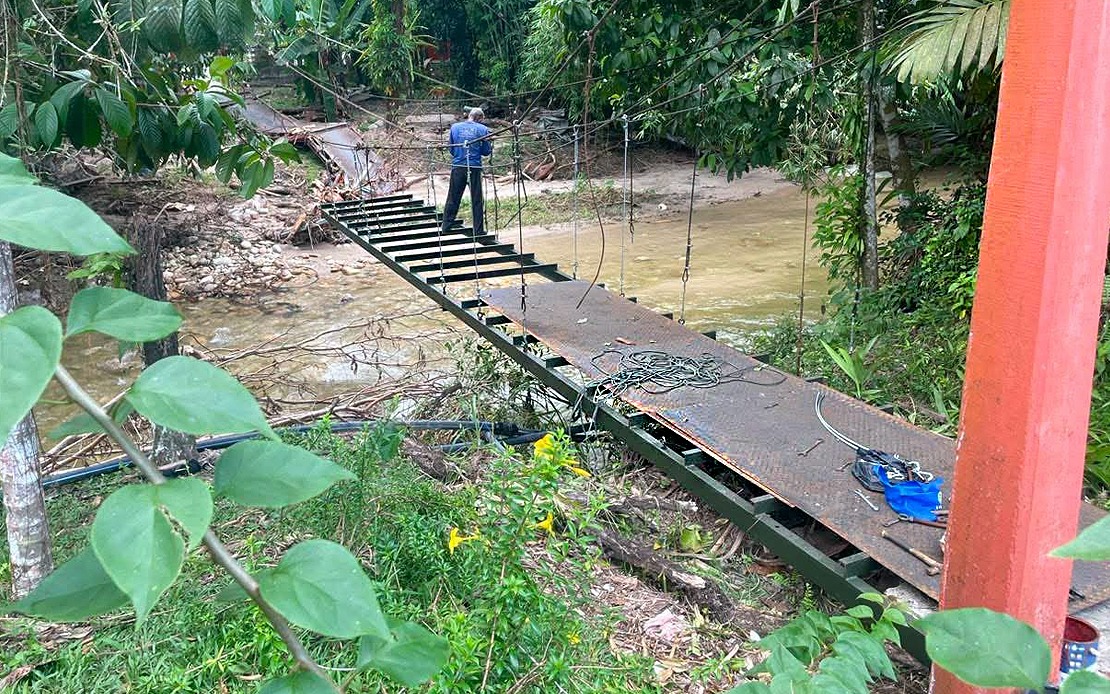
The Perak state government has moved swiftly to address the infrastructure crisis in Kampung Ulu Geruntum, approving a RM500,000 allocation for constructing a permanent concrete bridge to replace the one destroyed during catastrophic flooding on June 19. The decision signals the administration's commitment to restoring normalcy to the rural settlement in Gopeng district, which saw its main link to the outside world severed when powerful water surges swept away the critical crossing.
State Housing and Local Government Committee chairman Sandrea Ng Shy Ching announced the approval on July 4, underscoring the urgency of the reconstruction effort. The concrete bridge represents a long-term engineering solution designed to withstand future water surges and prevent recurrence of the devastation that left the village isolated and forced the evacuation of over 50 residents to emergency shelter at Gopeng Town Hall. Sandrea, who represents the Teja constituency, expressed confidence that construction would commence immediately upon completion of ongoing stabilization work in the affected area.
The approval comes as part of a multi-layered response strategy that recognises both immediate and longer-term community needs. Sandrea pledged RM45,000 from her own constituency development allocation specifically toward repairing damaged water infrastructure and restoring the piped supply that the disaster had disrupted. This parallel investment addresses one of the most pressing challenges residents faced in the days following the collapse, when communities were left without reliable access to potable water—a critical issue in tropical Malaysia where waterborne health risks compound during flood recovery periods.
Recognising that permanent reconstruction typically requires months of planning, design, and material procurement, the state government has simultaneously fast-tracked a temporary solution. An emergency allocation of RM150,000 has been approved for constructing a suspension bridge, a more rapidly deployable structure that can serve community needs while the concrete bridge undergoes construction. This interim crossing is expected to be operational by mid-July, a timeframe that minimises the period during which residents remain cut off from essential services, employment, and education facilities located in Gopeng town centre.
The June 19 incident itself reveals the vulnerability of rural infrastructure to extreme weather events increasingly common across Malaysia. The water surge that destroyed the bridge exhibited sufficient force to sweep away a substantial structure, displacing residents and creating an acute humanitarian situation. The fact that the village had been served by a single access point underscores the limited redundancy in rural road networks and the disproportionate impact infrastructure failures have on remote communities compared to urban areas with alternative transportation corridors.
Sandrea's public acknowledgement of the various agencies and personnel mobilised for relief operations reflects the institutional coordination required to manage such crises. From immediate evacuations to ongoing site assessment and remediation, multiple government departments, emergency responders, and local authorities operated in tandem to prevent loss of life and minimise community suffering. This coordination extended to identifying funding sources across different budget allocations—constituency development funds, emergency reserves, and state development budgets—to construct a comprehensive recovery package.
The allocation strategy reveals important priorities in local governance decision-making. Rather than waiting months to source funds through a single budgetary channel, the administration deployed available resources flexibly. The RM150,000 emergency allocation reflects recognition that a three-to-four month wait for the permanent concrete structure would impose unacceptable hardship on residents dependent on the bridge for medical emergencies, school attendance, and livelihood activities. The suspension bridge thus serves as both a practical necessity and a symbol of government responsiveness.
For Perak specifically, this reconstruction exercise provides an opportunity to reassess broader infrastructure resilience in flood-prone districts. The Gopeng area has experienced previous water emergencies, and the pattern suggests that building standards and siting decisions for critical infrastructure may warrant review through a climate resilience lens. A concrete bridge designed with adequate clearance, appropriate foundation depth, and materials resistant to flood-borne sediment and debris would represent an improvement over whatever structure was destroyed in June.
The incident also carries implications for similar rural communities across Malaysia and Southeast Asia. Many villages depend on single critical infrastructure points—a bridge, road, or water pipeline—that if severed create proportionally greater hardship than comparable failures in better-connected areas. The Kampung Ulu Geruntum response, if executed effectively and transparently, could serve as a model for how state governments balance emergency responsiveness with sustainable reconstruction in the face of climate-related infrastructure challenges that show no signs of diminishing.

