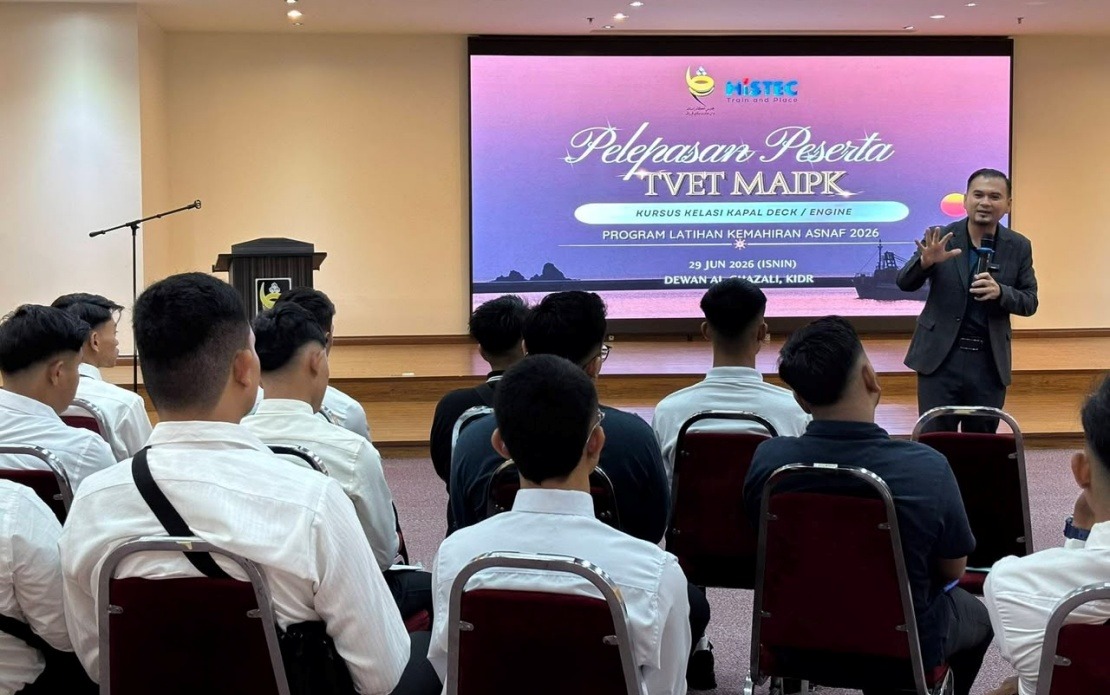
The Perak Islamic Religious and Malay Customs Council (MAIPk) has demonstrated its commitment to technical and vocational education by dedicating RM470,000 towards sponsoring 25 underprivileged youth to pursue careers in maritime crew operations. The significant financial commitment reflects a strategic approach to addressing skills shortages in Malaysia's maritime sector while simultaneously tackling socioeconomic challenges within vulnerable communities.
Each participant will receive comprehensive support valued at RM18,800, covering the complete cost of professional training in both deck and engine crew operations. This investment model represents a deliberate effort to remove financial barriers that traditionally prevent disadvantaged youth from accessing high-demand vocational pathways. By eliminating tuition costs, MAIPk enables asnaf groups to pursue career trajectories that would otherwise remain inaccessible due to economic constraints.
The training programme will take place over three months at the Ranaco Education and Training Institute in Chukai, Terengganu, an established centre for maritime vocational education. Participants will engage in a structured curriculum combining theoretical instruction with hands-on practical training, ensuring they develop both conceptual understanding and operational competence required in professional maritime environments. The course culminates in the awarding of professional certifications and a seaman's licence, documents essential for employment in the maritime industry.
The seaman's licence represents a critical credential that serves as a regulatory requirement for all personnel working aboard commercial vessels. By ensuring participants obtain this qualification, MAIPk guarantees that graduates possess the legal standing to immediately enter employment within Malaysia's maritime sector. This credential-based approach aligns vocational training with actual industry employment requirements, eliminating the gap that often exists between certification and job readiness.
MMAIPk's initiative directly addresses documented skills deficiencies within Malaysia's maritime workforce. The shipping and offshore industries continue to face recruitment challenges for skilled crew members, creating genuine employment opportunities for qualified workers. By developing homegrown talent through structured vocational training, the programme strengthens the nation's capacity to support expanding maritime commerce while generating employment for citizens who might otherwise face limited economic prospects.
The employment placement mechanism integrated into this programme distinguishes it from conventional training initiatives. Rather than completing their courses with uncertain job prospects, graduates will be channelled directly into maritime industry positions, facilitating rapid labour market integration. This placement guarantee transforms the training into a comprehensive employment pathway, ensuring participants transition from education into stable, income-generating work immediately upon qualification.
For the participating youth, the programme represents a tangible pathway towards enhanced earning capacity and career advancement. Maritime employment typically offers competitive remuneration packages, including opportunities for international work that generates foreign exchange earnings. The income prospects available through maritime careers enable participants to transition from asnaf status towards financial self-sufficiency, creating ripple effects throughout their families and communities.
The initiative reflects broader recognition within Malaysia's Islamic institutional framework that vocational empowerment constitutes a legitimate component of community development. Rather than restricting support to traditional welfare mechanisms, MAIPk channels resources towards productive skills acquisition that generates sustainable income streams. This approach aligns with Islamic principles emphasizing human dignity through productive labour and economic self-reliance.
The send-off ceremony, officiated by MAIPk Asnaf Empowerment Division General Manager Amirudin Osman at Kompleks Islam Darul Ridzuan in Ipoh, marked formal recognition of this commitment. The ceremonial aspect underscores the significance attached to these participants' journeys, acknowledging that their transition into maritime careers represents meaningful individual and collective achievement within Perak's development framework.
From a regional perspective, this initiative demonstrates how Malaysian institutions are strategically addressing both workforce development and poverty alleviation through coordinated vocational initiatives. As Southeast Asian economies increasingly integrate through maritime trade routes and shipping corridors, skilled crew availability becomes a competitive advantage. MAIPk's investment in developing qualified maritime personnel strengthens Perak's contribution to Malaysia's broader maritime ambitions while demonstrating how religious institutions can effectively mobilize resources for socioeconomic transformation.
The programme's three-month intensive structure reflects pragmatic understanding that underprivileged youth often face constraints preventing extended educational absences. By compressing comprehensive maritime training into a focused quarter-year commitment, the initiative balances rigorous skill development against the economic pressures that typically force disadvantaged individuals into immediate employment. This timing strategy enhances programme accessibility while maintaining educational quality standards.
Looking forward, the success of this cohort may establish a replicable model for skills-to-employment initiatives across Malaysia's Islamic institutional landscape. If graduates achieve strong labour market outcomes and career advancement, the demonstrated effectiveness could justify expansion of similar programmes across other regions and maritime vocational specializations, scaling impact across the nation's asnaf population.

