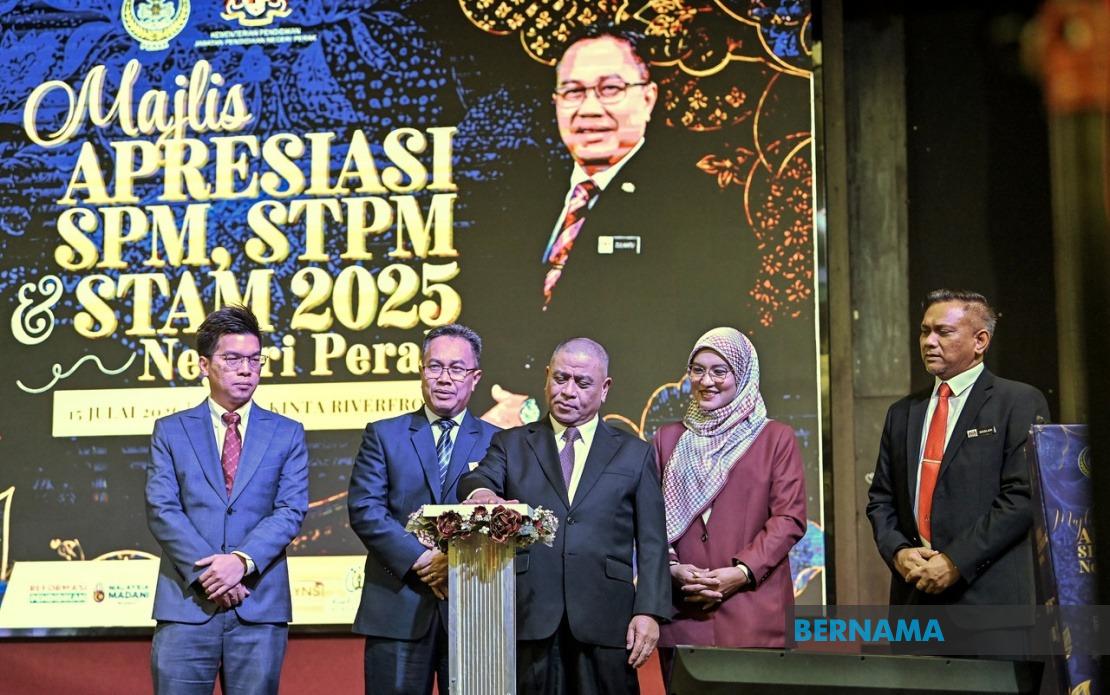
The Perak state government's Menteri Besar Scholarship continues demonstrating its value as a practical intervention addressing the financial pressures that often constrain academic achievement among talented students from modest family backgrounds. At an appreciation ceremony held in Ipoh on July 15 honouring 2025 examination performers, scholarship recipients shared how the financial support directly enabled their educational advancement whilst relieving strain on household budgets during a critical transition period toward tertiary studies.
Yoong Lam, 20, from Sekolah Menengah Kebangsaan Sultan Yussuff, exemplifies the programme's impact on student outcomes. Having achieved a perfect Overall Grade Point Average of 4.00 in her Sijil Tinggi Persekolahan Malaysia examination, she credited the RM1,200 per-semester assistance with enabling her to manage essential study expenses including examination fees, academic reference materials, and supplementary tuition that proved instrumental to her success. As the eldest of two children supporting a self-employed father as the family's sole income earner, Yoong Lam acknowledged that without this financial cushion, her family would have faced difficult choices between educational investment and household necessities.
The scholarship's significance extends beyond individual achievement to address broader equity concerns within Perak's education system. Muhammad Haziq Hafit, 19, from Al-Ulum Al-Syar'Iyyah Religious Secondary School in Bagan Datuk, received RM1,000 assistance designated for university preparation expenses, particularly relevant given his intention to pursue education studies at the University of Malaya. Similarly, Muhammad Taufiq Ikwan Mohammad Asri, also 19 from the same institution, viewed the assistance as meaningful precisely because it targets students from middle-income households often overlooked by larger scholarship schemes, enabling him to prepare for further studies in Egypt without placing extraordinary burden on family finances.
The programme arrives amid genuinely encouraging developments in Perak's educational performance. Menteri Besar Datuk Seri Saarani Mohamad highlighted that the state achieved an average grade point of 4.49 in 2025 Sijil Pelajaran Malaysia results, representing the strongest performance in thirteen years and continuing an upward trajectory across three consecutive examination cycles. This achievement gains particular significance when examined through an equity lens: the performance gap between urban and rural examination candidates narrowed to merely 0.04 points, suggesting that quality education and genuine prospects for excellence are becoming increasingly accessible across geographic divides within the state.
Understanding this improvement requires attention to complementary state interventions operating alongside direct financial assistance. The Tuisyen Cikgu Saarani programme, coordinated by Yayasan Perak in partnership with the Perak State Education Department, represents a structured approach to bolstering examination performance through enhanced study materials. Rather than relying solely on generic textbooks, the initiative produced supplementary reference books specifically designed by experienced educators after analysing Perak students' actual learning requirements, emphasising concept mastery and examination technique development tailored to local contexts.
The reach and ambition of this reference book initiative demonstrate escalating institutional commitment to inclusive excellence. Since launch, approximately 63,567 copies have been distributed among secondary school candidates throughout Perak, with particular focus on students identified as capable of achieving examination success but requiring additional structured support. This year's expansion extended the programme for the first time to potential passers enrolled in Sekolah Menengah Tahfiz Darul Ridzuan and Sekolah Menengah Agama Rakyat institutions, bringing nearly 25,000 SPM 2026 candidates into the intervention's scope through coordination with the Perak Islamic Religious Department.
For Malaysian education observers, Perak's integrated approach—combining direct financial assistance with contextualised teaching materials and institutional coordination—offers instructive contrast to scholarship schemes operating in isolation. The scholarship alone addresses family financial stress, whilst supplementary materials target pedagogical gaps that often persist despite adequate household resources. Together, these programmes acknowledge that educational inequality reflects multiple reinforcing obstacles: insufficient household income for educational essentials, but also unequal access to examination preparation resources and guidance.
The implications extend throughout Southeast Asia's education landscape, where similar combinations of household financial constraint and unequal resource distribution shape opportunity structures. Malaysia's regional education standing depends partly on whether states like Perak can sustain this dual-track approach consistently, demonstrating that examination excellence and equity enhancement need not conflict. Indeed, Perak's thirteen-year performance improvement suggests they may be mutually reinforcing: as more students from diverse backgrounds receive genuine support, they contribute to cohort-wide achievement elevation rather than creating zero-sum competition for fixed places.
Looking forward, the sustainability question becomes critical. Yoong Lam's observation that the scholarship "really helps a lot and reduces the burden on parents" reflects widespread sentiment among beneficiaries, yet scholarship funding and supplementary material production require ongoing fiscal commitment. As Perak considers whether these programmes merit expansion alongside emerging educational priorities, the evidence from current recipients—students proceeding to selective universities and specialised fields—suggests returns justify investment through both individual advancement and state-level performance metrics.
The ceremony's assembly of Menteri Besar Saarani, Perak Education director Zulkafli Mohamed Mokhtar, and Yayasan Perak leadership underscores institutional alignment around these educational objectives. Yet systemic effectiveness ultimately depends on whether such commitments translate into consistent resource allocation across political cycles and fiscal pressures. Perak's recent performance trajectory suggests the current approach merits continued support, particularly given evidence that targeted scholarships and structured learning materials together create measurable improvements in both individual achievement and system-wide equity.

