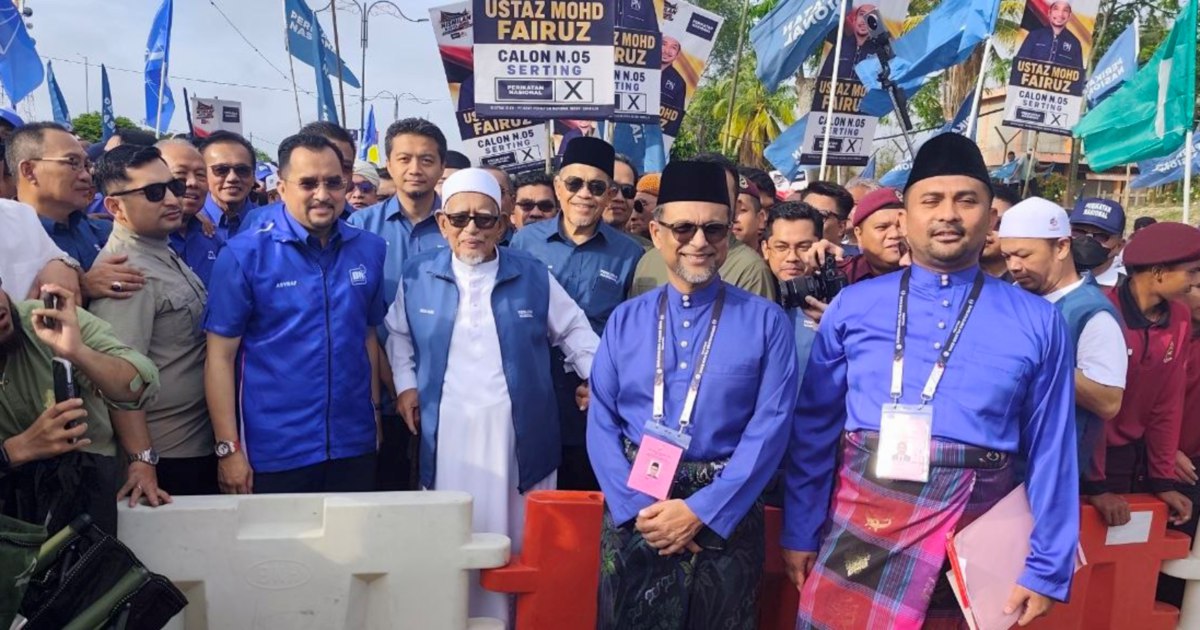
Perikatan Nasional will provide campaign assistance to Barisan Nasional during the forthcoming Negri Sembilan state election, PAS president Tan Sri Abdul Hadi Awang announced at an event in Jempol. The commitment represents a continuation of the political cooperation established between the two coalitions at the national level and reflects their shared interest in maintaining influence across Malaysia's state governments.
The pledge underscores the evolving dynamics of Malaysia's political landscape, where Perikatan Nasional and Barisan Nasional have moved beyond their competitive positioning to embrace a more collaborative approach in certain electoral contests. This strategic alignment differs markedly from the fractured opposition coalition, which has struggled to present a unified front in recent elections. By joining forces in Negri Sembilan, the two coalitions demonstrate their capacity to coordinate efforts and pool resources when mutual interests align.
Negri Sembilan holds particular significance within Malaysia's political ecosystem. As one of the smaller peninsular states, its government composition influences the broader balance of power at the national level and affects intra-coalition dynamics. The state has experienced considerable political volatility in recent years, making unified coalition support an important strategic consideration for both Perikatan Nasional and Barisan Nasional. Hadi's announcement suggests both coalitions view the Negri Sembilan contest as sufficiently consequential to warrant coordinated action rather than parallel or competing campaigns.
PAS, as the dominant component of Perikatan Nasional, wields considerable influence over coalition strategy and messaging. Hadi's willingness to commit resources to supporting Barisan Nasional candidates reflects the party's calculation that strengthening Barisan Nasional's electoral position serves broader interests. For Perikatan Nasional, which has experienced internal cohesion challenges and electoral setbacks since the 2022 general election, demonstrating capacity to mobilise supporters on behalf of coalition partners reinforces its relevance and bargaining power within the coalition framework.
The timing of this announcement proves significant given Malaysia's accelerating election cycle. With multiple state elections anticipated over the coming years, the precedent established in Negri Sembilan may influence subsequent contests. Voters and political analysts will scrutinise how effectively Perikatan Nasional operationalises its campaign support and whether such cooperation translates into tangible electoral gains. The test will reveal whether coalition coordination at the state level proves as functional as its proponents claim or whether deep-rooted tensions continue to undermine unified messaging and strategy.
For Barisan Nasional, which has rebuilt its political fortunes since its 2018 electoral collapse, accepting active support from Perikatan Nasional suggests pragmatic acknowledgment that securing state governments requires assembling the broadest possible electoral coalitions. This approach contrasts with historical patterns where Barisan Nasional maintained dominance through its own organisational strength and machinery. The necessity to solicit external support highlights the transformed competitive environment Malaysian politics now inhabits, where no single coalition can assume automatic victory without active engagement and resource mobilisation.
The ground-level implications of this coalition cooperation extend beyond formal party structures. Campaign volunteers, messaging coordination, and voter engagement strategies will reflect this partnership. Negri Sembilan voters encountering campaign materials and field operations from both coalitions' representatives will observe unprecedented levels of coordination. This may either enhance overall campaign effectiveness through synergistic efforts or create confusion regarding which coalition voters fundamentally support, potentially fragmenting the electorate's response.
Regional and international observers of Malaysian politics will monitor this arrangement closely. The cooperation between Perikatan Nasional and Barisan Nasional in Negri Sembilan provides data points regarding the durability of Malaysia's current political configuration. If the collaboration succeeds electorally, it may encourage similar arrangements in other states, potentially reshaping Malaysia's political map. Conversely, if internal tensions or campaign missteps undermine the partnership, it could signal fundamental incompatibilities that prevent longer-term coalition consolidation.
The opposition coalition's response to this development will also bear close examination. Faced with unified Perikatan Nasional-Barisan Nasional coordination, opposition parties must decide whether to similarly coordinate their efforts or pursue more atomised strategies. The fragmented nature of opposition politics in recent years has contributed to electoral losses across multiple states, suggesting that unified coordination might offer pathways to competitive positioning in future contests. However, ideological differences and leadership rivalries continue to complicate such cooperation among opposition parties.
Hadi's statement simultaneously affirms Perikatan Nasional's commitment to its broader political agenda while acknowledging the practical necessity of building electoral majorities through coalition partnerships. This balancing act reflects the reality that Malaysian electoral politics increasingly requires sophisticated coalition management rather than assuming that any single party or coalition can govern independently. As voters prepare for the Negri Sembilan election, the dynamics of this coalition partnership will provide significant lessons about Malaysia's contemporary political direction and the mechanisms through which future governments will be constituted and sustained.

