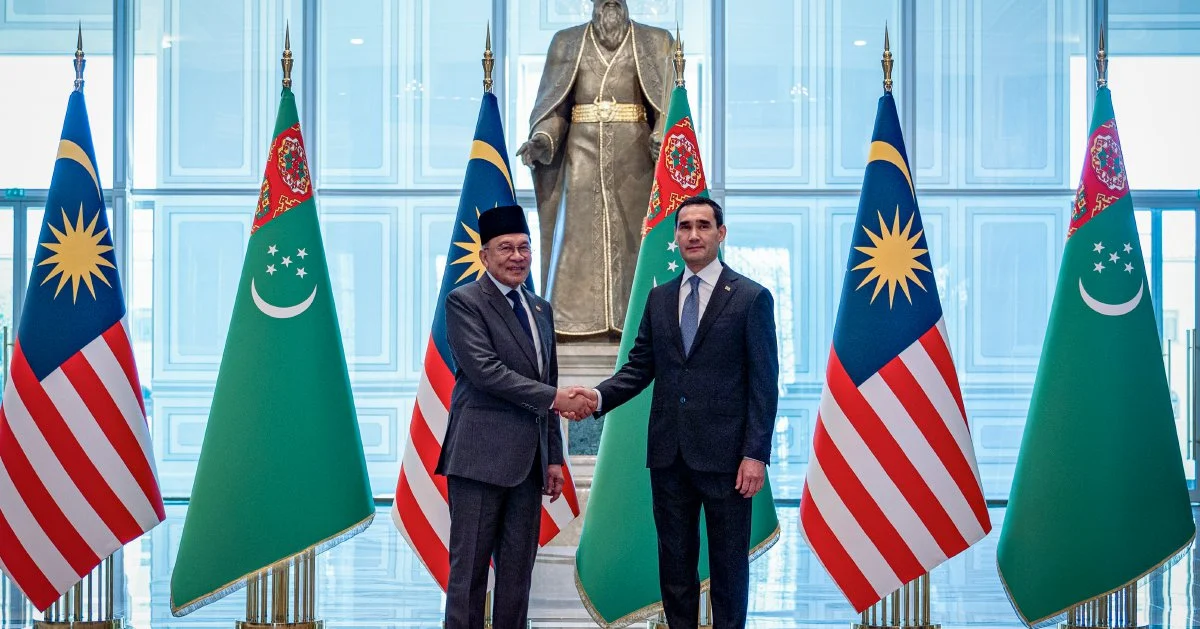
Malaysia's flagship energy company Petronas is becoming a central vehicle for strengthening diplomatic and economic ties with Turkmenistan, a strategically important Central Asian partner. The company's expanding operations in the resource-rich nation have gained fresh momentum following Prime Minister Datuk Seri Anwar Ibrahim's recent official visit, positioning energy cooperation as a cornerstone of bilateral relations between Kuala Lumpur and Ashkhabad.
Petronas brings substantial operational credentials to this partnership. The company's established presence in Turkmenistan—built over many years of active engagement in the nation's hydrocarbon sector—provides a trusted foundation upon which Malaysia can develop wider commercial and diplomatic connections. This institutional foothold distinguishes Malaysia from many other Asian nations seeking to deepen engagement with Central Asia, offering genuine economic substance rather than purely ceremonial interaction.
Turkmenistan represents an especially significant opportunity within Malaysia's evolving Central Asia strategy. The nation possesses vast proven natural gas reserves, among the world's largest, alongside substantial oil production capacity. For Malaysia, a country with declining domestic energy reserves and growing energy security concerns, establishing deeper ties with major hydrocarbon producers aligns with long-term national interests. Petronas's technical expertise and capital access position it well to participate in developing Turkmenistan's energy resources at a time when the Central Asian nation is diversifying its international partnerships beyond its traditional Russian and Chinese relationships.
The Prime Minister's visit underscores the political commitment supporting Petronas's commercial initiatives. Official government engagement at the highest level typically precedes or accompanies major corporate expansion plans, suggesting that Malaysia's leadership views the energy partnership as part of a broader foreign policy objective. This creates a favourable environment for Petronas to pursue fresh investment opportunities, negotiate improved contractual terms, and expand its operational footprint across Turkmenistan's energy landscape.
The economic benefits extend beyond oil and gas extraction. Energy sector partnerships invariably generate secondary opportunities across engineering, project management, technology transfer, construction, and service provision—domains where Malaysian companies possess relevant capabilities. A successful Petronas-led energy initiative in Turkmenistan could create spillover opportunities for other Malaysian enterprises seeking footholds in Central Asian markets, establishing Malaysia as a credible business partner in a region increasingly important to Asian geopolitical and economic dynamics.
For regional context, Malaysia's engagement with Central Asia has historically lagged behind countries like China, Russia, and even India. Most Malaysian corporate activity in the region remains concentrated in energy, reflecting the comparative advantages that companies like Petronas possess. However, strengthened ties with Turkmenistan could catalyse broader Southeast Asian-Central Asian cooperation, positioning ASEAN nations more prominently within the complex geopolitical space between Europe, Russia, China, and South Asia.
Turkmenistan's own strategic interests align favourably with deepened Malaysian engagement. The Central Asian nation has long sought to reduce economic overdependence on Russian and Chinese relationships, particularly following geopolitical tensions and pricing disputes that have periodically disrupted energy export relationships. Malaysian companies offer an alternative partnership model—demonstrating strong technical capability while remaining less politically intrusive than major powers and representing a relatively neutral actor within Central Asian regional dynamics.
Energy security considerations make this partnership mutually beneficial. Malaysia faces the prospect of increasing energy import dependency, particularly for natural gas, as domestic reserves deplete. Turkmenistan, conversely, needs stable, predictable markets for its hydrocarbon production and reliable partner companies capable of operating complex extraction and processing infrastructure. Petronas bridges these complementary needs, applying its regional experience and technological sophistication to unlock Turkmenistan's resource potential while securing supply arrangements that strengthen Malaysian energy security.
The timing of renewed diplomatic engagement also reflects broader shifts in Malaysian foreign policy. The current administration has emphasised diversifying Malaysia's international partnerships and reducing excessive reliance on traditional partners. Central Asia offers an underdeveloped avenue for Malaysian engagement, with significant untapped commercial potential and limited competitive saturation compared to Southeast Asia's crowded marketplace. Successfully establishing Malaysia as a preferred partner in Turkmenistan could generate replicable models for engagement with other Central Asian republics.
Petronas's involvement also addresses capabilities often absent from smaller partner nations. The company brings international financial resources, technical expertise in complex geological environments, experience managing large-scale infrastructure projects, and established relationships with international service providers and technology suppliers. These assets prove invaluable in developing energy resources within developing nations often lacking such operational infrastructure.
The broader implications deserve consideration. Malaysia's strengthening ties with Turkmenistan through energy cooperation contribute to creating an increasingly multipolar approach to Asian geopolitics, with Southeast Asian nations developing direct partnerships across diverse regions rather than exclusively through major power intermediaries. This trend potentially enhances Malaysia's strategic autonomy while contributing to regional stability through expanded economic interdependence.
Looking ahead, the success of Malaysia-Turkmenistan energy cooperation will likely determine whether this partnership becomes a durable strategic relationship or remains transactional in nature. Petronas's performance in Turkmenistan—measured through project delivery, profitability, and responsible operational conduct—will directly influence Malaysia's broader influence within Central Asia. Accordingly, the company's activities extend well beyond commercial significance into the realm of national interest and regional positioning.

