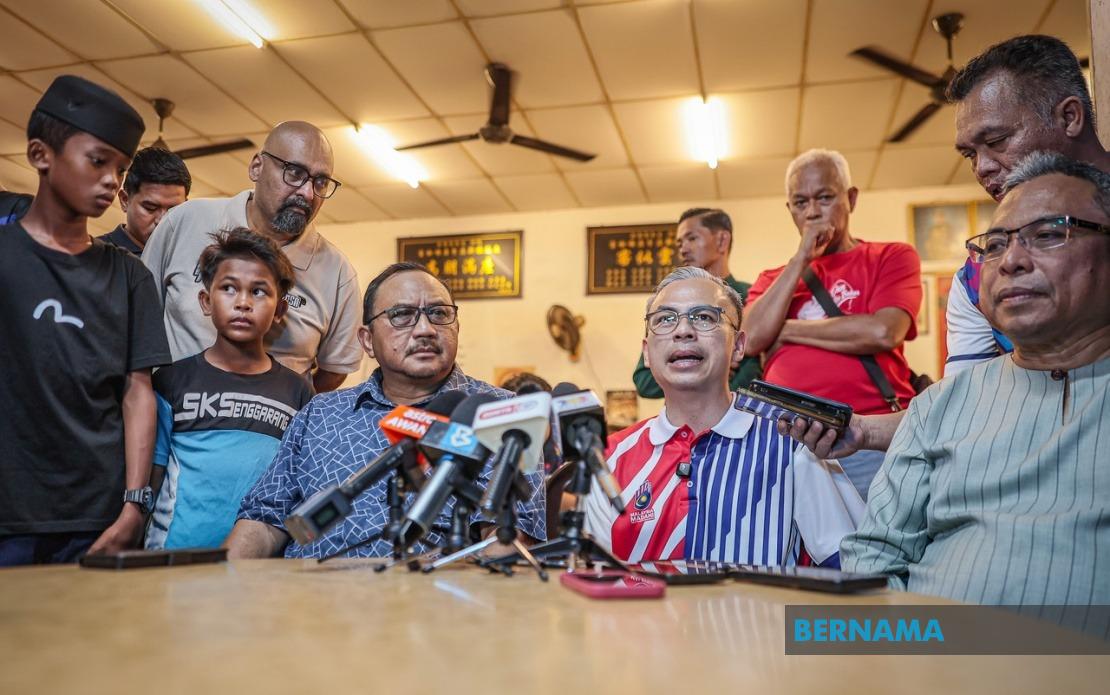
Pakatan Harapan is deploying a two-pronged campaign strategy that marries traditional grassroots mobilization with contemporary digital outreach as it gears up for the 16th Johor State Election. The coalition's communications apparatus, led by Datuk Fahmi Fadzil, recognizes that contemporary electioneering demands simultaneous presence across multiple platforms to saturate the information landscape and ensure policy messages penetrate different demographic cohorts effectively.
Fahmi, who serves as Minister of Communications alongside his PH role, articulated the strategic rationale during a press briefing in Batu Pahat on June 26. The integrated approach reflects a broader acknowledgment within Malaysian opposition politics that reliance on any single channel—whether traditional ground activation or digital dissemination—leaves blind spots in voter engagement. By synchronising these efforts, PH aims to construct redundancy into its communication architecture, ensuring that even citizens with limited social media exposure receive campaign information through face-to-face interaction, whilst digitally-native younger voters benefit from rapid information circulation through official party channels.
PKR, contesting twenty seats across the state, will launch its ground operations immediately following the conclusion of nomination procedures on the morning of June 27. The party's leadership has already mapped out specific assignments for senior figures, with Fahmi personally overseeing activities in Semerah while PKR deputy president Nurul Izzah Anwar mobilizes voters in Senggarang alongside candidate Onn Abu Bakar. This granular delegation of responsibility signals organizational preparation and demonstrates that senior party leadership will have tangible presence throughout the campaign period rather than concentrating activity at state level.
The digital component of PH's strategy hinges on establishing rapid-response information dissemination mechanisms. The coalition has established an official media group specifically tasked with accelerating the flow of candidate-related content and campaign announcements. In the context of Malaysian electoral politics, where narrative competition intensifies dramatically during campaign periods, such structured digital infrastructure helps prevent PH messaging from being overwhelmed by competing narratives or misinformation circulating through unmoderated channels.
Critically, PH has prioritized fact-based communication as a foundational campaign principle. This positioning carries particular resonance in the Malaysian political environment, where accusations of misinformation have become routine charges between competing coalitions. By explicitly committing to factual accuracy as a campaign pillar, PH attempts to create differentiation based on information credibility. Whether voters ultimately perceive this distinction remains uncertain, but the rhetorical commitment signals awareness that trust in political messaging has become a contested commodity.
The coalition is leveraging federal-state cooperation achievements as centerpiece campaign material. Fahmi emphasized ongoing infrastructure projects including the Rapid Transit System Link and the Johor-Singapore Special Economic Zone as tangible demonstrations of PH's developmental capacity. These initiatives function as campaign ammunition because they represent physical, observable outcomes rather than abstract policy promises. For Malaysian voters—particularly in less developed districts where economic disparities remain pronounced—such projects embody concrete evidence of political delivery. The framing positions PH as capable of translating federal resources into state-level improvements, an argument with particular force in states where federal-state governance alignment has historically been inconsistent.
PH's track record in administering three states provides another argumentative foundation. The coalition governs Selangor, Negeri Sembilan, and Penang, jurisdictions where it can point to accumulated achievements spanning multiple electoral cycles. This experiential portfolio distinguishes PH from parties without comparable administrative experience. In Malaysian electoral psychology, demonstrated governance capacity—even in non-Johor contexts—carries persuasive weight for voters evaluating competing parties' competence. The invocation of specific candidate names like Dr Maszlee Malik and Onn Abu Bakar alongside these governance credentials personalizes the abstract argument about coalition capability, anchoring it to recognizable figures.
PH has committed to releasing a comprehensive state-specific manifesto as the campaign progresses. Such documents function as campaign infrastructure, providing talking points for candidates, establishing clear policy differentiation, and creating reference material for media engagement. The decision to time this release strategically rather than launching simultaneously with the campaign announcement reflects calculated pacing designed to maintain campaign momentum and sustain media attention across the election period.
External institutional architecture complements PH's internal campaign machinery. The Malaysian Communications and Multimedia Commission has established a specialized task force incorporating the Election Commission, Royal Malaysia Police, and Malaysian Media Council to surveil misinformation. This multi-agency approach targets the ecosystem in which false information circulates rather than relying solely on individual party fact-checking. For PH, this institutional infrastructure provides third-party credibility in countering misinformation, reducing the perception that the coalition is simply defending itself against attacks.
Fahmi's participation in community engagement activities—including attending a public film screening in Senggarang—illustrates how contemporary political campaigns blend policy communication with grassroots presence. Such activities create opportunities for direct voter interaction whilst generating visual content for digital distribution. The "wayang pacak" screening serves simultaneously as community service, voter contact opportunity, and content generation mechanism, exemplifying the efficiency logic underlying modern campaign integration.
The Johor election assumes particular significance within Malaysia's broader political realignment. As the nation's largest and most economically developed state outside Selangor, Johor's electoral outcome will significantly influence national political momentum. PH's campaign strategy—combining sophistication in digital infrastructure with traditional ground mobilization—represents an attempt to compete effectively in a state where opposition politics historically faced structural disadvantages. The coalition's approach suggests recognition that victory in Johor requires simultaneous excellence across multiple campaign dimensions rather than reliance on any single strategic pillar.
Ultimately, PH's dual-track campaign methodology reflects the maturation of electoral competition in Malaysia. Sophisticated campaigns now demand fluency across traditional and digital domains, coordinated leadership presence, rapid-response institutional infrastructure, and explicit commitment to information quality. The coalition's articulation of these principles demonstrates awareness that contemporary electoral success requires integration rather than sequential deployment of campaign resources.

