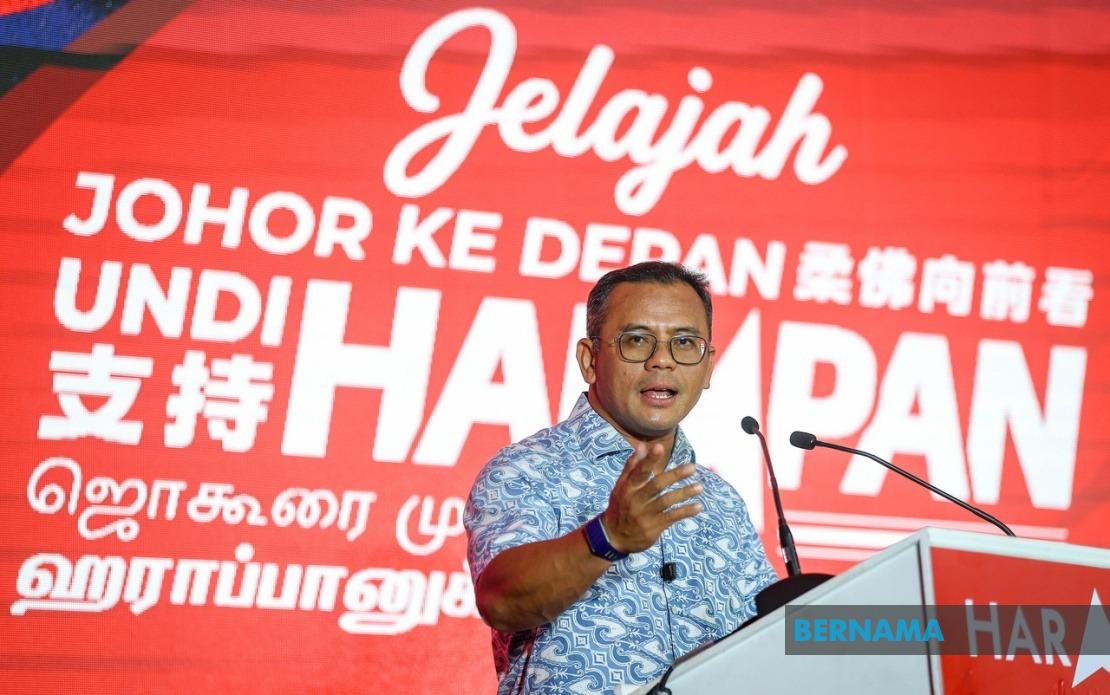
Pakatan Harapan's entry into Johor's political contest reflects a broader strategy to reframe state governance around sustainable and geographically inclusive development, according to PKR vice-president Datuk Seri Amirudin Shari, who emphasised the coalition seeks to strengthen, not destabilise, the southern state. Speaking in Batu Pahat ahead of the July 11 state election, Amirudin articulated a vision of Johor that transcends its dominant commercial hub, positioning the coalition as a corrective force against what he characterises as lopsided economic geography that has left peripheral regions struggling to keep pace with development gains concentrated in the capital district.
The case Amirudin presents hinges on a specific economic paradox: despite Johor attracting substantially larger foreign and domestic investment than neighbouring Selangor in the past fiscal year, the quantum of employment generated has fallen significantly short of what rival state has achieved. Johor's RM101 billion in investments, he noted, produced fewer than 40,000 jobs in net terms, a figure dwarfed by Selangor's RM83 billion intake that translated into 60,000 openings. This disparity, central to PH's campaign messaging, suggests that investment quality and employment capacity remain disconnected—a structural problem requiring administrative and strategic intervention rather than merely attracting fresh capital into existing concentrated zones.
The regional inequality argument carries particular resonance across Johor's diverse constituencies. Income disparities between Johor Bahru and interior districts such as Segamat remain stark, reflecting decades of development clustering around the port city and its industrial catchment. Communities in the northern, eastern, and western portions of the state have historically experienced slower growth trajectories, resulting in youth migration patterns toward Singapore or more developed Malaysian corridors. Amirudin's acknowledgement that "Johor is more than just Johor Bahru" directly addresses this lived grievance, framing PH's participation not as external interference but as recognition of marginalised constituencies whose economic aspirations remain unfulfilled under incumbent administration.
At the heart of PH's proposed solution lies strategic alignment between state investment promotion and federal development initiatives, particularly the Johor-Singapore Special Economic Zone framework. By positioning state governance as a facilitating partner to federal projects, Amirudin suggests that PH would unlock higher-value economic activities that generate better-remunerated employment. The reference to daily cross-border commuting to Singapore—a common reality for thousands of Johor residents despite living within Malaysia—carries implicit critique of the current government's failure to create sufficiently attractive domestic opportunities. PH's framing positions job creation not merely as numerical targets but as quality employment that reduces the economic necessity of external commuting.
Amirudin, who simultaneously holds the position of Selangor Menteri Besar and serves as PKR's election director, brings comparative governance experience to his messaging. His invocation of Selangor's employment performance implicitly benchmarks Johor against a state PH has administered, suggesting transferable competence in translating investment into sustainable livelihoods. This comparison operates on two levels: it demonstrates PH's track record in managing economic growth across multiple administrative levels, and it implicitly challenges incumbent Johor leaders to justify the efficiency gap between capital attraction and job creation in their own state.
The coalition's commitment to an "open leadership" governance model represents another dimension of its campaign positioning in Johor. This phraseology appears designed to contrast with perceptions of insularity or preferential treatment that may characterise relationships between current state leadership and particular economic or political constituencies. By invoking transparency and inclusive administrative practices, PH appeals to voters who perceive themselves as marginalised by existing power arrangements, whether geographically, ethnically, or economically.
The "Jewel of the South" branding initiative encapsulates PH's aspirational messaging for Johor—a state imagined as a source of pride and prosperity benefiting all residents rather than enriching narrow segments. This rhetoric acknowledges Johor's foundational importance to Malaysian federalism while suggesting that its potential remains unrealised under present stewardship. The invocation of both Malaysia and its people as stakeholders in Johor's development projects the election beyond parochial state boundaries into national interest framing.
Johor's economic geography and PH's analytical approach hold implications extending beyond state politics into broader questions of regional development equity across Southeast Asia. As subnational governments compete for foreign investment amid regional economic integration, the disconnect between capital inflows and employment generation that Amirudin identifies reflects structural tensions evident across the region. Whether subnational governments can effectively redirect investment toward employment-intensive sectors whilst maintaining competitive advantage presents a persistent governance challenge that transcends party politics.
The 56-seat Johor contest, with polling scheduled for July 11 and early voting commencing July 7, will test whether regional development equity concerns mobilise sufficient electoral support to shift state governance. The presence of Amanah deputy president Datuk Seri Dr Mujahid Yusof at Amirudin's campaign event underscores PH's coalition coherence around its economic messaging. For Malaysian readers observing these elections, the outcome will signal whether development asymmetry and employment quality emerge as decisive electoral issues, potentially reshaping how regional politicians approach investment promotion and economic distribution across their constituencies.

