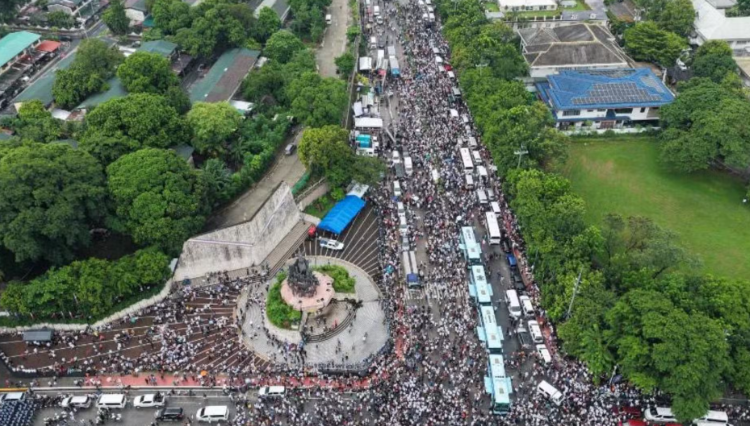
Thousands of members belonging to the Iglesia Ni Cristo, one of the Philippines' most influential religious organisations, descended on Manila's major thoroughfare EDSA on Tuesday to oppose the anticipated detention of Senator Rodante Marcoleta, creating significant traffic disruptions during the morning rush hour. The demonstration underscored the sect's continued clout as a political force while highlighting the deepening legal troubles enveloping former president Rodrigo Duterte's political network as he faces impeachment proceedings in the Senate.
Marcoleta's legal predicament emerged following an announcement by government ombudsman Jesus Remulla, who confirmed that charges would be filed against the senator for allegedly concealing 75 million pesos in unspent campaign contributions. The senator, who holds significant influence within the INC's inner circles, had been expected to serve as a crucial vote during impeached Vice President Sara Duterte's trial, which commences on 6 July. The overlap between Marcoleta's prosecution and the vice president's impeachment has created a perfect storm of political and religious mobilisation.
Police estimated the gathering at approximately 8,000 demonstrators during the morning hours, with expectations of further growth as the day progressed. The sheer scale of the turnout paralysed commuter movements along one of Metro Manila's most vital arteries, leaving only bus lanes passable and affecting countless workers and students attempting to reach their destinations. The disruption served as a potent reminder of the INC's capacity to mobilise its members for political purposes, a capability that has made the organisation a significant player in Philippine electoral politics for decades.
Through a Facebook video statement, INC spokesman Edwil Zabala articulated the sect's position, contending that the prosecution represented selective justice rather than principled law enforcement. Zabala's rhetoric framed the dispute not merely as a defence of one member but as a broader assertion about equitable treatment under the law, suggesting that the church viewed the charges as politically motivated rather than based on legitimate investigative findings. This framing proved instrumental in mobilising ordinary church members who may have had limited familiarity with the technical details of campaign finance violations but understood the message of institutional injustice.
The timing of the rally coincided with a period of unprecedented turbulence within Duterte's formerly dominant political coalition. Beyond Marcoleta's troubles, Senator Jose Estrada faced charges related to a massive corruption scandal involving fraudulent flood control projects that generated public outrage across the archipelago. Similarly, Senator Ronald Dela Rosa had gone into hiding to evade an International Criminal Court warrant connected to alleged extrajudicial killings perpetrated during Duterte's controversial war on drugs. This cascade of legal challenges demonstrated how swiftly the political fortunes of once-ascendant figures could deteriorate.
The INC's mobilisation on behalf of Marcoleta represented a calculated deployment of institutional resources during a critical moment in Philippine politics. The church had previously organised demonstrations numbering in the hundreds of thousands in November over the flood control scandal, though those events primarily directed criticism toward President Ferdinand Marcos rather than defending specific individuals. The organisation's willingness to stage major rallies repeatedly within a compressed timeframe illustrated both its organisational capacity and its determination to protect allies facing prosecution.
Marcoleta's forthcoming trial assumes particular significance because conviction would mathematically weaken Duterte's defensive position in her Senate trial. The Senate comprises twenty-four members, and a guilty verdict on impeachment charges requires sixteen votes. Each confirmed absence or defection could prove decisive, making Marcoleta's continued presence and loyalty strategically invaluable. The senator's potential incarceration thus threatened to alter the arithmetic of the impeachment proceedings in ways unfavourable to the former president's cause, creating incentives for the INC to mobilise its members aggressively.
President Ferdinand Marcos responded to the unfolding situation by cancelling a scheduled luncheon with foreign journalists, prioritising what his office characterised as necessary monitoring of events. This decision reflected the gravity with which the administration viewed the potential for escalating civil unrest or further disruptions to urban life. The cancellation also signalled that senior officials were treating the INC's actions as more than a mere religious expression, recognising them instead as politically significant demonstrations requiring executive attention.
The INC's political activism has deep historical roots in Philippine democracy. The organisation has functioned as a bloc voter for decades, wielding disproportionate influence in electoral contests through its capacity to deliver substantial numbers of disciplined supporters. The Duterte family maintained close associations with INC leadership, and this relationship had been cemented through years of political cooperation and mutual benefit. Marcoleta's prominence within the church hierarchy elevated his political importance beyond his individual senatorial position, making his defence a matter affecting the broader institutional interests of the INC within the political system.
Looking forward, the convergence of Marcoleta's prosecution and Duterte's impeachment trial will likely shape Philippine politics throughout the coming months. If the senator faces incarceration before or during the trial proceedings, the dynamics of the Senate vote could shift substantially. Conversely, if legal processes stall or judicial interventions occur, the trajectory remains uncertain. The INC's show of strength through its Tuesday demonstration conveyed that the organisation intends to remain an active, assertive player in these contests rather than a passive observer.

