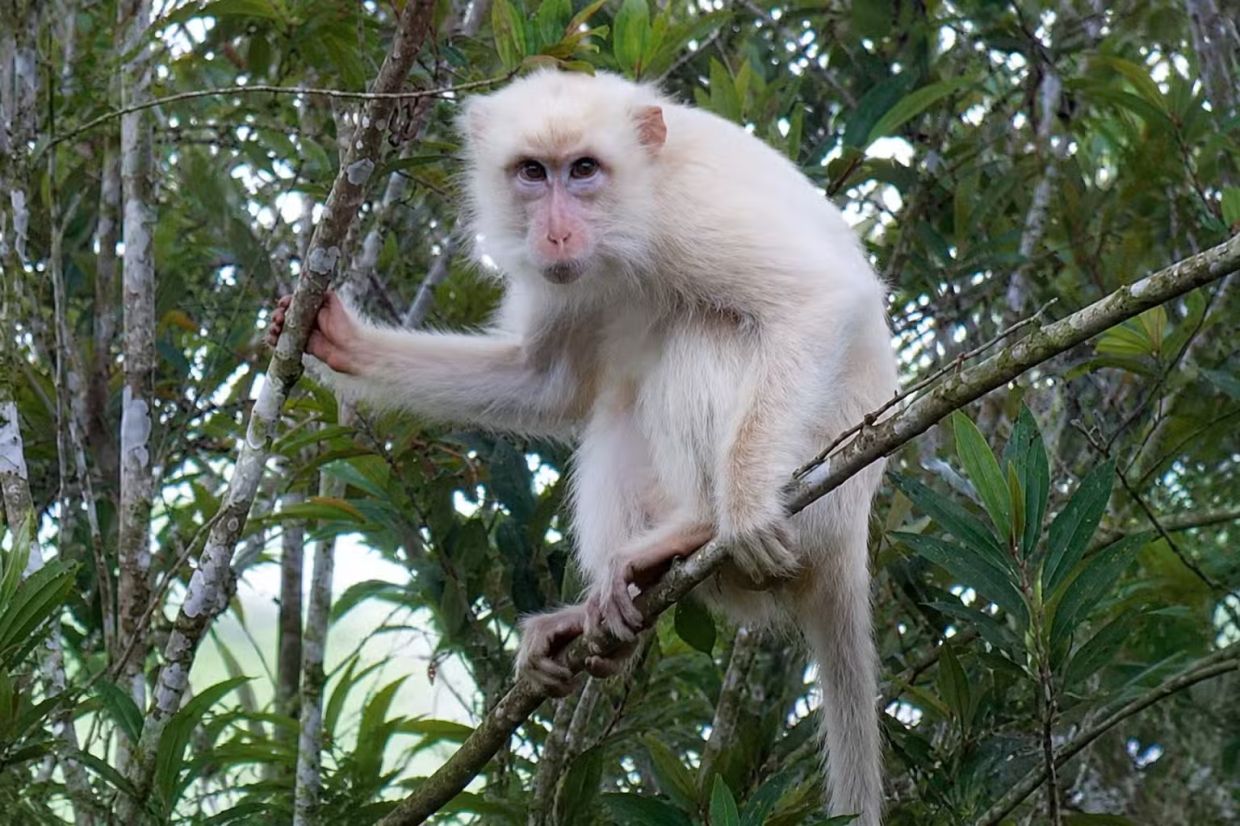
A distinctive white-furred macaque that has roamed the forests of Sultan Kudarat province for nearly a decade has become the unexpected focal point of a coordinated conservation initiative by Philippine environmental authorities. The animal's emergence into public consciousness through social media has prompted officials to implement immediate protective restrictions and develop longer-term safeguarding strategies, illustrating the complex challenge of balancing species preservation with digital-age visibility.
The macaque, identified as a Philippine long-tailed macaque with an unusual pigmentation condition, initially drew the attention of residents in Senator Ninoy Aquino town, who observed it regularly traversing the local forest ecosystem. Its pale colouration distinguishes it markedly from the typical appearance of other members of the macaque population in the region, making it particularly vulnerable to capture once its existence became widely known through online platforms. When photographs and videos began circulating across social media networks, conservation officials recognised the potential danger posed by sudden public interest in the animal's location and welfare.
The Department of Environment and Natural Resources Region XII partnered with local government units to conduct a comprehensive field assessment of the macaque and its immediate environment. Initial observations suggested the animal might have albinism, but field teams led by DENR XII experts documented features inconsistent with this diagnosis, including distinctly brown to dark brown eye pigmentation. Specialists now believe the condition may constitute leucism or an alternative pigmentation anomaly, though definitive scientific verification remains pending. The Biodiversity Management Bureau will receive formal documentation for technical evaluation and species classification purposes.
Research into the macaque's history reveals that local resident Armando and other community members have encountered the animal regularly since 2016, suggesting it represents an established member of the regional wildlife population rather than a recent arrival or escapee. The habitat surrounding the sighting area maintains suitable conditions for the species, with secondary forest vegetation and naturally occurring food sources continuing to sustain the broader macaque population. This ecological stability indicates that targeted protection measures can be implemented without requiring extensive habitat reconstruction or ecosystem rehabilitation.
Authorities identified multiple threats accompanying the animal's viral visibility. Poaching, wildlife trafficking networks, unauthorised capture attempts, and deliberate disturbance of the macaque's natural behaviour all emerged as serious concerns following the social media circulation of its images. The Philippine Wildlife Resources Conservation and Protection Act, formally known as Republic Act No. 9147, establishes comprehensive legal protections for all wildlife, prohibiting hunting, capture, collection, transportation, and trading without official permits. However, enforcement becomes substantially more challenging once a species attracts public attention and amateur naturalists begin seeking direct encounters.
In response to these escalating risks, the municipal government of Senator Ninoy Aquino town implemented temporary closure of the area where the macaque is frequently observed. Barangay Bugso, the specific administrative division where most sightings occur, has commenced preparation of a municipal ordinance designed to establish permanent legal protection for the white macaque, its habitat, and the surrounding forest ecosystem. Until formal enactment occurs, unauthorised access to the immediate vicinity of documented sighting locations remains officially prohibited, with local officials responsible for enforcement and monitoring.
The barangay administration has begun planning complementary conservation initiatives intended to strengthen ecosystem health while demonstrating commitment to responsible wildlife stewardship. Tree-planting campaigns and habitat-restoration activities are scheduled to proceed alongside the protection measures, creating opportunities for community participation in biodiversity conservation. These initiatives simultaneously serve as frameworks for developing responsible ecotourism practices that could allow controlled, sustainable community engagement with the natural environment without exposing the white macaque to excessive disturbance or capture risk.
DENR officials have issued explicit public appeals addressing the digital ecosystem's role in wildlife endangerment. Vloggers, photographers, journalists, and social media users have been urged to refrain from publishing precise geographic coordinates, geotagged content, or detailed location descriptions that could facilitate unauthorised access or predatory activities targeting protected species. This guidance reflects growing recognition among conservation professionals that viral documentation, despite appearing to serve educational purposes, can rapidly convert protected wildlife into targets for exploitation and trafficking networks across Southeast Asia.
The case of the Sultan Kudarat macaque reflects broader regional conservation challenges confronting Southeast Asian nations as digital connectivity accelerates the commodification of unusual species. Malaysia, Indonesia, and other nations in the region have similarly confronted situations where social media virality precipitated dramatic increases in wildlife trafficking and poaching pressure. The Philippines' coordinated response—combining legal protection, habitat preservation, public education, and deliberate information control—represents an integrated conservation model that other Southeast Asian countries may adapt to their own endangered species protection efforts.
Continuing surveillance and adaptive management will remain essential as DENR XII maintains ongoing habitat monitoring and coordination with local stakeholders throughout implementation of formal protection measures. The department's commitment to intensified information campaigns on wildlife protection demonstrates acknowledgment that long-term species preservation requires sustained community education alongside regulatory enforcement. For the white macaque, the transition from unnoticed inhabitant of Sultan Kudarat's forests to recognised subject of formal conservation attention marks a critical juncture determining whether its unusual genetic characteristics will be preserved for future generations or lost to trafficking and poaching networks already active throughout the region.

