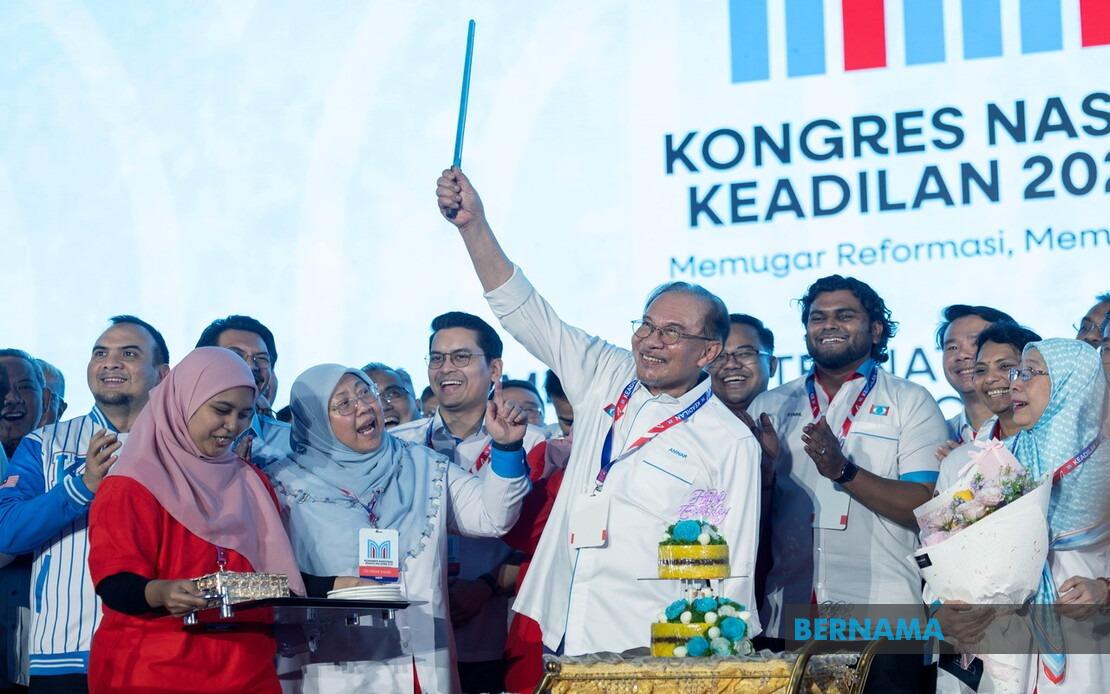
The PKR National Congress 2026, held in Melaka, concluded with party leadership reinforcing dual priorities: maintaining the political equilibrium of the Unity Government while preserving the reformist identity that has defined the party since its inception. The two-day gathering highlighted an inherent tension within PKR's current position—how to function as a government partner without abandoning the transformative agenda that secured its electoral appeal and organisational cohesion.
PKR president Datuk Seri Anwar Ibrahim used his closing address to pledge continued defence of the Unity Government coalition, framing political stability as prerequisite for economic advancement and societal prosperity. As Pakatan Harapan chairman, Anwar stressed that PKR's commitment to this arrangement reflects measured political pragmatism rather than ideological compromise. However, he carefully circumscribed PKR's agency, indicating that the long-term viability of the coalition depends substantially on UMNO and Barisan Nasional's reciprocal commitment—a reminder that the government's stability remains contingent on broader consensus among multiple power centres.
The Prime Minister issued a pointed caution to all coalition members against destabilising actions, characterising the Unity Government as an arrangement built on constitutional responsibility and national interest rather than transactional politics. This framing carries significance for Malaysian political observers, as it attempts to elevate the coalition beyond mere convenience while implicitly warning against the kind of brinkmanship that has periodically threatened governmental continuity. Anwar's emphasis on this distinction suggests awareness that public confidence in the administration depends on demonstrable commitment from all participating parties.
A central narrative threading through the congress focused on PKR's ability to effect meaningful reforms despite holding ministerial positions within a broader coalition government. Deputy president Nurul Izzah Anwar underscored this point, arguing that reform momentum cannot stall simply because the party has assumed state responsibilities. She pointed to the repeal of the Universities and University Colleges Act (AUKU) 1971 as concrete evidence that transformative change remains achievable within a government framework. This accomplishment carries particular resonance for Malaysia's educated classes and younger demographics, constituencies PKR has historically mobilised through advocacy for academic freedom and democratic participation.
Expanding on the AUKU matter, Anwar provided assurances that the government would not introduce replacement legislation that could reimpose restrictions on student activism and expression. Instead, he proposed that existing criminal law provisions offer sufficient mechanisms to address genuine misconduct without requiring university-specific restrictions. This position reflects a deliberate choice to distinguish between legitimate governance concerns and excessive control—a nuance that matters considerably in a regional context where student movements have historically served as crucibles for political change. The commitment to Cabinet-level review signals institutional seriousness around the matter.
PKR Wanita chief Fadhlina Sidek, concurrently serving as Education Minister, articulated demands for expanded female representation in both party structures and government decision-making. Her emphasis on leadership openness to constructive criticism suggests recognition that governance legitimacy depends on genuine receptiveness to dissenting perspectives. For Malaysian women in professional and political spheres, this emphasis carries practical implications, as institutional positions on accountability and transparency directly influence whether women's concerns receive substantive consideration or perfunctory acknowledgment.
The congress also showcased PKR's organisational approach to political readiness, with party officials stressing that membership should maintain preparedness for electoral contestation without requiring formal signals such as parliamentary dissolution or candidate declarations. This emphasis reflects a hardened organisational culture attuned to Malaysian politics' volatility and the potential for rapid shifts in coalitional alignment. For regional observers, this readiness posture demonstrates how Malaysian political parties have adapted to an environment where electoral mathematics can shift unexpectedly.
Angkatan Muda Keadilan, PKR's youth wing, prioritised economic empowerment within emerging technology sectors—artificial intelligence, semiconductors, and biotechnology—with particular attention to Bumiputera participation and equity. This focus acknowledges Malaysia's positioning within global technological competition while addressing legitimate concerns about equitable access to high-value sectors. For Generation Z and younger workers, the wing simultaneously raised bread-and-butter issues including gig economy formalisation, enhanced social protections, mental health support, and credible skills development pathways. These concerns reflect structural economic shifts that have displaced traditional employment arrangements without establishing corresponding social safety nets.
The gathering's overall tenor suggests PKR leadership views the congress as an opportunity to consolidate internal consensus around a governing strategy that preserves reform credibility while acknowledging coalition realities. This balancing act appeals to different party constituencies—those prioritising stability can highlight PKR's constructive governmental role, whilst reform advocates can reference AUKU repeal and policy improvements as evidence that participation has not compromised principles. Whether this narrative remains persuasive will depend substantially on tangible policy advances over subsequent years and on maintaining coalition stability itself.
For Malaysia's broader political ecosystem, the congress demonstrates how one coalition partner manages the perpetual tension between oppositional identity and governmental responsibility. PKR's emphasis on reform persistence while governing suggests a model distinct from parties that either wholly abandon earlier commitments upon assuming power or maintain purely adversarial stances incompatible with coalition membership. The sustainability of this approach depends on whether measurable improvements in governance quality, economic opportunity, and institutional accountability accumulate sufficiently to justify the compromises inherent in coalition participation—a test that will play out across the coming electoral cycle and shape both party fortunes and Malaysian politics' future configuration.

