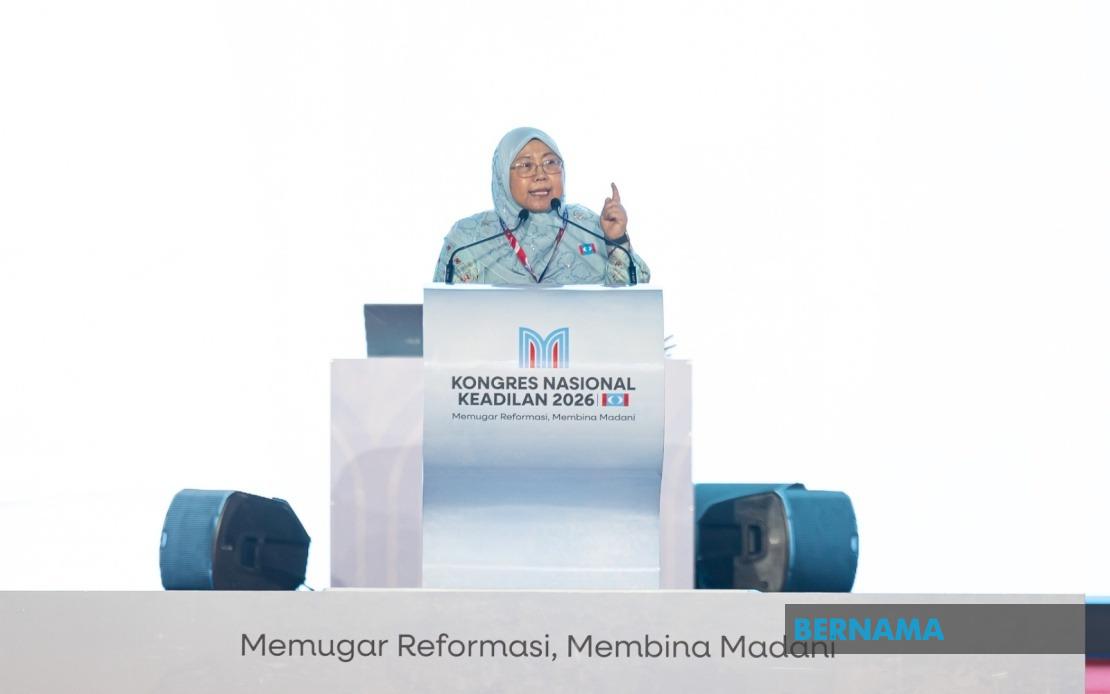
Parti Keadilan Rakyat leadership gathered in Melaka this week delivered a clear message to the grassroots: electoral reverses need not define the party's trajectory. At the 2026 PKR National Congress held at the Melaka International Trade Centre in Ayer Keroh, secretary-general Senator Datuk Dr Fuziah Salleh articulated a vision of resilience, urging members and leaders to channel recent disappointments into a reinvigorated commitment to organisational strengthening rather than internal recrimination. The appeal comes at a moment when PKR faces mounting pressure to demonstrate stability and forward momentum within an increasingly fractious Malaysian political landscape.
Fuziah's framing of the congress as an occasion for measured introspection rather than finger-pointing reflects a deliberate strategic choice. She explicitly cautioned against using the gathering as a venue for members to apportion blame or seek retribution regarding the party's electoral performance or its current predicaments. Such directness suggests that underlying tensions exist within PKR's ranks—tensions that party leadership recognises could festoon or even derail efforts at renewal if allowed to metastasise unchecked. By setting clear behavioral expectations at the outset, the secretary-general attempted to create intellectual and emotional space for constructive dialogue centred on institutional rejuvenation rather than factional score-settling.
The congress theme, "Memugar Reformasi, Membina MADANI," carries particular resonance given PKR's foundational narrative. The word "memugar" signals not a wholesale ideological overhaul but rather a conscious retrieval and revitalisation of the original Reformasi impulse that animated the party's creation. Fuziah underscored that this approach differs fundamentally from chasing novel ideals; instead, PKR seeks to recover and adapt the underlying values and principles that once galvanised its membership and gave moral weight to its political challenge. This distinction matters significantly in a context where Malaysian voters have grown sceptical of parties perceived as adrift or in thrall to expedient reinvention.
Fuziah drew an instructive historical parallel to contextualise the party's present difficulties. She recalled the 2004 General Election, when PKR won only a single parliamentary seat—an outcome far more catastrophic in raw numerical terms than recent setbacks. Despite that nadir, the party persisted in cultivating its organisational infrastructure, deepening grassroots engagement, and propagating the Reformasi message across the nation. That durability and refusal to capitulate transformed PKR into a formidable political force capable of shaping national outcomes. The invocation of this historical trajectory serves multiple purposes: it reinforces leadership's conviction that current travails are surmountable, it demonstrates that institutional memory contains resources for resilience, and it implicitly cautions members against precipitous despair.
The scale of the congress underscores the party's attempt to project unity and organisational vitality. With 2,594 accredited delegates and more than 2,000 observers converging on Melaka, coupled with attendance from 26 diplomatic representatives spanning 19 countries—including six ambassadors—PKR sought to demonstrate that it remains a force commanding international diplomatic attention and commanding significant domestic mobilisation capacity. This pageantry serves important functions, signalling to supporters that the party retains structural coherence and continues to attract serious engagement from the global community.
Fuziah's exhortation that members avoid allowing past disappointments to dictate future horizons contains an implicit psychological insight. Organisational momentum and morale are fundamentally intertwined with perception and narrative. When members fixate on defeat, they unconsciously internalise narratives of decline, which manifests as reduced volunteerism, dampened donation flows, and diminished enthusiasm for canvassing and community outreach. By contrast, framing past setbacks as temporary obstacles within a longer arc of struggle and periodic renewal can psychologically reorient members toward agency and possibility. The secretary-general's intervention thus operates simultaneously as practical leadership instruction and as a form of collective psychological repositioning.
The emphasis on "strengthening and renewing the agenda" rather than wholesale departure from foundational principles reflects a sophisticated reading of Malaysian political temperament. Voters often punish parties perceived as abandoning their core constituencies or ideological moorings. PKR's challenge is to remain faithful to its anti-corruption, democratic reform, and social justice positioning while adapting tactical approaches and policy emphasis to address contemporary concerns—inflation, employment precarity, education quality, environmental sustainability. The congress framing suggests party strategists recognise this delicate equilibrium.
For the broader Malaysian political ecosystem, PKR's internal renewal efforts carry significant implications. As a key component of various coalition iterations, the party's organisational health and internal cohesion directly influence the stability and effectiveness of any government formation involving Pakatan Harapan or successor groupings. A PKR beset by unresolved grievances and factional strife inevitably becomes vulnerable to defections and parliamentary miscalculations. Conversely, a party that successfully transmutes electoral setbacks into organisational learning and member recommitment becomes a more reliable coalition partner and a more credible opposition force.
The congress's deliberate positioning as a moment for reflection on "the bitter experiences" members have endured warrants close observation in coming months. How party mechanisms translate Fuziah's aspirational rhetoric into concrete policy reforms, candidate selection protocols, campaign strategies, and grassroots support structures will determine whether this gathering represents genuine institutional reckoning or performative theatre. Malaysian political history abounds with instances where congresses and party conferences produced eloquent calls for renewal that dissipated without substantive implementation.
Looking ahead, the 2026 timeframe carries strategic significance. General elections need not occur before 2027, affording PKR roughly eighteen months for party-building initiatives and message refinement. Whether this window proves sufficient to reverse electoral trajectories remains uncertain. Nevertheless, Fuziah's insistence on mature reflection and renewed determination suggests leadership understands that sustainable political recovery demands more than rhetorical flourishes—it requires painstaking work to restore member confidence, articulate compelling policy visions, and demonstrate that the Reformasi project remains vital to contemporary Malaysian aspirations.

