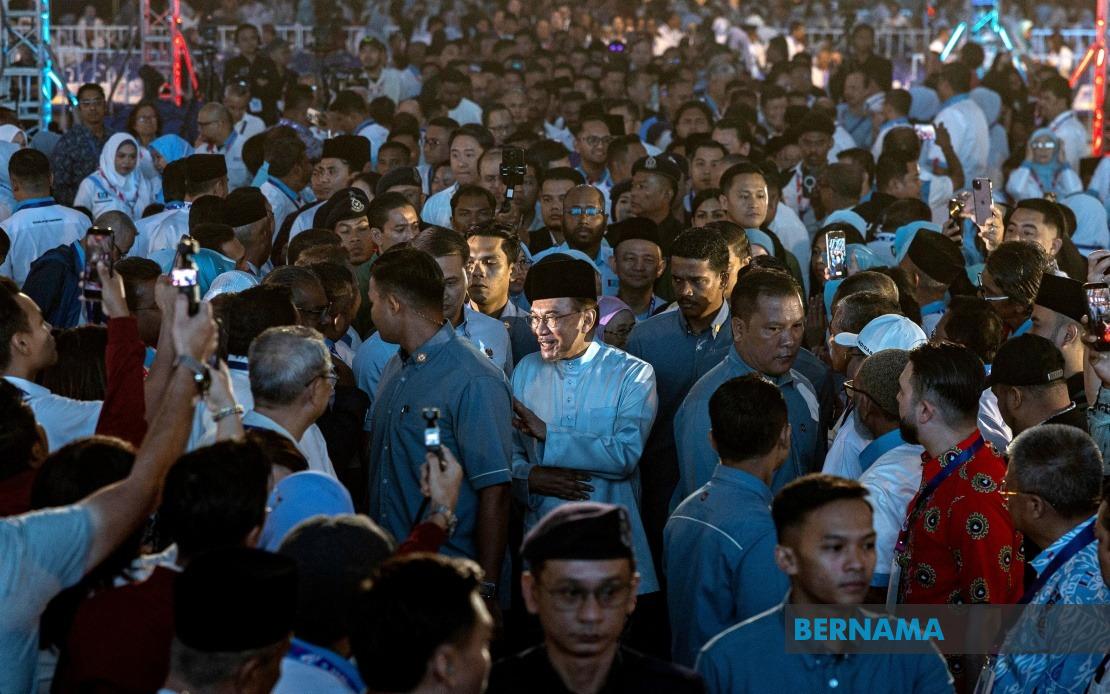
The Prime Minister's senior political adviser, Tengku Datuk Seri Zafrul Tengku Abdul Aziz, has called on the People's Justice Party (PKR) to seize the 2026 National Congress as a critical juncture for internal consolidation and public confidence restoration. Speaking as an ex-officio member of the PKR Political Bureau, Tengku Zafrul emphasised that the gathering must transcend routine party proceedings to become a meaningful platform for honest introspection and organisational renewal.
The remarks arrive at a delicate moment for PKR within Malaysia's Unity Government coalition. Recent state election outcomes have prompted difficult questions about the party's electoral performance and its capacity to deliver on campaign promises. Rather than deflecting responsibility onto coalition partners, Tengku Zafrul has steered the conversation inward, suggesting that PKR's pathway to recovery lies primarily in diagnosing and remedying internal deficiencies. This framing reflects a recognition that while the Unity Government structure constrains individual party performance, voter dissatisfaction ultimately reflects on PKR's own effectiveness and messaging.
Tengku Zafrul has specifically urged party members to undertake comprehensive assessments of the party's operational weaknesses across all organisational levels. He emphasised the need to strengthen party machinery from grassroots divisions through to the central leadership apparatus, implying that disconnects between different tiers may be hampering both internal coordination and public outreach. This hierarchical focus suggests concerns that PKR's volunteer networks and local branches may lack adequate resources, training, or strategic direction to effectively represent party interests in their constituencies.
The adviser's call for honest self-reflection carries particular weight given the party's historical trajectory. PKR has positioned itself as a reformist force advocating accountability and transparency in governance, yet recent electoral setbacks have exposed a credibility gap between these values and actual party performance. Acknowledging this paradox publicly signals that senior leadership recognises the necessity of walking the talk internally before claiming moral authority on broader governance issues.
Communication deficiencies feature prominently in Tengku Zafrul's analysis. He noted that even when PKR delivers tangible results for constituents, the party may have failed to articulate these achievements compellingly to the broader public. This observation highlights a critical vulnerability in contemporary politics: effective governance alone proves insufficient without accompanying narrative control and strategic communication. Malaysian voters increasingly expect political parties to demonstrate not just what they have accomplished, but to explain clearly why their contributions matter and how citizens benefit. PKR's apparent struggle in this domain suggests potential weaknesses in its communications infrastructure, media engagement capabilities, or strategic messaging frameworks.
Equally significant is Tengku Zafrul's counsel that party members must fundamentally reorient their approach to constituent engagement. Rather than rushing to defend party positions or counter opposition narratives, he advocates for genuine listening to public grievances. This approach acknowledges that many voters hold legitimate concerns regardless of political affiliation, and that dismissing these concerns as partisan opposition simply widens the trust deficit. The emphasis on acknowledging unresolved problems before attempting solutions reflects a more sophisticated understanding of political legitimacy—one grounded in demonstrated responsiveness rather than partisan rhetoric.
The adviser's framework implicitly recognises that PKR's position within the Unity Government coalition creates particular challenges. Since the coalition includes multiple parties with distinct interests, PKR cannot simply blame partners for collectively unpopular policies. Instead, Tengku Zafrul suggests that PKR must distinguish its own policy contributions and messaging to differentiate itself within the coalition framework. This becomes particularly important for a party that has long positioned itself as the reformist alternative to established political structures.
For Malaysian readers and political observers across Southeast Asia, Tengku Zafrul's intervention reflects broader challenges facing reformist political movements in the region. Coalition governance requires compromise that can blur party identities and dilute public expectations management. PKR's experience demonstrates that even parties with clear ideological positioning must navigate the complexities of shared power, where individual party performance becomes difficult to isolate and communicate to voters. The 2026 congress, in this context, becomes more than routine party business—it represents an opportunity to clarify PKR's distinct vision and value proposition within Malaysia's increasingly fragmented political landscape.
The emphasis on strengthening party machinery at grassroots levels also carries implications for Malaysia's broader democratic health. If established political parties struggle to maintain effective organisational structures and constituent engagement, this vulnerability potentially creates space for alternative political formations or extra-institutional mobilisation. Tengku Zafrul's call for organisational investment thus serves not just PKR's electoral interests but also the maturation of Malaysia's party system more generally.
Looking ahead to 2026, the congress will test whether PKR can translate Tengku Zafrul's prescriptive framework into concrete organisational reforms. The party's capacity to emerge from this process with renewed credibility and operational effectiveness will significantly influence Malaysia's political trajectory in the latter half of this decade. Whether PKR can rebuild public trust while navigating coalition responsibilities remains one of the most consequential questions facing Malaysian politics.

