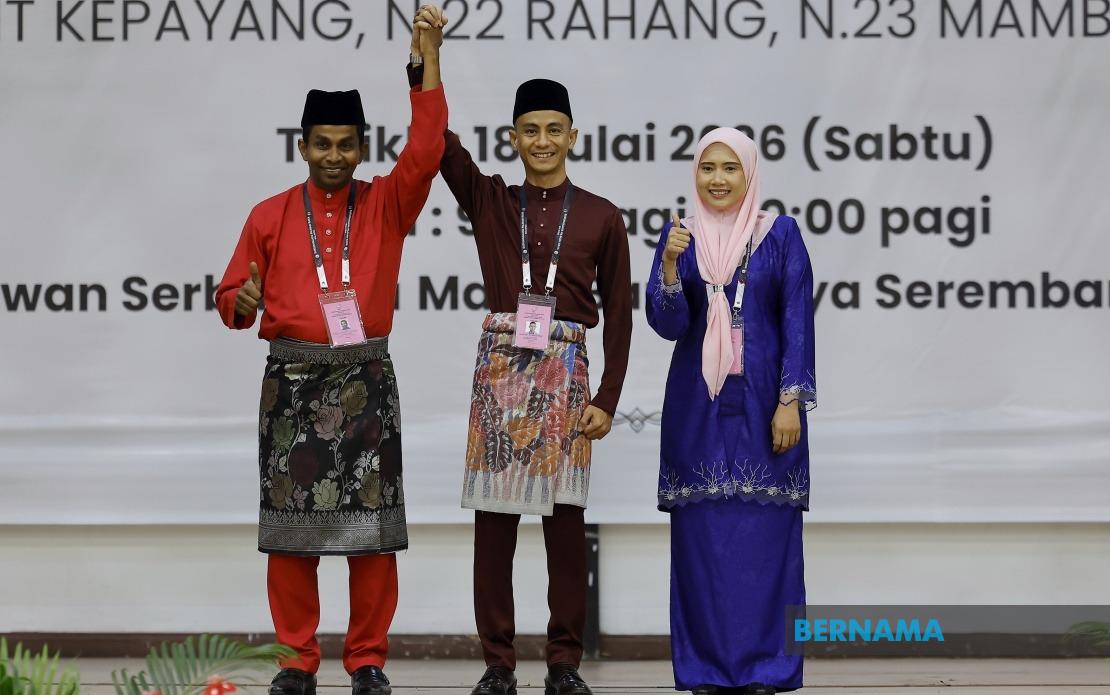
Datuk Ahmad Faez Abdul Razak stepped forward as Pakatan Harapan's candidate for the Labu state seat in Negeri Sembilan's 16th election, framing his first political contest as a mandate to reclaim the constituency for the coalition. Speaking after nomination proceedings in Seremban on July 18, the PKR contender acknowledged the emotional weight of his electoral debut whilst expressing confidence in his grassroots work over the past two years and eight months.
Ahmad Faez's entry into the contest reflects PH's determination to wrest back Labu from Mohamad Hanifah Abu Baker of Bersatu, who currently holds the seat with a narrow 1,640-vote advantage from the 2023 election. That previous result saw the incumbent secure 10,021 votes against PKR's Datuk Ismail Ahmad, a margin that underscores the constituency's competitive nature. The addition of Barisan Nasional candidate Siti Nur Umaira Hasim creates a three-way battle that could prove decisive, given Mohamad Hanifah's slim majority in a constituency containing 32,884 registered voters.
The property developer brings professional credentials to his campaign platform, positioning himself as uniquely qualified to navigate Labu's most pressing tension: balancing accelerated growth with community welfare. His dual background as both an investor and long-term resident worker offers him a potential advantage in speaking credibly to both development aspirations and residential anxieties. Ahmad Faez articulated this positioning explicitly, arguing that his industry experience allows him to understand how construction projects and new economic opportunities can be integrated without overwhelming existing communities.
Labu's rapid expansion stems largely from its location within the Malaysia Vision Valley development corridor, a vast project spanning 11,000 to 12,000 hectares designated for mixed industrial and residential use. This scale of planned change could fundamentally reshape the constituency's character within years, bringing employment prospects but also infrastructure strain, environmental concerns, and social disruption. Ahmad Faez's acknowledgement that "development must be carefully managed to safeguard the well-being of the community" suggests he recognises these legitimate concerns among voters weary of uncontrolled expansion elsewhere in Negeri Sembilan.
Central to his manifesto is a commitment to establish a dedicated community centre and recreational facility focused on youth engagement. This pledge directly addresses an identified gap in services, indicating his campaign has conducted sufficient ground-level consultation to pinpoint concrete deficiencies. Youth facilities often serve broader purposes than mere recreation—they provide safe spaces, reduce social tension, and signal government attentiveness to younger voters who frequently feel marginalised in constituency development discussions. For a rapidly growing area attracting new families, such infrastructure becomes essential to maintaining social cohesion amid demographic change.
Ahmad Faez's optimism rests partly on evident support building during his extended presence in the constituency, though he remained candid about first-election jitters. His exposure to local concerns over nearly three years positions him differently from candidates parachuted into seats immediately before elections. This embedded presence allows him to speak with specificity about Labu's character and challenges rather than generic campaign rhetoric, potentially resonating with residents seeking leaders who understand their daily realities.
The timing of the election—with early voting on July 28 and polling on August 1—compresses the campaign window, advantaging candidates with pre-existing community networks. Ahmad Faez's prior groundwork thus becomes a tangible asset against opponents lacking similar embedding, though incumbent Mohamad Hanifah benefits from the institutional advantages of holding office and demonstrated voter loyalty. The three-way contest introduces unpredictability; tight races can swing on voter turnout, tactical voting, and how undecided voters ultimately break.
From a broader Negeri Sembilan perspective, Labu's result will reflect wider coalitional dynamics. PH's performance across the state, alongside Bersatu's positioning and BN's revival efforts, will determine which bloc ultimately governs. A constituency this competitive, with a property developer offering development-friendly policies, also suggests PH is actively competing for middle-class, aspirational voters traditionally allied with growth-oriented parties. Ahmad Faez's messaging—emphasising his ability to deliver both progress and protections—reflects this strategic positioning.
The challenge Ahmad Faez faces transcends simply winning votes; it involves constructing a governing philosophy that acknowledges legitimate tensions between growth and livability. Malaysian constituencies increasingly confront this dynamic as urban expansion accelerates. His explicit commitment to "balance" rather than choosing between development or conservation stakes out moderate ground, potentially attractive to swing voters exhausted by polarised debate. However, converting campaign pledges about youth centres and managed growth into actual delivery would demand considerable political capital and cooperation across administrative levels.
For Malaysian observers tracking state elections, Labu exemplifies emerging patterns: younger, urban-oriented candidates leveraging professional expertise rather than solely party machinery; constituencies transformed by major infrastructure projects seeking reassurance about livability; and three-way contests where traditional two-coalition battlegrounds become unpredictable. Ahmad Faez's candidacy and messaging reflect these evolving political contours, even as the fundamental question—can development genuinely be balanced against community interests, or must one ultimately prevail?—remains unresolved by his campaign rhetoric alone.

