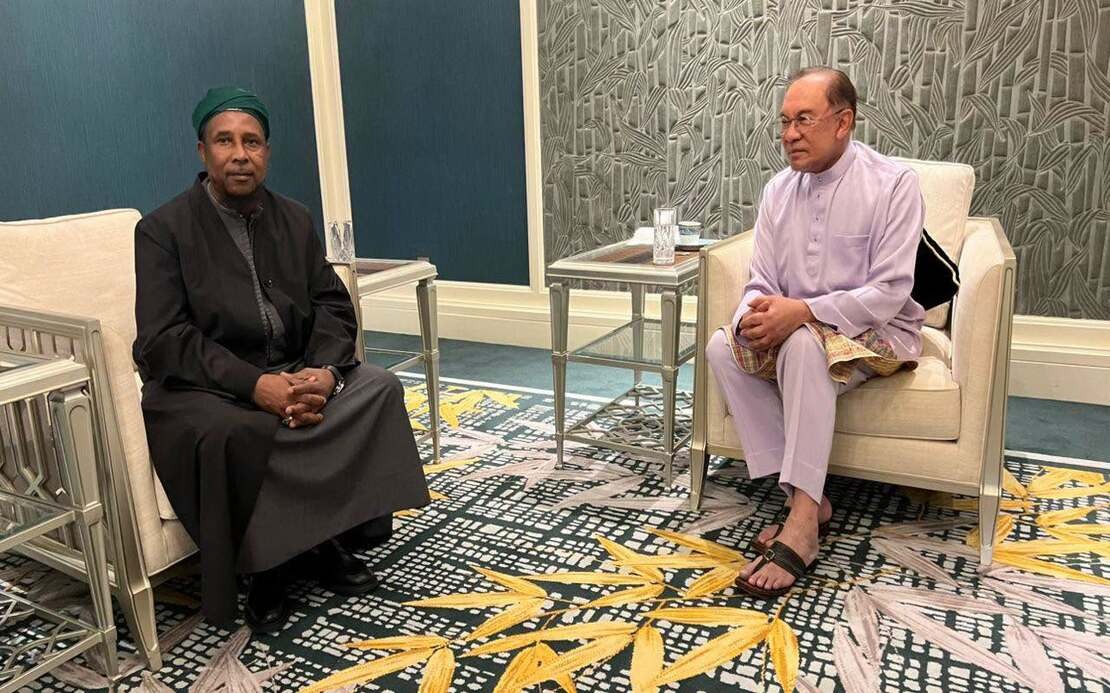
Prime Minister Datuk Seri Anwar Ibrahim hosted a farewell meeting on June 26 with Gambian Islamic scholar Sheikh Muhammad Haydara Al-Jilani, marking the conclusion of an extensive month-long visit to Malaysia devoted to religious instruction and spiritual gatherings. The encounter, documented on the Prime Minister's official social media channels, underscored the significance of cross-cultural Islamic scholarship in Malaysia's evolving religious landscape and its openness to engaging international Muslim thought leaders.
Sheikh Muhammad Haydara Al-Jilani's extended stay represents part of a coordinated dakwah initiative that leveraged his scholarly credentials to conduct a series of knowledge-exchange sessions and dhikr programmes at multiple venues throughout the country. The breadth of these activities indicates a deliberate effort to expose Malaysian Muslim communities to diverse Islamic perspectives and contemporary interpretations of Islamic teachings, particularly from West African Islamic traditions represented by the Gambian cleric.
The timing of the farewell audience coincided with the observance of the Day of Ashura, a significant date in the Islamic calendar marking the tenth day of Muharram. This convergence enabled the Prime Minister to request special supplications from the visiting scholar on behalf of the Malaysian nation. Such ceremonial moments, whether formally planned or coincidentally aligned, carry symbolic weight in diplomatic and religious contexts, signalling respect for Islamic observances and the sanctity of prayer in state affairs.
Anwar's documented remarks, shared via Facebook, emphasised his petition for the scholar's prayers concerning Malaysia's collective well-being, national peace, and continued divine favour. The invocation of Allah's mercy, blessings, and protection reflects standard terminology in Malaysian political discourse that acknowledges the Islamic foundations of national identity whilst appealing to broader values of social harmony and prosperity. This rhetorical approach has become characteristic of Anwar's leadership style, which emphasises inclusive Islamic governance that respects religious sentiment without imposing sectarian divisions.
The scholar's tour across multiple Malaysian locations speaks to a strategic approach in contemporary Islamic education and community engagement. Rather than concentrating his activities in a single urban centre, the distributed nature of Sheikh Muhammad Haydara Al-Jilani's programme demonstrates an intention to reach geographically dispersed Muslim populations and bring international scholarly perspectives to communities beyond major cities. This model of Islamic knowledge dissemination mirrors trends across Southeast Asia, where transnational religious movements and visiting scholars play increasingly important roles in shaping local theological discourse.
Gambia's position as a Muslim-majority West African nation creates a particular context for the scholar's mission. West African Islamic scholarship carries distinct historical traditions rooted in centuries-old Quranic schools and Islamic centres, notably the famous Timbuktu manuscripts and the broader Saharan Islamic intellectual heritage. The presence of such a scholar in Malaysia potentially introduces Malaysian Muslim audiences to alternative pedagogical methods, interpretive frameworks, and spiritual practices that diverge from the Middle Eastern or South Asian Islamic influences that have historically dominated Southeast Asian Islamic education.
The dakwah programmes conducted throughout the month represent a form of religious soft diplomacy that strengthens bilateral relations between Malaysia and Gambia whilst simultaneously enriching Malaysia's Islamic intellectual environment. For Malaysian participants, engagement with international Islamic scholars offers opportunities to contextualise their own religious practice within a broader global Muslim community and to encounter fresh approaches to perennial theological questions. Such exposure can foster theological sophistication and intellectual humility, countering insularity or rigidity in religious thinking.
From a diplomatic perspective, hosting visiting religious scholars and facilitating their teaching missions reinforces Malaysia's self-presentation as a hub of Islamic learning and interfaith tolerance within Southeast Asia. This positioning has become increasingly important as Malaysia navigates complex questions about religious identity, pluralism, and governance in an era of global religious competition and transnational Islamic movements. The Prime Minister's personal involvement in farewelling the scholar elevates the programme's significance and demonstrates official endorsement of international Islamic scholarly exchange.
The reference to specific locations for the scholar's activities, though not detailed in the available accounts, suggests a coordinated national strategy involving coordination between federal authorities and state-level religious administrators. Such coordination, whilst routine in administrative terms, underscores the integration of Islamic education into Malaysia's broader governance framework and the alignment between political leadership and religious institutional structures in facilitating knowledge transmission across the nation.
Looking forward, the legacy of Sheikh Muhammad Haydara Al-Jilani's visit may extend beyond the immediate participants who directly attended his sessions. In an era of social media and digital dissemination, recordings or accounts of his teachings potentially reach audiences far beyond those physically present at venues, creating ripple effects that influence theological discussions within Malaysian Muslim communities for months or years thereafter. The visit thus exemplifies how transnational religious movements operate through both traditional institutional channels and contemporary digital networks to shape Muslim consciousness across borders.

