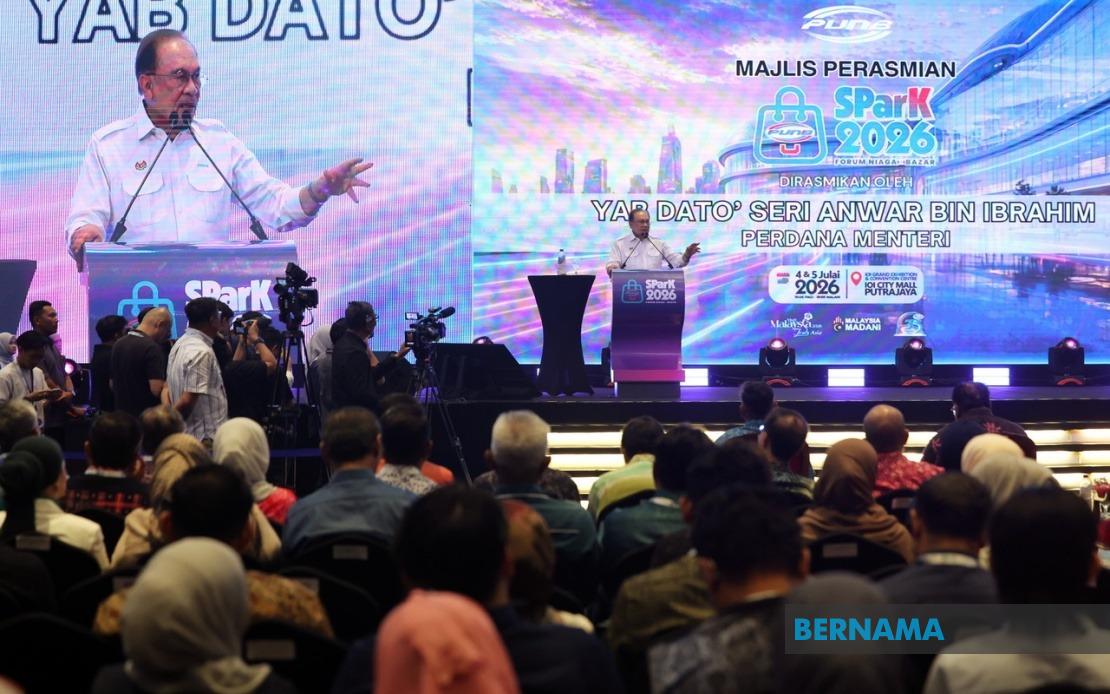
Prime Minister Datuk Seri Anwar Ibrahim has launched a direct assault on longstanding practices within Malaysia's government lending apparatus, demanding that support letters, political patronage and cronyism be eliminated from decisions to approve financing for entrepreneurs. Speaking at the SPaRK 2026 event organised by Perbadanan Ushawan Nasional Bhd (PUNB) in Putrajaya, Anwar, who doubles as Finance Minister, painted a stark picture of how decades of entrenched institutional habits have corroded the effectiveness of public support mechanisms for business development.
The core of Anwar's criticism centres on a systemic problem that has plagued Malaysia's entrepreneurial ecosystem for generations: the substitution of merit-based lending criteria with relationships, coloured endorsement letters—understood in Malaysian bureaucratic parlance to represent different political affiliations—and personal connections to power brokers. These mechanisms, he contended, do not strengthen the business community but instead weaken it by directing capital to recipients ill-suited to manage enterprises. The result is cascading business failures that damage both the individuals receiving support and the credibility of government institutions tasked with fostering entrepreneurship.
Anwar's remarks reveal frustration with a pattern of abuse that extends beyond simple inefficiency. He highlighted instances where loan recipients have diverted funds intended for business development into personal consumption and lifestyle improvements, including relocating to expensive offices and purchasing vehicles, before their ventures inevitably collapse. Such behaviour represents not merely poor business judgment but a misuse of taxpayer resources that demands stricter oversight and accountability. The Prime Minister's willingness to address this openly suggests an administration determined to reform lending practices that have become entrenched in Malaysia's bureaucratic culture.
The distinction Anwar drew between failures attributable to market forces and those caused by poor stewardship is analytically important for Malaysian policymakers and entrepreneurs alike. Economic cycles, shifting consumer preferences, and external shocks are inevitable challenges that even well-managed businesses must navigate. Distinguishing between these unavoidable setbacks and failures rooted in misappropriation or negligence is essential for designing better support frameworks. Government cannot shield businesses from competitive pressures, nor should it attempt to do so, but it can ensure that resources are allocated to entrepreneurs demonstrating genuine commitment and capability.
For Malaysia's entrepreneurial landscape, these remarks carry significant implications. The country's push toward developing a robust small and medium-sized enterprise (SME) sector has long been hampered by the perception that access to government-backed financing depends more on who one knows than what one can demonstrate. This perception, whether entirely accurate or not, has discouraged many capable entrepreneurs from pursuing formal channels for financing and has reduced the quality of applicant pools at institutions like PUNB. Reforming these practices could unlock genuine talent that has been bypassed in favour of politically connected but less capable operators.
The practice Anwar is targeting has deep historical roots in Malaysian governance. Colonial-era patronage systems were replaced after independence not with entirely merit-based frameworks but with systems that merged bureaucratic procedures with political influence networks. Multiple administrations have inherited and perpetuated these arrangements, creating institutional inertia that resists change. Breaking this cycle requires not just executive directives but structural reforms to loan evaluation processes, improved transparency in funding decisions, and stronger consequence frameworks for officials who permit political considerations to override professional judgment.
Anwar's emphasis on transparency and seriousness as criteria for receiving government assistance suggests a move toward more rigorous vetting mechanisms. This could involve enhanced business plan reviews, clearer performance metrics, and periodic assessments of how recipients are utilising funds. Such measures would require additional administrative capacity but would likely improve overall outcomes by filtering out applicants with weak intentions or capabilities. The approach also signals to the business community that government support comes with expectations and accountability, not merely as patronage to be exploited.
For Malaysian entrepreneurs genuinely committed to building sustainable enterprises, these reforms offer an opportunity to compete on a more level playing field. Those who have previously been disadvantaged by lacking political connections may find improved access to financing if support letters and coloured endorsements lose their currency in loan evaluations. This could broaden the pool of business founders and potentially increase innovation and economic dynamism across regions and communities that have historically been underrepresented in government-supported entrepreneurship programmes.
The regional dimensions of this issue extend beyond Malaysia's borders. Across Southeast Asia, similar patterns of patronage-based lending have hindered SME development and economic inclusion. Malaysia's efforts to reform its approach could serve as a model for neighbouring countries wrestling with comparable challenges. A demonstrated commitment to merit-based allocation of development resources would enhance Malaysia's credibility as a regional economic leader and could attract entrepreneurial talent seeking environments where success depends on capability rather than connections.
Implementing these reforms will present considerable challenges. Entrenched interests benefit from the current system and will resist change. Government agencies accustomed to operating within established networks may struggle with new evaluation protocols. Anwar's challenge, therefore, extends beyond rhetorical commitment to creating institutional mechanisms capable of enforcing the principles he has articulated. Success will require sustained political will, adequate resourcing for oversight bodies, and clear consequences for officials who circumvent reformed procedures.
The timing of Anwar's intervention is significant given Malaysia's broader reform agenda and the government's emphasis on combating corruption and improving governance standards. Entrepreneur loan financing represents a critical interface between state resources and private economic activity. Ensuring that this interface operates transparently and according to merit-based principles serves multiple policy objectives simultaneously: it strengthens the SME sector, improves public finance management, reduces opportunities for corruption, and builds institutional legitimacy. These interconnected benefits explain why Anwar has made this issue a priority for his administration.

