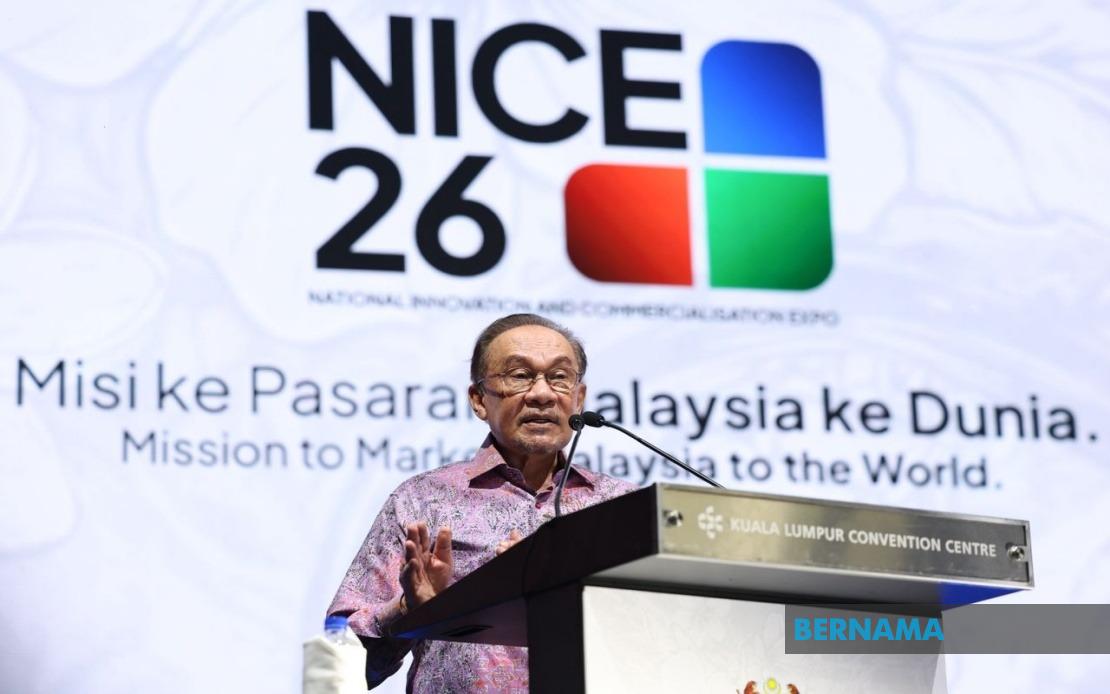
Prime Minister Datuk Seri Anwar Ibrahim has delivered a sharp critique of Malaysia's entrenched bureaucratic systems, arguing that outdated administrative procedures are undermining the nation's capacity to compete in the global innovation race. Speaking at the National Innovation and Commercialisation Expo (NICE) 2026 held at the Kuala Lumpur Convention Centre on Tuesday, Anwar emphasised that the country risks falling behind internationally unless government processes adapt to the accelerated demands of modern technology commercialisation.
The Prime Minister's intervention reflects growing frustration within the administration over institutional bottlenecks that constrain Malaysia's ability to respond quickly to emerging opportunities in fields such as artificial intelligence, biotechnology, and advanced manufacturing. Anwar articulated a fundamental tension between the measured pace of traditional governance structures and the velocity required by contemporary innovation ecosystems, where competitive advantage often depends on first-mover advantage and rapid market deployment.
To illustrate his point, Anwar highlighted a concrete success story that challenges conventional wisdom about institutional timelines. The establishment of artificial intelligence faculties at multiple Malaysian universities was accomplished within three months—a dramatic compression compared to the standard approval cycle, which typically stretches to twelve months or longer. This acceleration was achieved through streamlined decision-making rather than regulatory shortcuts, demonstrating that systemic change is operationally feasible without sacrificing institutional integrity.
The traditional pathway for faculty establishment involves multiple layers of institutional review, including senate deliberations, council consultations, and various departmental evaluations. While these safeguards serve legitimate purposes in ensuring academic quality and institutional coherence, Anwar contends they have become inappropriately rigid in an era when the shelf-life of technological expertise diminishes rapidly. A curriculum designed over twelve months may already be partially obsolete by the time implementation begins, creating a structural mismatch between institutional capacity and market needs.
Anwar specifically directed his remarks toward officials at the Ministry of Science, Technology and Innovation (MOSTI) and other relevant government agencies, urging them to recognise that Malaysia now operates in what he termed a "post-normal world." This framing suggests that historical administrative norms no longer apply, and that exceptional flexibility must become standard operational practice rather than a deviation from protocol. The message carries implicit pressure on agency leadership to champion cultural transformation within their organisations.
The distinction between innovation and commercialisation is particularly significant in Anwar's argument. Innovation alone—the generation of new ideas and technologies—has never been Malaysia's primary challenge. The critical bottleneck lies in translating innovations into market-ready products and services. When bureaucratic processes add months or years to this commercialisation phase, they effectively transfer competitive advantage to nations with more nimble institutional frameworks. Singapore, South Korea, and other regional competitors have already demonstrated the economic rewards of such agility.
For Malaysia's innovation ecosystem, the implications are substantial. Universities that must choose between maintaining rigid approval processes and losing talented researchers to better-positioned institutions will increasingly face a talent drain. Entrepreneurs working on time-sensitive technological applications may relocate operations to jurisdictions offering faster regulatory clearance. Foreign investors considering regional innovation hubs may interpret slow institutional responses as signals of systemic risk, redirecting capital flows elsewhere in Southeast Asia.
The NICE 2026 platform itself represents an attempt to catalyse cultural shifts around innovation commercialisation. By convening stakeholders across government, academia, and private enterprise, such events create pressure for policy harmonisation and encourage institutional actors to benchmark their practices against peers. Anwar's public call for bureaucratic reform at this venue sends a powerful signal to this assembled audience about government commitment to systemic change.
Implementing such reform will require more than rhetorical commitment. Specific policy frameworks must be established to distinguish routine administrative matters—which appropriately warrant traditional oversight—from innovation-critical decisions that demand compressed timelines. Without such differentiation, Anwar's appeal risks being absorbed into the existing system without triggering fundamental change. Career civil servants may view the directive as expressing dissatisfaction without providing clear operational guidance for rebalancing speed against due diligence.
The governance challenge extends beyond individual ministries. Coordination across multiple agencies often introduces sequential delays, as applications migrate through departmental silos. Establishing parallel approval tracks or joint review processes could theoretically accelerate timelines, but requires inter-agency agreements that themselves involve bureaucratic negotiation. The irony of using bureaucratic processes to overcome bureaucratic constraints is not lost on observers of government reform efforts.
Regional context amplifies the urgency of Anwar's message. Southeast Asian nations are competing intensely to attract innovation investment and talent, with Singapore, Vietnam, and Thailand all pursuing deliberate strategies to position themselves as technology hubs. Malaysia's historical advantages in human capital and infrastructure remain substantial, but they are eroding if institutional responsiveness lags behind competitors. Countries that can move faster through the innovation-to-commercialisation cycle will progressively accumulate ecosystem advantages that become self-reinforcing.
The three-month AI faculty timeline that Anwar cited offers a template for what becomes possible when institutional will aligns with operational necessity. Replicating such results across other domains will depend on whether Anwar's directive translates into sustained administrative reform or remains a high-profile intervention that eventually fades as institutional inertia reasserts itself. The coming months will reveal whether government agencies respond with genuine process transformation or merely superficial adjustments designed to satisfy political pressure.
Ultimately, Anwar's intervention addresses a structural challenge that transcends any single policy lever. Malaysia's innovation competitiveness depends on creating institutional environments where speed is valued alongside quality, where bureaucratic processes enable rather than impede entrepreneurship, and where government acts as catalyst rather than obstacle to technological advancement. Achieving such transformation requires not simply eliminating procedures, but fundamentally reimagining how governance institutions can support rapid innovation while maintaining appropriate accountability. Whether Malaysia's bureaucratic apparatus proves capable of such reimagining will significantly shape the nation's economic trajectory in coming decades.

