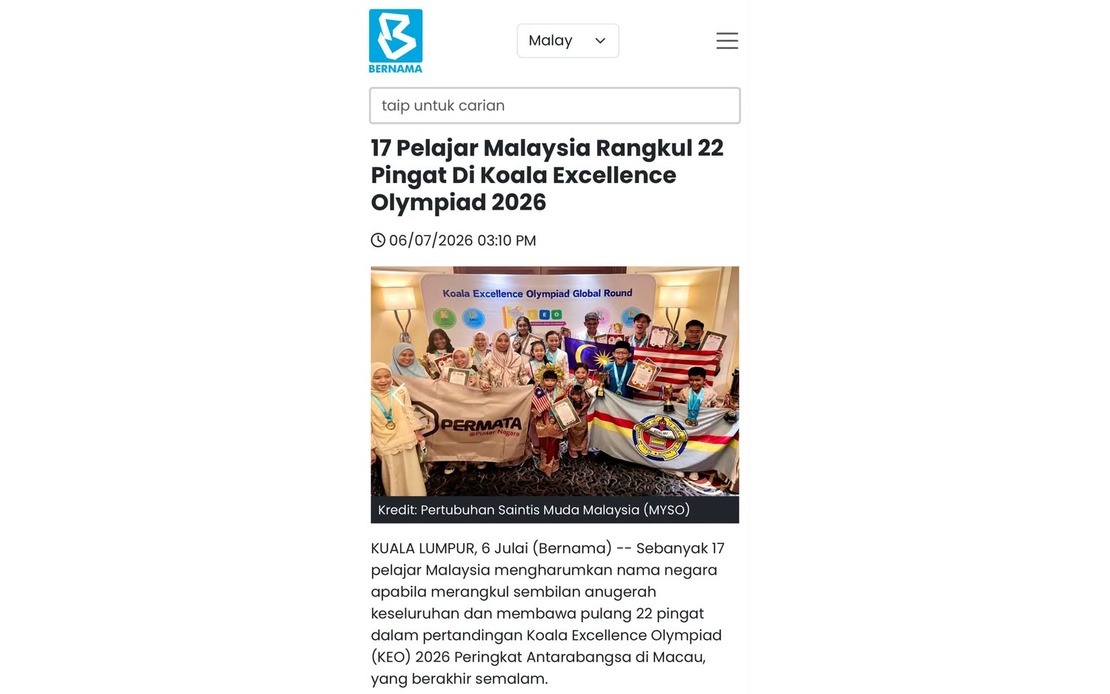
Prime Minister Datuk Seri Anwar Ibrahim has praised 17 Malaysian students for their impressive showing at the 2026 Koala Excellence Olympiad (KEO) Global Finals in Macau, where the contingent accumulated nine overall awards and 22 medals across multiple disciplines. The achievement represents a significant recognition of Malaysian talent on an international academic stage, highlighting the calibre of young scholars emerging from the country's education system.
The medal tally comprised five gold, six silver and eleven bronze medals, according to Aidah Misran, coordinator of the Malaysia Young Scientists Organisation (MYSO) and head of the Malaysian delegation to the competition. This distribution across all medal categories underscores a broad-based strength rather than concentration in a single area, suggesting systematic excellence across the participating students' strengths.
Anwar expressed his confidence in the nation's youth through a post on social media, urging the student medallists to maintain their trajectory of achievement. His remarks emphasised continuity and ambition, framing these current accomplishments as stepping stones toward even more substantial future successes. The Prime Minister's public acknowledgment reflects the government's investment in nurturing academic excellence and competitive participation at the global level.
The KEO competition functions as an international academic platform designed by a team of Australian educational specialists and alumni. The event encompasses four core subject areas: English, Mathematics, Science and Arts Olympiads. This multi-disciplinary approach ensures that competing nations demonstrate intellectual prowess across a spectrum of knowledge domains rather than specialisation in isolated fields, creating a more holistic measure of educational achievement.
The competition drew participation from students representing various countries, creating a genuinely international arena for academic competition. Such cross-border engagement exposes young Malaysians to different educational methodologies, learning styles and perspectives from peers across the globe. Beyond the medals themselves, this exposure fosters cultural exchange and builds networks among emerging scholars who may become leaders and innovators in their respective societies.
The contest was jointly organised by KEO and Miss Man International Group, with MYSO serving as Malaysia's coordinating body. This collaborative structure demonstrates how private organisations, international bodies and local academic institutions can pool resources to facilitate meaningful learning opportunities for youth. MYSO's role as the coordination point has positioned Malaysia as an active participant in the international academic competitions circuit.
For the Malaysian education sector, the results provide quantifiable evidence of competitiveness at the tertiary level of academic competitions. In an era where regional nations increasingly compete for recognition in science, technology and mathematics education, Malaysia's medal haul at KEO provides benchmarking data relative to other participants. The balanced performance across English, Mathematics, Science and Arts suggests that Malaysian education has succeeded in developing well-rounded intellectuals rather than narrow specialists.
The achievement also carries implications for secondary and tertiary education planning in Malaysia. Success at international Olympiads typically reflects investment in gifted education programmes, quality of coaching and availability of resources for competitive academic pursuits. As the country seeks to enhance its standing in global education rankings and produce graduates capable of competing internationally, these results offer encouragement that existing frameworks are yielding results.
Furthermore, the recognition of these young achievers at the highest governmental level sends a powerful signal to the broader student population. When a Prime Minister publicly celebrates academic excellence, it elevates the status of intellectual pursuits within national culture. For Malaysian students considering participation in future international competitions, Anwar's remarks provide both validation and motivation to pursue similar pathways.
The KEO platform represents one of multiple international academic competition venues available to Malaysian students. Others include traditional Olympiads in mathematics, physics, chemistry and informatics, as well as newer competitions spanning diverse subjects. The participation and success in KEO specifically highlights Malaysia's diversification strategy in nurturing talents beyond conventional science competition domains.
Looking forward, the strong showing in Macau establishes a benchmark for future Malaysian contingents. It signals to educational institutions, schools and parents that investment in competitive academic development yields tangible international recognition. As Southeast Asian economies emphasise human capital development and knowledge-based growth, the success of Malaysian students in competitions like KEO provides evidence of progress toward these goals.

