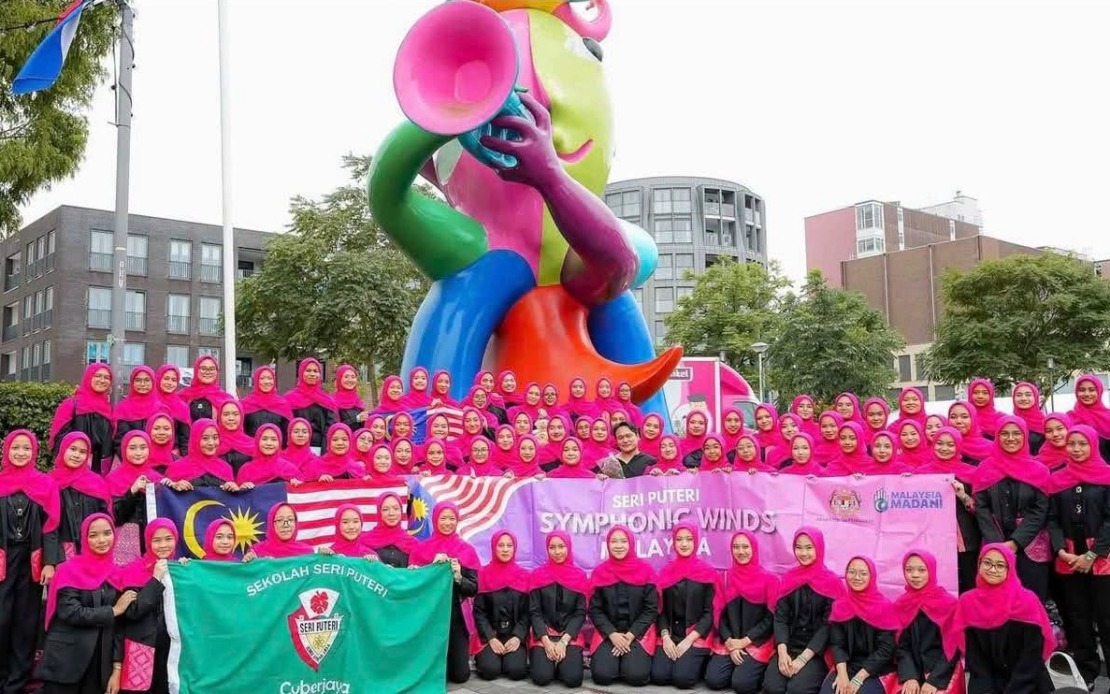
Prime Minister Datuk Seri Anwar Ibrahim has commended the Seri Puteri Symphonic Winds Orchestra (SPWinds) for its stellar performance at an international music competition, securing the Gold With Distinction accolade in the Wind Band Youth Division at the World Music Contest held in the Netherlands. The recognition underscores Malaysia's growing presence in the global classical music landscape and reflects the calibre of young musical talent being nurtured within the country's educational institutions.
Anwar took to Facebook to acknowledge the orchestra's remarkable achievement, framing it as a testament to the possibilities that emerge when Malaysian youth dedicate themselves to artistic pursuits with commitment and rigour. The Prime Minister's public commendation carries weight beyond mere ceremonial praise, as it signals government support for cultural and artistic development as a priority within Malaysia's broader national agenda. His message carried an underlying call for the broader Malaysian public to draw inspiration from such accomplishments and to recognise the value of excellence across disciplines beyond the conventional economic sectors.
The Prime Minister's endorsement reflects a deeper government investment in the arts ecosystem. In April of this year, Anwar had announced a RM100,000 financial contribution directed specifically at SPWinds, positioning the gesture as tangible backing for the orchestra's developmental programmes and activities. This funding was unveiled during his attendance at the "Winds of Glory: AM:PM Amir Masdi & SPWinds in Concert" performance staged at the Putrajaya International Convention Centre (PICC) on April 25, providing a high-profile platform that amplified the government's commitment to supporting youth cultural initiatives.
The orchestra's trajectory of international success extends beyond this latest achievement. Previously, SPWinds had demonstrated its competitive prowess by capturing the Gold Award at the 11th World Orchestra Festival in Vienna, Austria, during the period from July 23 to 26 of the previous year. This pattern of consistent international recognition suggests that the orchestra benefits from sustained institutional support, quality coaching, and access to training opportunities that position it favourably against peer groups from other nations. For Malaysian observers, such consistent success challenges perceptions about the nation's capacity to produce world-class performers in classical music disciplines.
The significance of SPWinds' achievements for Malaysia extends into the realm of soft power and cultural diplomacy. International music competitions serve as platforms where nations subtly project their educational standards, cultural values, and national pride. Each Gold With Distinction award represents not merely individual student achievement but reflects positively on Malaysia's educational institutions, music pedagogy standards, and the broader environment supporting artistic development. In an era where nations increasingly recognise culture as a strategic asset, such successes contribute to Malaysia's international standing in ways that complement economic and political engagement.
The orchestra itself, affiliated with Sekolah Seri Puteri, draws from a student body with access to specialised music training facilities and instruction that remain concentrated in select institutions. The school's capacity to field competitive ensembles capable of winning international distinctions reflects investment in music education infrastructure and the recruitment of qualified instructors. However, such concentration of excellence also raises questions about equity and access to musical training across Malaysia's diverse socioeconomic landscape, a consideration that policymakers may need to address to broaden the base from which future musical talent emerges.
Anwar's encouragement for SPWinds to achieve even greater success positions the orchestra as a potential standard-bearer for Malaysian cultural representation on the global stage. The implicit message to the student performers is that their achievements matter beyond personal accomplishment; they carry national significance and embody the aspirations of a developing nation invested in nurturing talent across multiple dimensions of human endeavour. This framing aligns with broader government rhetoric emphasising the importance of cultural pride and national identity during a period when Malaysia continues to define its role in the region and globally.
The Wind Band Youth Division category at the World Music Contest represents a significant competitive tier, attracting entries from established music programmes across multiple continents. Malaysia's success in this category indicates that SPWinds competes effectively against orchestras from nations with longer historical traditions in classical music training and substantially greater per-capita resources devoted to music education. This achievement therefore carries particular resonance for a Southeast Asian context where classical orchestral music remains relatively niche compared to popular music sectors.
Moving forward, the momentum generated by such international recognition could potentially catalyse broader interest in instrumental music training among Malaysian youth, particularly if the achievements receive sustained media attention and government promotion. The government's financial backing, coupled with prime ministerial endorsement, creates an environment conducive to attracting additional institutional investment in music education programmes. For other Malaysian schools and organisations, SPWinds' success offers a template demonstrating that world-class musical achievement remains accessible through institutional commitment and programmatic rigour, even within a regional and global context where resources and training facilities may be constrained relative to established Western music conservatories.

