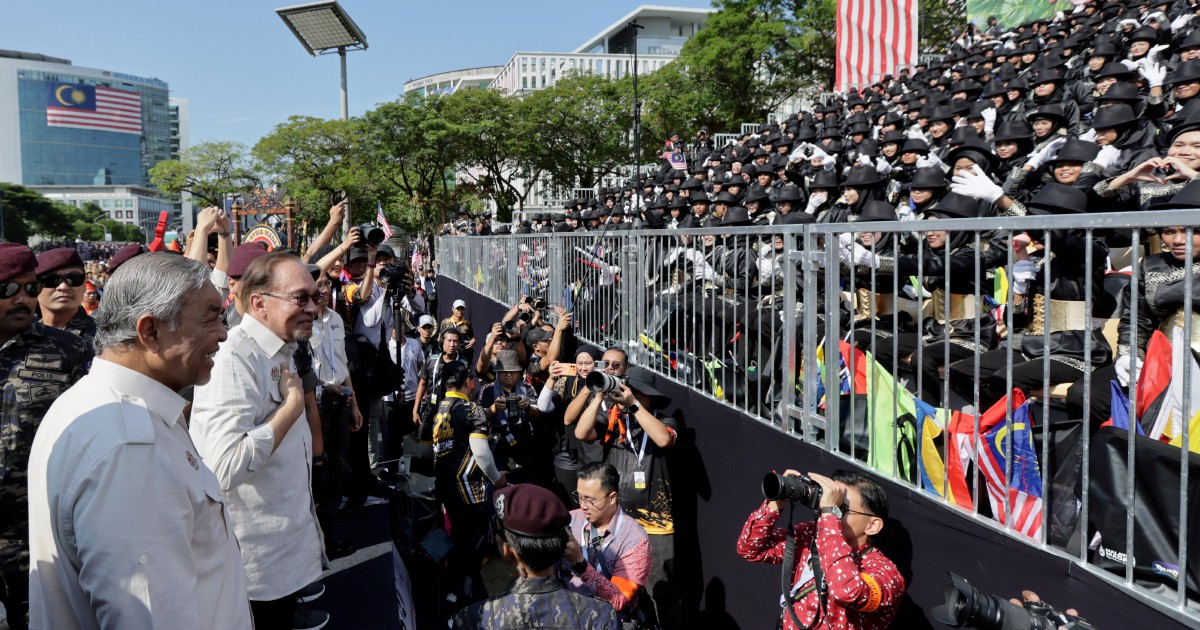
Prime Minister Datuk Seri Anwar Ibrahim extended Malaysia's National Day festivities beyond the formal ceremonial proceedings, embarking on an impromptu public engagement walkabout through Putrajaya after the main parade concluded at Dataran Putrajaya. The informal interaction saw the Prime Minister pause multiple times along the route to exchange greetings with assembled crowds, demonstrating the kind of direct civic engagement that has increasingly characterised his public appearances since assuming office.
The walkabout reflected a deliberate effort to bridge the gap between ceremonial state functions and grassroots public connection. Rather than limiting his involvement to the formal parade observations, Anwar Ibrahim chose to extend his presence among Malaysians, creating informal moments that transcended the scripted nature of official National Day proceedings. Such engagements have become a recognisable pattern in his recent public calendar, suggesting a strategic approach to maintaining visible accessibility to ordinary citizens.
Perhaps most notably, the Prime Minister's interactions with children formed a central element of these public exchanges. By stopping specifically to embrace and engage with young Malaysians, Anwar Ibrahim created tangible moments that resonate beyond mere political optics. For Malaysian families attending the celebrations, such direct personal contact with the nation's leading political figure represented a rare opportunity, particularly for children for whom such encounters hold lasting impressions about national leadership and civic participation.
The informal nature of the walkabout distinguished it from the formal protocol typically surrounding high-level political events. Whereas state ceremonies often maintain considerable distance between leadership and public, this particular engagement invited spontaneous interaction, allowing citizens to approach and exchange words with the Prime Minister directly. This approach aligns with evolving expectations around political accessibility in contemporary Malaysia, where digital connectivity and casual public encounters have reshaped how citizens relate to their leaders.
National Day commemorations serve multiple functions within Malaysian society beyond symbolic patriotism. They provide occasions for citizens across the nation to gather, celebrate shared identity, and witness state leadership in ceremonial contexts. The inclusion of informal public walkabouts into these events adds a secondary layer of engagement that acknowledges the celebratory nature of the occasion while permitting more genuine, unscripted human interactions between leadership and the public sphere.
For political figures in Malaysia, National Day events represent critical opportunities to demonstrate national unity and connect with diverse constituencies. The timing of such public engagements—immediately following formal ceremonies—allows leaders to transition from their official roles into more accessible personas. This strategic positioning helps humanise political leadership while maintaining the dignity of state functions, creating a measured balance that contemporary Malaysian politics increasingly emphasises.
The presence of children as focal points in these interactions carries particular significance in the Malaysian context. Schools and youth organisations form essential components of National Day celebrations, making young Malaysians both visible participants and symbolic representations of national continuity. When political leaders prioritise direct engagement with children at such events, they signal investment in younger generations and recognition of youth as integral stakeholders in national discourse.
Putrajaya's role as the administrative capital provides a controlled yet accessible venue for such public engagements. The carefully planned layout of Dataran Putrajaya facilitates large public gatherings while maintaining manageable security parameters. This geographic and logistical context enables government leaders to conduct relatively fluid interactions with assembled crowds without compromising necessary safety protocols—a consideration increasingly important in Malaysia's contemporary security environment.
These walkabout moments, captured in videos and shared across social media platforms, extend their reach far beyond those physically present at Dataran Putrajaya. In Malaysia's connected society, such imagery circulates rapidly across digital networks, creating secondary audiences that exceed the immediate participants. This multiplier effect amplifies the intended messaging around political accessibility and national unity far beyond the original event venue.
The informal engagement style observed during this National Day celebration reflects broader shifts in how Malaysian political leadership navigates public-facing interactions. Rather than exclusively relying on formal speeches, ceremonial protocols, and controlled media appearances, contemporary political figures increasingly incorporate spontaneous public engagements into their public schedules. These moments serve dual purposes: they satisfy emerging citizen expectations for tangible accessibility to leadership while generating authentic content for media circulation.
Looking forward, such public walkabouts may increasingly feature as expected components of major national celebrations rather than exceptional displays of accessibility. Malaysian citizens have demonstrated growing appreciation for leadership that moves beyond podium-bound formality, making informal engagements practical political strategy rather than mere public relations exercises. The challenge for political leadership involves maintaining genuine human connection while managing the inherent complications that accompany public accessibility in contemporary Malaysia.

