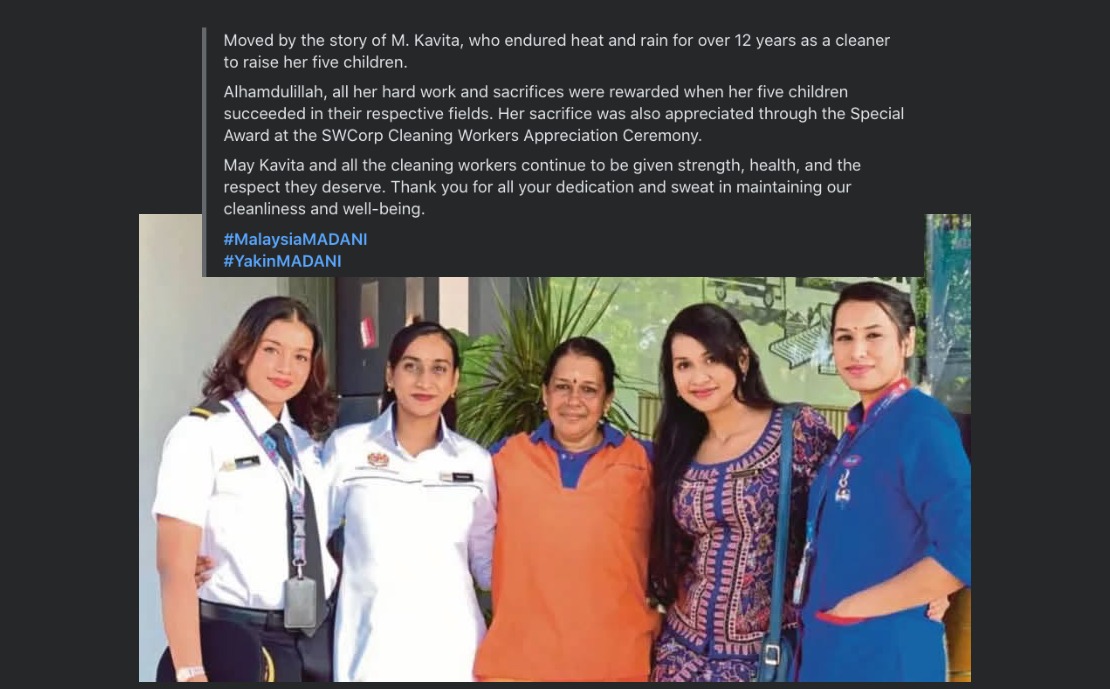
Prime Minister Datuk Seri Anwar Ibrahim has publicly acknowledged the remarkable perseverance of street sweeper M. Kavita, whose steadfast commitment to her family whilst maintaining a demanding career in sanitation services has become an inspiring example of sacrifice and resilience. In a Facebook address, Anwar reflected on how Kavita's more than 12 years of labour—often performed in adverse weather and arduous circumstances—ultimately enabled all five of her children to flourish professionally across diverse sectors of the Malaysian economy.
Kavita's journey represents a compelling narrative within Malaysia's socioeconomic landscape, where individuals in lower-income service sectors frequently juggle multiple responsibilities to secure their families' futures. The Prime Minister's recognition underscores an important national conversation about the value and dignity of essential workers who operate largely beyond the public spotlight yet sustain critical infrastructure and community wellbeing. By elevating Kavita's story, Anwar has drawn attention to the often-overlooked contributions of Malaysia's cleaning and sanitation workforce, whose labour undergirds public health and environmental standards across urban centres.
Kavita's achievements as a parent extend beyond conventional measures of success. Her five children have established themselves across professional domains, with some attaining roles typically associated with higher education and technical training. This collective upward mobility reflects not only Kavita's personal determination but also the broader potential for social advancement when families prioritise education despite financial constraints. For many Malaysian households operating on modest incomes, Kavita's trajectory offers tangible proof that circumstance need not dictate destiny.
The turning point in Kavita's public recognition came when her four daughters executed a touching surprise at her workplace to commemorate her 50th birthday last month. The gesture carried particular emotional resonance because the daughters presented themselves in their professional uniforms, each representing a distinct career pathway. The group included a pilot, cabin crew member, and registered nurse, among other accomplished professionals. Witnessing her daughters' collective achievement in full professional regalia moved Kavita to tears, a moment that resonated across Malaysian social media platforms and touched a cultural nerve about maternal sacrifice and familial pride.
Beyond the Prime Minister's public commendation, Kavita's contributions were formally recognised through institutional channels. She received a Special Award at a recent Cleaning Workers' Day Appreciation ceremony organised by SWCorp, the statutory body overseeing solid waste management in Malaysia. This dual recognition—both from the nation's highest political office and from the regulatory authorities governing her sector—signals a shift toward greater acknowledgment of sanitation workers' professional status and societal value. Such formal recognition carries implications for labour dignity and workplace respect within Malaysia's service sectors.
Anwar's tribute extended beyond individual praise to encompass the broader community of street sweepers and environmental workers throughout Malaysia. He expressed hope that Kavita and her colleagues would continue to receive the blessings of physical strength, good health, and social respect commensurate with their essential contributions. This framing positions sanitation work not as peripheral or degrading labour but as a fundamental component of national development and public welfare. The language of respect and dignity employed by the Prime Minister reflects evolving attitudes toward occupational hierarchy in Malaysia.
The circumstances of Kavita's employment with SWM Environment in Seremban, a state capital in Negeri Sembilan, ground her story within Malaysia's regional development narrative. Seremban, as a medium-sized urban centre, depends substantially on municipal workers like Kavita to maintain public spaces and environmental standards. Her decades of service have contributed directly to the livability and cleanliness of her community, yet such workers rarely receive public acknowledgment proportionate to their actual impact on daily urban life.
For Malaysian readers and policymakers, Kavita's story illuminates several interconnected themes. It demonstrates that individuals in low-wage service sectors possess agency and capability to dramatically reshape their families' life trajectories through sustained effort and prioritisation of education. It underscores the persistent gap between the social necessity of sanitation work and its corresponding status and remuneration within the labour market. It also highlights how social media has created unexpected pathways for ordinary citizens' stories to reach national prominence and inspire broader conversations.
The viral nature of Kavita's birthday surprise reflects contemporary Malaysian society's hunger for authentic human narratives that cut across class boundaries. Unlike manufactured or political narratives, Kavita's story emerged organically from a genuine family moment, resonating with millions of Malaysians who navigate similar economic constraints and aspire toward educational advancement for their children. This authenticity lent credibility to her achievement and made her an effective vehicle for national reflection on values, family, and opportunity.
Moving forward, Anwar's public endorsement of Kavita's example carries potential implications for how Malaysia addresses broader questions of occupational dignity and worker welfare. By positioning a sanitation worker alongside her accomplished children, the Prime Minister has implicitly challenged conventional hierarchies and invited Malaysians to reconsider their assumptions about who merits respect and recognition. Whether this moment catalyses sustained policy changes toward improved conditions for essential workers in Malaysia's service sectors remains to be determined, but the symbolic significance of a nation's leader publicly honouring a street sweeper's lifetime dedication cannot be understated.

