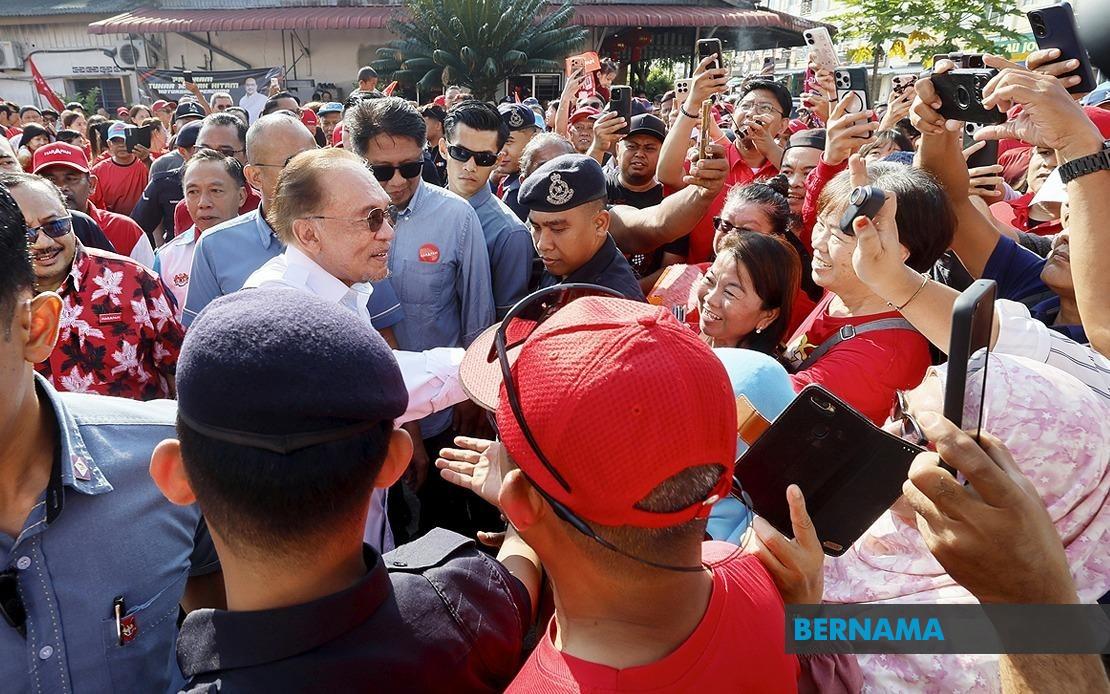
Prime Minister Datuk Seri Anwar Ibrahim took time out of his campaign schedule to reunite with an elderly couple whose determined effort to meet him captured public attention and circulated widely across social media. Abdul Razak Pelangga, 86, and his wife Jamilah Samsudin, 64, had become subjects of public interest following their journey to seek out the Prime Minister during his visit to Senggarang in Batu Pahat the previous Sunday. The reunion took place at the "Yok! Meriahkan Johor! Undi Harapan" programme in the same district, reflecting the government's emphasis on direct engagement with ordinary Malaysians during the final push of the election campaign.
The couple's original encounter had involved Abdul Razak pedalling a trishaw for nearly one kilometre through the streets of Senggarang, driven by his wife's wish to meet the Prime Minister as he made a breakfast stop at a local eatery. What might have seemed an unremarkable gesture in any other context became emblematic of voter engagement when documented and shared across digital platforms. The image of an octogenarian making such physical effort to greet a sitting Prime Minister resonated with audiences, particularly given the often-transactional nature of modern political interactions.
During their reunion at the campaign event, Anwar adopted a warm and personable approach, sharing light-hearted banter with Abdul Razak about the 86-year-old's obvious physical fitness and endurance in operating the trishaw. Rather than limiting the interaction to formal pleasantries, the Prime Minister acknowledged and expressed genuine gratitude for the couple's demonstrated support, a gesture that underscored the government's messaging around grassroots connection. Such moments of authentic human exchange have become increasingly valued in an era when political communication often occurs through media intermediaries and digital channels.
The event brought together several layers of the ruling coalition's political machinery. Datuk Fahmi Fadzil, who serves as both Pakatan Harapan Communications director and Minister of Communications, attended the gathering. His presence highlighted the coalition's intention to amplify such heartwarming human interest angles through official communication channels. The programme also featured three Pakatan Harapan candidates contesting in the Johor state election: Onn Abu Bakar representing Senggarang, Mohd Khuzzan Abu Bakar for Semerah, and Felicia Poh Rui Ling for Penggaram.
The timing of this campaign event proved significant, arriving just three days before the scheduled Johor state election. In Malaysian electoral politics, the final week before polling day typically intensifies with concentrated grassroots activity, candidate visibility, and attempts to consolidate support. The ruling coalition's focus on Johor represents a strategic priority, given the state's political weight and historical importance in determining overall national political dynamics. Early voting had already occurred on the preceding Tuesday, establishing a narrowed window for persuasion and mobilisation activities.
The couple's story carries particular resonance for Malaysian voters who value demonstrations of civic participation and genuine interest in governance. Rather than waiting passively for politicians to appear on television or in formal addresses, Abdul Razak and Jamilah made deliberate physical effort to express their political engagement. This narrative stands in contrast to cynical portrayals of voter apathy or disillusionment, instead presenting an image of determined democratic participation across age groups. For Anwar's administration, such grassroots enthusiasm provides welcome validation of broader governance narratives around inclusivity and connection to ordinary citizens.
The incident also reflects broader patterns in Malaysian political communication, where personal stories and emotional connections increasingly shape electoral messaging. Rather than relying solely on policy announcements or technical governance discussions, political campaigns frequently leverage human interest narratives to build affective bonds between leaders and constituents. The trishaw journey, simple as it was, conveyed messages about determination, spousal devotion, and genuine enthusiasm for political engagement without requiring explicit articulation.
For the elderly couple themselves, the opportunity to meet the Prime Minister likely fulfilled aspirations that extended beyond immediate electoral calculations. In Malaysian culture, personal audience with prominent national figures carries symbolic weight and social significance. The reunion event provided formal recognition and public acknowledgment of their efforts, transforming a personal initiative into an officially sanctioned moment within the broader political calendar. Jamilah's original wish, facilitated through her husband's physical exertion, had been not merely met but amplified through media attention and prime ministerial recognition.
The Johor state election results would ultimately determine whether such grassroots engagement and emotional connection translated into sustained electoral support for the Pakatan Harapan coalition. While individual anecdotes and touching human interest moments can contribute to positive political atmospherics, structural factors including economic conditions, local governance records, and community-specific issues typically exercise greater influence on voting outcomes. Nevertheless, the couple's story and its strategic deployment represented the coalition's attempt to frame itself as responsive, accessible, and genuinely connected to constituents beyond formal institutional channels.

