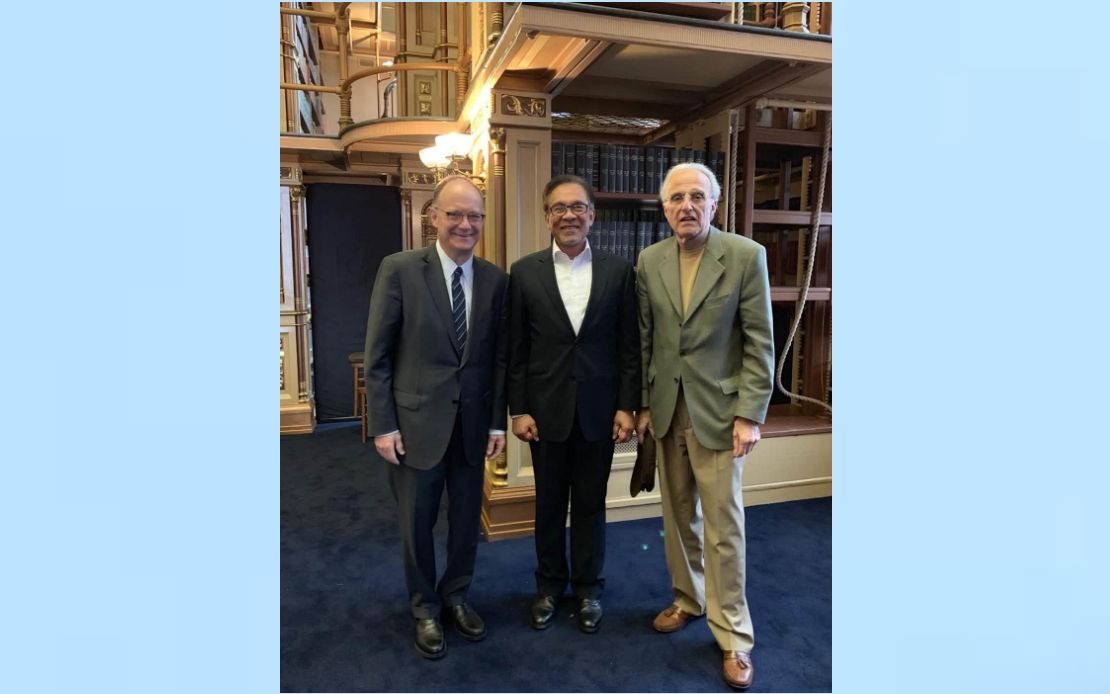
Prime Minister Datuk Seri Anwar Ibrahim has expressed profound grief at the death of Professor John L. Esposito, one of the world's most distinguished authorities on Islamic studies and Muslim-Western relations. The Prime Minister shared his condolences through a Facebook post, reflecting on a personal connection that spanned more than fifty years since their initial meeting in the early 1970s.
Esposito's legacy extends far beyond academic achievement. Throughout his career, he systematically dismantled misconceptions about Islam in the Western world, positioning himself as a crucial intellectual bridge during an era marked by growing religious tensions and mutual suspicion between civilisations. His scholarly work transformed how millions of Western readers understood Islamic history, theology, and contemporary Muslim societies, making complex theological and political concepts accessible without compromising intellectual rigour.
Among Esposito's most significant institutional contributions was his founding of Georgetown University's Centre for Muslim-Christian Understanding, which became a flagship programme for promoting substantive dialogue between faith communities. This initiative proved particularly timely as it operated during a period when tensions between Muslims and Christians reached critical levels globally. Through this platform, Esposito facilitated countless conversations that prioritised understanding over confrontation, creating spaces where scholars, religious leaders, and policymakers could engage substantively with one another.
Anwar particularly highlighted Esposito's collaborative work on "Makers of Contemporary Islam," a comprehensive examination of influential figures shaping the modern Muslim world. This publication demonstrated Esposito's commitment to documenting and interpreting Islamic thought beyond stereotypes, providing readers with nuanced portraits of diverse Muslim intellectual traditions. The book exemplified his broader scholarly mission: presenting Islam as a complex, multifaceted civilisation rather than a monolithic entity.
The Prime Minister found particular resonance in Esposito's accessibility without compromise. Works such as "What Everyone Needs to Know About Islam" and "Who Speaks for Islam?" proved instrumental in educating global audiences, especially during the post-9/11 period when urgent need existed for informed perspectives on Islam and its relationship with modernity. These publications demonstrated that scholarly authority need not remain confined to academic journals; instead, it could reach the general public while maintaining intellectual credibility and depth. Esposito recognised that public understanding of Islam directly influenced international relations and social cohesion, motivating his prolific output of accessible scholarship.
Anwar's characterisation of Esposito as someone who "built bridges where others were content to build civilisational barriers" captures the essence of his scholarly philosophy. Rather than reinforcing the prevalent narrative of inevitable clash between Islam and the West, Esposito insisted that genuine understanding was both possible and necessary. His life's work represented an intellectual rejection of fatalism regarding interfaith relations, proposing instead that dialogue grounded in rigorous scholarship could transform global consciousness.
The personal dimension of Anwar's tribute reveals the depth of their relationship beyond professional respect. Anwar described valuing Esposito's wisdom and guidance over decades, characterising him as "formidable" in scholarly output while remaining warm and generous in private exchange. This portrait suggests that Esposito balanced intellectual stringency with human warmth, demonstrating that academic excellence and personal kindness were complementary rather than contradictory qualities. The Prime Minister emphasised that Esposito remained "loyal" through significant periods, suggesting the friendship weathered major geopolitical shifts and personal transformations.
For Malaysia and the broader Muslim world, Esposito's passing represents the loss of a rare figure—a non-Muslim Western scholar who consistently advocated for Muslim voices, Muslim perspectives, and the legitimacy of Islamic civilisation. Unlike orientalists who sought to exoticise or subordinate Islamic knowledge systems, Esposito engaged with Islam on its own intellectual terms while remaining intelligible to Western audiences. This positioning made him invaluable to Muslim leaders and intellectuals seeking to communicate their traditions and concerns to global audiences.
Anwar's extension of official condolences to Esposito's widow, Jean, and his family carries symbolic weight within Malaysia's diplomatic context. It signals that the Malaysian government recognises the importance of interfaith scholarship and international intellectual collaboration in building peaceful, pluralistic societies. In an era of rising religious polarisation globally and locally, Esposito's emphasis on dialogue remains relevant to Malaysia's own challenges in maintaining religious harmony amid diversity.
The late scholar's influence on subsequent generations of Islamic scholars, Christian theologians, and religious studies academics will continue reverberating through institutions worldwide. His methodological approach—combining historical rigour with contemporary relevance, scholarly depth with public accessibility—established a model for engaged scholarship that bridges academic and popular understanding. Students and colleagues trained in Esposito's intellectual tradition carry forward his commitment to informed dialogue.
As Anwar noted in his closing remarks, Esposito remained "a true friend to the Muslim world" until his final days. This designation captures how a Western scholar of Christianity and Islam could be authentically embraced by Muslim leaders not through compromising intellectual integrity but through demonstrating genuine commitment to understanding Islam's complexity and championing Muslim voices in global discourse. His death marks the end of an era in which such bridge-building seemed almost commonplace among serious scholars, a loss that Southeast Asian nations engaged in their own interfaith work will acutely feel.

